网址:http://m.1010jiajiao.com/timu_id_2308894[举报]
-How can I keep healthy, doctor?
-You'd better ________ some time doing exercise every day.
to spend
take
spend
 I love it at night. It’s peaceful. And when it cools down I sometimes do some ironing. I don’t really care for it. I work full-time and I am too busy for most housework. I remember the old woman who taught me to iron. I was about 15 and I had to get a job taking care of a woman to make a living. She had been an able-bodied, healthy woman until the accident that caused her to be paralyzed.
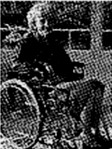
The woman sat in an electric wheelchair all day. She could only move her head and arms. She would tell me how to do things. She would teach me in great detail on the correct ways to do things. Her home was perfect and beautiful. She would follow me around in her electric wheelchair to make sure I did everything exactly right. I’m sure she had been a perfect homemaker. She would have me fold(折叠) everything, including socks. I would complain silently and wish terrible things on her. She taught me the right way to make the bed. I know sometimes she’d get frustrated(沮丧) and impatient with me. I knew she wanted to do it herself. But she never shouted or scolded. She only insisted I do it right. I didn’t like it much, but I did it.
Today I can iron pretty well. I know where to start on a shirt and the right way to do the trousers. Now when I think about it, I don’t think she is an old lady. I think she might have been about my age now. Anyway, when I iron, I think of her and silently thank her for all the things I learned.
【小题1】The writer used to take care of the lady because ________.
| A.she wanted to learn to do housework |
| B.she was a friend of the lady’s |
| C.she had to earn some money |
| D.she couldn’t find a room to live in |
| A.destroyed | B.deaf | C.seriously ill | D.unable to walk |
| A.encouraged to learn | B.unwilling to learn |
| C.delighted to learn | D.recommended to learn |
| A.is still afraid of the lady | B.hates the strict lady |
| C.admires the disabled lady | D.is very grateful to the lady |
If you are feeling anxious, my advice is to first find the cause or causes. Make s list of those things that are making you nervous and work out which ones you can do something about. Focus all of your efforts on managing the causes that you can control.
Most people cannot tell the difference between controllable(可控制的) and uncontrollable causes, so things they can’s control become a big reason for nervousness. Dealing with this is very important if people want to keep a healthy mind.
Simply try to accept the uncontrollable causes of nervousness. You might be worried about the weather on a big day, an accident or an attack on the train, or perhaps just things that other people are doing at work. The results may be very important but there is still no use worrying because you can’t control any of these things. Accept that you can’t control everything. Once you understand this, it becomes easier not to worry.
If a situation, such as swimming, is causing you to be anxious, try to face it as often as possible so that you can get used to it.
It can often help to think about yourself doing the thing that makes you nervous—then close your eyes and imagine it going well. Imagine how the flight or job interview is going to happen so that you can get used to it. This will help you understand that the thing you fear most is probably not going to happen.
【小题1】Who wrote this passage?
| A.A reporter. | B.A sportsman. | C.A patient. | D.A professor. |
| A.most are not very important |
| B.they are not the real causes of the problem |
| C.they cannot be controlled by people |
| D.it’s better to deal with one cause at a time |
| A.Go swimming often to get used to it. |
| B.Avoid going to the swimming pool. |
| C.Find a swimming teacher. |
| D.Imagine watching others swim. |
| A.It usually has only one cause. |
| B.It is usually caused by people. |
| C.People can easily manage it. |
| D.Most people suffer from it. |
| A.To introduce the writer’s sports experience. |
| B.To advise on how to deal with nervousness. |
| C.To help people remember their fears. |
| D.To explain the dangers of nervousness. |
----How amazing, Sara! You are used to going to bed early and getting up early these days.
----_______ And I hope you can lead such a healthy life, too.
| A.So do I | B.So I do | C.So I am | D.Thanks a lot |
 I love it at night. It’s peaceful. And when it cools down I sometimes do some ironing. I don’t really care for it. I work full-time and I am too busy for most housework. I remember the old woman who taught me to iron. I was about 15 and I had to get a job taking care of a woman to make a living. She had been an able-bodied, healthy woman until the accident that caused her to be paralyzed.
The woman sat in an electric wheelchair all day. She could only move her head and arms. She would tell me how to do things. She would teach me in great detail on the correct ways to do things. Her home was perfect and beautiful. She would follow me around in her electric wheelchair to make sure I did everything exactly right. I’m sure she had been a perfect homemaker. She would have me fold(折叠) everything, including socks. I would complain silently and wish terrible things on her. She taught me the right way to make the bed. I know sometimes she’d get frustrated(沮丧) and impatient with me. I knew she wanted to do it herself. But she never shouted or scolded. She
 only insisted I do it right. I didn’t like it much, but I did it.
Today I can iron pretty well. I know where to start on a shirt and the right way to do the trousers. Now when I think about it, I don’t think she is an old lady. I think she might have been about my age now. Anyway, when I iron, I think of her and silently thank her for all the things I learned.
【小题1】The writer used to take care of the lady because ________.
| A.she wanted to learn to do housework |
| B.she was a friend of the lady’s |
| C.she had to earn some money |
| D.she couldn’t find a room to live in |
| A.destroyed | B.deaf | C.seriously ill | D.unable to walk |
| A.encouraged to learn | B.unwilling to learn |
| C.delighted to learn | D.recommended to learn |
| A.is still afraid of the lady | B.hates the strict lady |
| C.admires the disabled lady | D.is very grateful to the lady |