网址:http://m.1010jiajiao.com/timu_id_2278938[举报]
2. Is she _____ (babysit) her younger brother?
3. There are many _____ (different) between the two books.
4. You must eat more vegetables and keep _____ (health).
5. Mr Morgan finished _____ (make ) his last movie.
6. It takes me 30 minutes _____ (surf ) the Internet.
7. Why not _____ (join ) us ?
8. Now you need _____ ( put ) some sauce into the soup.
9. Susan's mother _____ ( buy) a new dictionary yesterday.
10. The little baby is too young _____ (walk).
| when, make, easy, start, for, more, think, hard, newspaper, from, return, talk |
You can 3 becoming outgoing with your best friend or a group of friends. But the real challenge (挑战) comes 4 you meet strange people or new friends. Smile more, and usually they will 5 you a smile. In this way, you may have some talks.
Start a 6 . Just a simple "Hello" or " How is it going" is a good Start. If you want to make interesting talks, you should read news in 7 and prepare your views, or surf the Internet
8 new information and then keep that in mind.
The 9 way to become more outgoing is to go out. This is also the most important step (步骤). Go to a park, beach, club, party or any other place that you 10 can be fun, and you may make new friends there. 查看习题详情和答案>>
Can you imagine a world without the Internet? It’s surprising to think about it.
Now, China has more than 162 million Internet users, according to the China Internet Network Information Centre. This is the second highest number of user in the world after the United States. Today, 66%of Chinese “netizens (网民)” are teenagers. “They spend about thirteen hours every week online,” said Qian Hulin, an Internet expert(专家). Doctor Song in Beijing Xuanwu Hospital said about 14% of Chinese netizens who are teens often lasted over ten hours to play online games.
The main reasons why teenagers surf the Web are to search for information, to communicate with others and to have fun. On the Internet, teenagers can find out almost anything. And surfing the Web can help students with their homework and widen their knowledge.
Li Dong, a teacher at No. 41 Middle School in Shijiazhuang, likes her students to use the Internet. “When we talk in class, students who surf the Net usually know more background information than the others,” she said.
In addition, people can use the Internet to write letters or stories and send e-mails. Many teens keep in touch with their friends online. It is cheaper than phoning somebody far away and also much quicker.
【小题1】_______ has the most Internet users in the world according to the article.
| A.China | B.America | C.Canada | D.Russia |
| A.107 million old | B.22.7 million old |
| C.107 million young | D.22.7 million young |
| A.playing online games |
| B.searching for information |
| C.chatting with their friends |
| D.sending e-mails to others |
______.
| A.thinks surfing the net can help students spend less time on homework |
| B.thinks her students can get more background information than the others |
| C.wants her students to talk to her about their hobbies and interests |
| D.wants to know what her students do and think about at home |
| A.Giving them a call. |
| B.Going to see them. |
| C.Writing a letter to them. |
| D.Sending e-mails to them. |
Last year, some groups of students in their community (社区) made a survey about "How do people spend their free time?" The following diagrams show some results of it:
Diagram (1): Hours for people of different ages who surf the Internet in a week.
Diagram (2): Different days people go to the library. (library attendance)
Diagram (3): Different programs people like.
根据上面三个图表内容,选择正确答案。
【小题1】People aged spend the most time surfing the Internet every week.
| A.7—16 | B.17—30 | C.31—55 | D.over 56 |
| A.the hours people spend | B.the number of people |
| C.the number of books | D.the days people spend |
| A.over sixty | B.less than sixty |
| C.about twenty | D.more than one hundred |
| A.The fewest people like watching music. |
| B.Sports are the most people's favorite programs. |
| C.People seldom go to the library on weekdays. |
| D.Half of the people like watching news or cartoons. |
| A.what people do every day |
| B.how people spend their free time |
| C.people's different lifestyles |
| D.people's different habits |
Last year, some groups of students in their community (社区) made a survey about "How do people spend their free time?" The following diagrams show some results of it:
Diagram (1): Hours for people of different ages who surf the Internet in a week.

Diagram (2): Different days people go to the library. (library attendance)
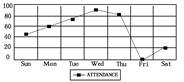
Diagram (3): Different programs people like.
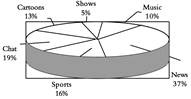
根据上面三个图表内容,选择正确答案。
1.People aged spend the most time surfing the Internet every week.
A.7—16 B.17—30 C.31—55 D.over 56
2.The word "attendance" in Diagram (2) means " in the library".
A.the hours people spend B.the number of people
C.the number of books D.the days people spend
3.On weekends, people go to the library every week.
A.over sixty B.less than sixty
C.about twenty D.more than one hundred
4.Which of the following is true according to the diagrams?
A.The fewest people like watching music.
B.Sports are the most people's favorite programs.
C.People seldom go to the library on weekdays.
D.Half of the people like watching news or cartoons.
5.The three diagrams show us the results of a survey about .
A.what people do every day
B.how people spend their free time
C.people's different lifestyles
D.people's different habits
查看习题详情和答案>>