网址:http://m.1010jiajiao.com/timu_id_2263881[举报]
根据句意及首字母提示完成短文
An old woman o 1.her window and looks out of it. The sun shines b 2.There’s a man in the g 3. in front of her house. The old woman looks at him and says, “He is eating g 4.!”??
She goes o 5.and asks the man, “Why are you eating grass? Are you h 6.?”?The man says, “Yes, I am very poor. I have n 7.for my breakfast today and I am hungry now.”?The old woman tells him to go to the b 8.door of her house, and she goes in again. The man s 9.and goes to the back door of the house. Then the old woman opens the door and says to the man,“The grass here is l 10.”?
查看习题详情和答案>>
Come and see the smart lions from Africa and the fun dolphins from New Zealand. The interesting
koala bears from Australia would be glad to meet you, and the intelligent pandas from China are waiting
to greet you.The lovely elephants from India are waiting to kiss you with his nose, and the cute penguins
are going to dance for you.
Tickets (票价):
Grown-ups (成年):£2.00
Children over 10:£1.00
Children under 10: Free (免费)
Opening time: 9:30 a.m.-5:30 p.m. except Wed & Fri
Keep the zoo clean!
Do not touch, give food or go near the animals.
B. five
C. six
D. seven
the tickets together?____.
B. £3.00
C. £4.00
D. £5.00
B. short
C. small
D. heavy
B. No, we can't
C. Yes, we can't
D. No, we can
The koalas are waiting(等) to meet you, and the monkeys from Thailand (泰国)
are waiting to throw (丢) things at you. The cute dogs from Australia are waiting
to laugh(笑) at you, and the giraffes from Zambia (赞比亚) are waiting to look
down on you.
Tickets:(票)Time:
Adults: (成人) ¥60June 1---June 2
Children: Free9:00 a. m. ------7:00 p. m.
Keep the park clean!
Do not touch (触摸), give food or go near the animals!
The Safari Park
B. 5
C. 6
D. 7
the tickets be together?
B. ¥120
C. ¥180
D. ¥240
B. watching the elephants dancing
C. laughing at the dogs from Australia
D. taking some pictures
B. fat
C. tall
D. strong
B. on Christmas Day
C. After Children's Day
D. before Children's Day
What do you do if you're stranded(处于困境的)on a lonely island? Surely you need to find a way to get in touch with the outside world. Your best chance of doing this is to draw the attention of a passing plane.
Body signals(信号)
Pilots from different countries understand body signals if they have the correct training. When you wave your arms up and down in a straight line, it means "yes". When you point downwards and swing your arm from side to side, it means "no". If you want the pilot to know that it's safe to land, push your hands out in front of you and bend(弯曲)your knees. If you want to say that it's not safe to land, put your arms in the air and move them to one side.
Smoke signals
The smoke from a fire can be seen from far away, so it's a good way to draw attention. If the weather is dry, it isn't hard to start a fire. Remember, however, that fires can be very dangerous if they get out of control. Never light a fire unless you're sure that it can't spread. If the ground is dark, light smoke can be seen more easily. Green grass and leaves produce light smoke.
Ground-to-air signals
It's a good idea to build some signals, too. Use large pieces of wood to make the symbols(标记). If you can't find any wood, use earth. Some useful symbols are:
F "I need food and water."
II "I need medicine."
I "I am badly hurt."
X" I am unable to move from here."
Pilots' replies
If the pilot lowers the plane's wings from side to side, this means "message received and understood". (At night, the pilot flashes the plane's green lights.) If the pilots flies the plane in a clockwise circle, this means "message received but not understood".(At night, the pilot flashes the plane's red lights.)
However, there is no signal which means "message not received". Why not?
1. Which picture means "it's not safe land"?
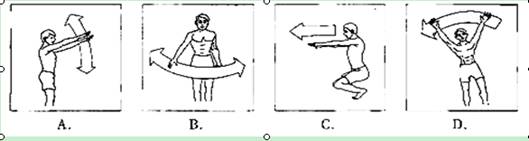
2. What can we learn from the passage?
A. Swinging your arm from side to side means "yes".
B. If the ground is dark, light smoke can't be seen.
C. If you need some medicine, make a symbol "II".
D. The pilots make replies with a blue light at night.
3. What is the passage mainly about?
A. The explanation of building signals on an island.
B. The importance of making signals on an island.
C. Ways of sending out signals on a lonely island.
D. Ways of receiving signals from a lonely island
查看习题详情和答案>>
With a determined(坚定的) look on his face, Chicago’s Michael McCarthy held on to the banister(扶手) and climbed to the top of the Willis Tower not long ago. The Tower stands 1,451 feet tall, the 41 building in the US.
As he got to the last step, McCarthy 42 fell down, but that didn’t stop him. The 14-year-old boy finally finished climbing the 2,109 steps and arrived at the top, where he 43 cheers from many people.
“I just want to show people that 44 a kid with no legs can do it, anyone can do it,” McCarthy said.
McCarthy, who was born without legs, has to wear prosthetic legs(假肢) and use a stick to walk. But McCarthy has a strong 45 . He believes having a disability shouldn’t stop anyone 46 achieving his or her success.
He has been in a special school 47 he was four. When he decided to climb the Willis Tower, his teacher, Jeff Kohn, was moved by his determination(决心) and offered 48 train him. They 49 more than ten hours practicing climbing stairs and keeping balance with the prosthetics and sticks on the steps every day. “ 50 seems that he never knows how difficult it is. 51 I was so tired that I asked him to rest for a day,” said Kohn. “But he said he was still full of energy and wanted more 52 .”
Kohn always walked with McCarthy for the climb. “I found when climbing the last 10 floors, he went faster,” said Kohn. “He’s the 53 sportsman I’ve ever trained.”
McCarthy said he was 54 of himself and that the tower now holds special meaning. “When I’m older, I’ll point(指着) to the building and 55 ‘Look at this building I climbed’,”
41. A. largest B. highest C. earliest D. latest
42. A. seldom B. hardly C. always D. almost
43. A. enjoyed B. needed C. made D. kept
44. A. while B. after C. if D. though
45. A. mind B. legs C. body D. love
46. A. by B. for C. in D. from
47. A. as B. since C. until D. before
48. A. help B. to help C. helping D. helped
49. A. used B. spent C. took D. wasted
50. A. Here B. There C. He D. It
51. A. However B. Sometimes C. Again D. Then
52. A. friends B. helpers C. time D. exercise
53. A. strong B. stronger C. strongest D. strongly
54. A. excited B. curious C. worried D. proud
55. A. say B. speak C. talk D. tell
查看习题详情和答案>>