网址:http://m.1010jiajiao.com/timu_id_2251245[举报]
Are the lives of city kids the same as those in villages? In lots of ways, they are very different. But what are the differences?
Hu Peng and his four friends decided to find them out. Earlier this month, they went to live for a week at Huagui Village near Xishui. They went door to door there and asked kids there lots of questions. They wanted to learn more about village kids’ everyday lives, so they asked questions like these: Do your parents teach you how to do housework? How much money do you usually spend on dinner? What would you do if a thief comes into your houses? They also asked 150 city kids the same question.
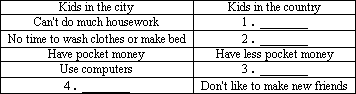
On April 12, the team gave a report to their class. They told about lots of differences between children’s lives in cities and those in villages. The biggest difference is independence. Hu’s team say that more than 60 percent of city kids can’t do much housework, but more than 80 percent of village kids can care for themselves.
City kids told Hu they cared about school a lot, and they had no time to wash clothes or make their beds. Village kids said they helped their parents with a lot: they cook, clean houses and feed farm animals, Hu’s team also saw that village kids had less pocket money. Many never use computers. They play in rivers or on mountains. Some don’t really like to make new friends.
Hu’s team said their trip gave them more self-confidence(自信心) because they were doing something by them-selves. But it also worried them a bit because they saw they still had a lot to learn. “When we grow up, our parents can’t take care of us,” Hu said. “We have to learn to take care of ourselves. ”
请根据短文内容完成下表信息:
| Kids in the city | Kids in the country |
| Can’t do much housework | 【小题1】____________________ |
| No time to wash clothes or make bed | 【小题2】____________________ |
| Have pocket money | Have less pocket money |
| Use computers | 【小题3】____________________ |
| 【小题4】____________________ | Don’t like to make new friends |
Are the lives of city kids the same as those in villages? In lots of ways, they are very different. But what are the differences?
Hu Peng and his four friends decided to find them out. Earlier this month, they went to live for a week at Huagui Village near Xishui. They went door to door there and asked kids there lots of questions. They wanted to learn more about village kids’ everyday lives, so they asked questions like these: Do your parents teach you how to do housework? How much money do you usually spend on dinner? What would you do if a thief comes into your houses? They also asked 150 city kids the same question.
On April 12, the team gave a report to their class. They told about lots of differences between children’s lives in cities and those in villages. The biggest difference is independence. Hu’s team say that more than 60 percent of city kids can’t do much housework, but more than 80 percent of village kids can care for themselves.
City kids told Hu they cared about school a lot, and they had no time to wash clothes or make their beds. Village kids said they helped their parents with a lot: they cook, clean houses and feed farm animals, Hu’s team also saw that village kids had less pocket money. Many never use computers. They play in rivers or on mountains. Some don’t really like to make new friends.
Hu’s team said their trip gave them more self-confidence(自信心) because they were doing something by them-selves. But it also worried them a bit because they saw they still had a lot to learn. “When we grow up, our parents can’t take care of us,” Hu said. “We have to learn to take care of ourselves. ”
请根据短文内容完成下表信息:
|
Kids in the city |
Kids in the country |
|
Can’t do much housework |
1.____________________ |
|
No time to wash clothes or make bed |
2.____________________ |
|
Have pocket money |
Have less pocket money |
|
Use computers |
3.____________________ |
|
4.____________________ |
Don’t like to make new friends |
查看习题详情和答案>>
Hu Peng and his four friends decided to find them out. Earlier this month, they went to live for a week at Huagui Village near Xishui. They went door to door there and asked kids there lots of questions. They wanted to learn more about village kids’ everyday lives, so they asked questions like these: Do your parents teach you how to do housework? How much money do you usually spend on dinner? What would you do if a thief comes into your houses? They also asked 150 city kids the same question.
On April 12, the team gave a report to their class. They told about lots of differences between children’s lives in cities and those in villages. The biggest difference is independence. Hu’s team say that more than 60 percent of city kids can’t do much housework, but more than 80 percent of village kids can care for themselves.
City kids told Hu they cared about school a lot, and they had no time to wash clothes or make their beds. Village kids said they helped their parents with a lot: they cook, clean houses and feed farm animals, Hu’s team also saw that village kids had less pocket money. Many never use computers. They play in rivers or on mountains. Some don’t really like to make new friends.
Hu’s team said their trip gave them more self-confidence(自信心) because they were doing something by them-selves. But it also worried them a bit because they saw they still had a lot to learn. “When we grow up, our parents can’t take care of us,” Hu said. “We have to learn to take care of ourselves. ”
请根据短文内容完成下表信息:
| Kids in the city | Kids in the country |
| Can’t do much housework | 小题1:____________________ |
| No time to wash clothes or make bed | 小题2:____________________ |
| Have pocket money | Have less pocket money |
| Use computers | 小题3:____________________ |
| 小题4:____________________ | Don’t like to make new friends |
The stories are the of Danish writer Hans Christian Anderson. He was born into a poor family in Odense, Denmark, on April 2, 1805. His early life was not . His father was a shoemaker and his mother a washerwoman. He very little education. As a child he was very emotional(情绪化) and was at for being feminine(女性化) and tall.
In 1816 his father died and Anderson was forced to go out to work, first in a tailor’s shop and then at a tobacco factory. At the age of 14 Anderson moved to Copenhagen to start a as a singer and actor. He struggled for three years he had to leave the theater when his voice broke in 1822.
, Anderson went to a grammar school. Having done well, he was allowed to go to Copenhagen University in 1828. He began to publish his fairy tales in1835.They in small volumes(量)until his death.
Anderson lived a hard life, but he tried to make people laugh in all his stories. He wrote because he didn’t want children to have a sad childhood as he did. The works Anderson famous all over the world , but he was still a lonely man. He never married and his friends were the people who paid for his work. Anderson passed away on August 4, 1875 at the age of 70. His home in Odense is now a museum and thousands of people visit it every year.
| 小题1: |
|
| 小题2: |
|
| 小题3: |
|
| 小题4: |
|
| 小题5: |
|
| 小题6: |
|
| 小题7: |
|
| 小题8: |
|
| 小题9: |
|
| 小题10: |
|
阅读理解
Are the lives of city kids the same as those in villages? In lots of ways, they are very different.But what are the differences?
Hu Peng and his four friends decided to find them out.Earlier this month, they went to live for a week at Huagui Village near Xishui.They went door to door there and asked kids there lots of questions.They wanted to learn more about village kids' everyday lives, so they asked questions like these:Do your parents teach you how to do housework? How much money do you usually spend on dinner? What would you do if a thief comes into your houses? They also asked 150 city kids the same question.
On April 12, the team gave a report to their class.They told about lots of differences between children's lives in cities and those in villages.The biggest difference is independence.Hu's team say that more than 60 percent of city kids can't do much housework, but more than 80 percent of village kids can care for themselves.
City kids told Hu they cared about school a lot, and they had no time to wash clothes or make their beds.Village kids said they helped their parents with a lot:they cook, clean houses and feed farm animals, Hu's team also saw that village kids had less pocket money.Many never use computers.They play in rivers or on mountains.Some don't really like to make new friends.
Hu's team said their trip gave them more self-confidence(自信心)because they were doing something by them-selves.But it also worried them a bit because they saw they still had a lot to learn.“When we grow up, our parents can't take care of us,” Hu said.“We have to learn to take care of ourselves.”
请根据短文内容完成下表信息: