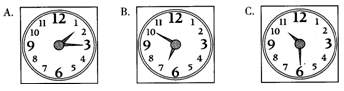
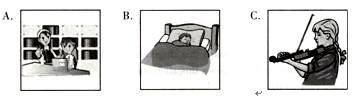
摘要:6.does.lunch.time.she.what, have

网址:http://m.1010jiajiao.com/timu_id_2235434[举报]

阅读短文,回答问题。
     It is Sunday. I never get up early on Sundays. I sometimes stay in bed until lunch time. Today is
Sunday again. I get up very late. I look out of the window. It is dark outside. "What a day!" I think.
"It's raining again." Just then, the phone is ringing. It is my aunt Lucy. "I arrive by train", she says.
"I'm coming to see you."
     "But I'm still having breakfast," I say. 
     "What are you doing?" She asks.
     "I'm having breakfast," I say it again.
     "Dear me, Do you always get up so late? It's one o'clock!"
1. Does the writer always get up early or late on Sundays?
                                                                                                                          
2. Does she arrive by train or on foot?
                                                                                                                          
3. Is she coming to see him or not?
                                                                                                                          
4. What time do you usually get up? And when do you usually have breakfast? 
                                                                                                                          
查看习题详情和答案>>

阅读短文,从各题所给的A、B、C、D四个选项中选出量佳选项。

Hello Sandy,

  We have just returned from our holiday.We went with our friends Edward Smith and his wife Tina to the Yorkshire Moors.This is a beautiful place.It is a natural park.There are lots of places to walk on the tops of the hills, miles of grassland with no people, just sheep and birds.

  Edward, who had just come out of hospital, could not walk as far as be used to.However this meant that we walked in the mornings, and then stopped at a cafe for lunch each day, before returning to the place we live.Edward and I slept in front of the fire all afternoon, while the ladies went for another walk.Very pleasant!

  I have taken lots of photos from the place we live, across the valley(峡谷)below us, of the morning sunrise, and the mist in the valley.Also, in England, the old steam powered trains(蒸汽火车)are very popular.I have taken many photos of the train and from it.

  Yesterday we had the first snow of this winter.It is very early(we usually expect snow in January).It rained all day, then snowed in the evening.Today we have bright sunshine!

  Both Jenny and I are well I don't know if I told you, in the last e-mail, that Jenny is now working in a hotel.Although she has to work hard, people there are nice and she is enjoying the work.

  Please write to us to tell us your news.

Yours,

Victor

(1)

What kind of place is the Yorkshire Moors?

[  ]

A.

A hotel.

B.

A natural park.

C.

A hospital.

D.

A cafe.

(2)

When did the ladies take a walk?

[  ]

A.

Only in the morning.

B.

Only in the afternoon.

C.

Both in the morning and in the afternoon.

D.

In the evening.

(3)

They had ________ snow this winter.

[  ]

A.

an early

B.

a late

C.

a usual

D.

a big

(4)

What does the underlined word “it” in Paragraph 3 mean?

[  ]

A.

The valley.

B.

Travel.

C.

The mist.

D.

The train.

(5)

What do we know from this passage?

[  ]

A.

This is the first time Victor wrote an e mall to Sandy.

B.

Edward didn't go traveling because he bad just come out of hospital.

C.

Jenny's new job in a hotel is an easy one.

D.

People in England like the old steam powered trains very much.

查看习题详情和答案>>
阅读理解。
      After I have lunch in an inn (小饭馆), I look for my handbag. I put it on a chair beside
the door and now it isn't there! As (当······时候) I am looking for it, the inn-keeper
comes in.
      "Do you have a good lunch?" he asks.
      "Yes, thank you," I answer. "But I can't pay (付款) the bill. Somebody takes away my bag.
      "The inn-keeper smiles and goes out at once. In a few minutes (过了一会儿) he comes
back with my bag and gives it to me.
      "I am very sorry," he says. "My dog takes it into the garden. He often does this."
1. The woman has a good lunch, but she ______ at first.
A. doesn't pay for it
B. can't pay for it
C. refuses (拒绝) to pay for it
D. wants to pay for it next time
2. _______ takes the woman's bag away.
A. A thief (小偷)
B. The woman herself
C. The inn-keeper
D. The dog in the inn
3. The inn-keeper knows _______.
A. who takes the woman's bag away .
B. the woman doesn't want to pay for her lunch
C. the woman can give him a lot of money
D. the dog can find the lost bag
4. The dog takes the bag away because it _______.
A. wants to play with it
B. wants to see if (是否) there is money in it
C. wants to help the inn-keeper to get more money
D. likes to see people looking for their bags
5. The underlined word "bill" in Paragraph 3 means _______.
A. a piece of bread
B. a kind of drink
C. a piece of paper, from which you can know how much you must pay
D. a piece of paper, from which you can know what food they sell
填词完成句子,第一个字母已给出
6. The woman puts her bag on a chair b______ she has her lunch.
7. The woman t______ somebody takes her bag away.
8. In this inn people eat first and t______ pay.
9. The inn-keeper k______ what happens (发生) to the woman's bag.
10. The inn-keeper's dog often p______ with the customers' bags.
查看习题详情和答案>>
查看习题详情和答案>>