网址:http://m.1010jiajiao.com/timu_id_2224508[举报]
阅读理解.
Steve Parkinson from Australia is coming to study in Britain. Mr and Mrs Field have come to meet him at the airport.
Mrs F: Oh dear, this airport is so puzzling. All these signs and notices----International Departures, Transfers, Domestic Arrivals...
Mr F: Oh, look at all these people. Where's Steve? He's late. The screen says his flight landed 30 minutes ago.
Mr F: He's possibly been held up in the customs (海关) or has to wait a long time for his luggage (行李).
Mrs F: There he is, with all those bags. Steve! Oh, he can't see us. There're so many people. Steve! We are over here.
Steve: Hello. Hello. There you are. What a crowd! Good day, Mrs Field, Mr Field.
Mrs F: Hello, Did you have a good journey? Was it a comfortable flight? Did everything go all right?
Mr F: You must be very tired.Anyway we don't have to go far. We've booked you in a hotel in the city center for tonight.
Steve: Oh, fine. Thank you.
Mr F: Well, we'd better go and find taxi. How do we get out of this airport?
Mrs F: Let's take the underground.There'll be a long queue for taxis and the bus will take a long time at this time of day. There's a station here at the airport. Eh, see the signs?
Steve: OK. That's fine for me, but I must change some money. Is there a bank or something here.
(1)The story happened in ________.
[ ]
|
A.Australia |
B.America |
|
C.France |
D.England |
(2)Which sign are Mr and Mrs Field looking for?
[ ]

(3)Steve had to ________ before he came to the International Arrivals.
[ ]
|
A.go through the customs |
B.wait for his ticket |
|
C.change some money |
D.book a room in a hotel |
(4)Who are Mr and Mrs Field going to meet?
[ ]
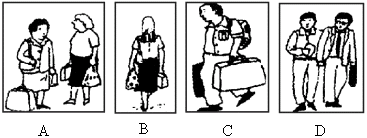
(5)According to the dialogue, how are they going to travel next?
[ ]
|
A.By taxi |
B.By underground |
|
C.By bus |
D.By plane |
阅读理解.
Steve Parkinson from Australia is coming to study in Britain. Mr and Mrs Field have come to meet him at the airport.
Mrs F: Oh dear, this airport is so puzzling. All these signs and notices----International Departures, Transfers, Domestic Arrivals...
Mr F: Oh, look at all these people. Where's Steve? He's late. The screen says his flight landed 30 minutes ago.
Mr F: He's possibly been held up in the customs (海关) or has to wait a long time for his luggage (行李).
Mrs F: There he is, with all those bags. Steve! Oh, he can't see us. There're so many people. Steve! We are over here.
Steve: Hello. Hello. There you are. What a crowd! Good day, Mrs Field, Mr Field.
Mrs F: Hello, Did you have a good journey? Was it a comfortable flight? Did everything go all right?
Mr F: You must be very tired.Anyway we don't have to go far. We've booked you in a hotel in the city center for tonight.
Steve: Oh, fine. Thank you.
Mr F: Well, we'd better go and find taxi. How do we get out of this airport?
Mrs F: Let's take the underground.There'll be a long queue for taxis and the bus will take a long time at this time of day. There's a station here at the airport. Eh, see the signs?
Steve: OK. That's fine for me, but I must change some money. Is there a bank or something here.
(1)The story happened in ________.
[ ]
|
A.Australia |
B.America |
|
C.France |
D.England |
(2)Which sign are Mr and Mrs Field looking for?
[ ]

(3)Steve had to ________ before he came to the International Arrivals.
[ ]
|
A.go through the customs |
B.wait for his ticket |
|
C.change some money |
D.book a room in a hotel |
(4)Who are Mr and Mrs Field going to meet?
[ ]
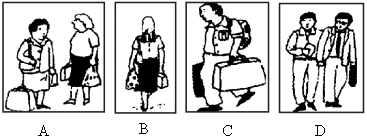
(5)According to the dialogue, how are they going to travel next?
[ ]
|
A.By taxi |
B.By underground |
|
C.By bus |
D.By plane |
| 阅读理解。 | |||
| |||
| 1.Where do you usually see these kinds of information? | |||
|
[ ] | |||
| A.On television B.In the books C.In the newspapers D.In the magazines | |||
| 2.Mr. Hanson who is from Germany _______. | |||
|
[ ] | |||
| A.can not join the Evening Post English club free of charge B.will not be accepted to teach primary school pupils spoken English C.has to pay if he wants to join the Wutong Mountain one-day trip D.will get paid badly if he teaches for Shenzhen Daily | |||
| 3.If people take part in the activities held by the Evening Post English club, they can do the following EXCEPT _______. | |||
|
[ ] | |||
| A.make new friends B.go to the English club for free C.make themselves more fit for society D.get new ideas from others | |||
| 4.If Mark, an Australian, wants to teach pupils oral English, he has to ______. | |||
|
[ ] | |||
| A.write a letter about himself and get in touch with Shenzhen Daily B.visit the website of Shenzhen Daily C.work every other week D.offer his childhood photo to Shenzhen Daily | |||
| 5.Which of the following is TRUE according to the passage? | |||
|
[ ] | |||
| A.All the foreigners will go to the Evening Post English club. B.All the people can take the one-day trip without any pay. C.Any English speaker can apply for the part-time job. D.the date of Wutong Mountain one-day trip is Apr. 27, 2009. |
have come from Turkey.
In the 1700s in Turkey, it was quite popular for people in love to send each other baskets full of strange things. The baskets were delivered(递送) secretly by the person who sold flowers or fruit on the street to
the person's door.
These baskets included a variety of "gifts":flowers, stones, feathers, wax(蜡), and even charcoal(炭).
Each thing in the basket had a special meaning, By figuring out the secret message contained in each item (项目 ), the person who received the basket began to understand the true feelings of the person who sent it.
This idea of sending gifts of love with secret meanings quickly spread to Germany, France and England. However, as time passed, only sending flowers, remained popular.
Many flower dictionaries were made to help young people in love understand the meaning of the flowers they received . Not all of the dictionaries agreed, however, on the meaning of each flower, so a person
had to be careful about the flowers they chose to send.
By the 1880s, using flowers to send messages had fallen out of fashion, and the more direct way of
sending love letters began. Today, flowers are still considered a lovely gift, but the meaning for each kind
of flower has been lost.
1. The first three paragraphs describe the tradition of .
A. sending gift baskets
B. selling flowers
C. selling love letters
D. sending dictionaries
2. What did the items in a basket explain to the receiver?
A.The lady's looks.
B. The sender's emotions (感情).
C. The person's door.
D. The person's country.
3. To where did the idea of sending gifts of love spread?
A. To Asia.
B. To Europe.
C. To Australia.
D. To North America.
4. How did people know the meaning of each kind of flower?
A. A dictionary told them.
B. Their parents told them.
C. A person in love told them.
D. Their friends told them.
5. When did the tradition of sending love messages through flowers slow down?
A. In the 17th century.
B. In the 19th century.
C. In the 18th century.
D. Never.
| |||||||||||||||||||||||||||||||||||||||||||||||||||||||||||||||||||||||||