网址:http://m.1010jiajiao.com/timu_id_2218116[举报]
阅读下面的短文,并完成短文后的任务。
Waste can be seen everywhere in the school. Some students ask for more food than they can eat and others often forget to turn off the lights when they leave the classroom. They say they can afford these things. But I don’t agree with them.
Waste can bring a lot of problems. Although China is rich in some resources (资源), we are short of others, for example, fresh water. It is reported that we will have no coal(煤) or oil to use in 100 years. So if we go on wasting our resources, what can we use in the future and where can we move? Think about it. (83) I think we should say no to the students who waste things every day. Everybody should stop wasting as soon as possible.
In our everyday life, we can do many things to prevent (阻止) waste from happening, for example, turn off the water taps when we finish washing, turn off the lights when we leave the classroom, try not to order more food than we need, and so on. Little by little, everything will be changed. (84) Waste can be stopped one day, if we do our best.
任务1:根据要求答题。(请注意问题后的词数要求) 提示: within 在…以内 waste浪费
1.List the wastes mentioned in the first passage: (within 15 words 15个词以内)
_________________________________________________________________
2.What problems can waste bring? (within 20 words)
(1) ______________________________________________________________
(2) ______________________________________________________________
任务2:将短文中划线的句子翻译成汉语。
3.______________________________________________________________
4.______________________________________________________________
任务3:请给短文拟一个适当的标题:(within 5 words)
5.______________________________________________________________
查看习题详情和答案>>
Listening test is one of the most important parts of
the English exam. Here are some tips ( 建议) for you.
Before you start to listen, you need to relax. Don’t be stressed out. And try to read the questions. These questions usually help you understand the conversation or the passage.
Then listen carefully to the first sentence. It usually tells you the main idea of the passage. When you’re listening, try to do some thinking and take some notes (笔记), such as:
·What happened (发生)?
·When, where, and how?
·What does the speaker want to tell us?
In this way, you may understand the passage better.
Please remember not to think about one or two words
for a long time. When you hear some word s
you don’t know, don’t spend too much time on them. Very often, you’ll find out
what they mean later when you go on with the listening.
1.This passage mainly talks about _________.
A. tips on listening B. tips on speaking
C. tips on reading D. tips on writing
2.It’s better for you to keep _________ when you start to have a listening test.
A. excited B. relaxed C. stressed out D. worried
3.We should listen to the first sentence carefully, because it usually tells us _________.
A. the answers to the questions
B. where to write the answers
C. the main idea of the passage
D. how much time left (剩余) for the listening test
4.When you’re listening, it’s important for you to _________.
A. remember every word
B. take some notes
C. understand all the words
D. think about one or two words for a long time
5.The_________ usually help(s) us understand the passage better.
A. questions B. first sentence C. notes D. A, B and C
查看习题详情和答案>>
One day, I went to see my last patient(病人), an old woman. In the doorway, I saw she was struggling (挣扎) to put socks on her swollen (浮肿)feet in the bed. I stepped in, spoke quickly to the nurse, read her chart noting. I was almost in the clear that she was not in serious condition.
I asked, “Could I help put on your socks? How are you feeling? Your sugars and blood pressure were high but they're better today. The nurse mentioned you're anxious to see your son. He's visiting you today. It's nice to have a family visit. I think you really look forward to seeing him."
"Sit down, doctor. This is my story, not yours." She said with a serious voice.
I was surprised as I helped her with the socks. She told me that her only son lived around the corner from her, but she had not seen him in five years. She believed that was the main cause of her health problems. After hearing her story and putting on her socks, I asked if there was anything else I could do for her. She shook her head no and smiled. All she wanted me to do was to listen.
Each story is different. Some are detailed; others are simple. Some have a beginning, middle and end; others don’t have clear ends. Some are true; others not. Yet all those things do not really matter. What matters to the storyteller is that the story is heard — without interruption(打断) or judgment(评价).
It was that woman who taught me the importance of stopping, sitting down and truly listening. And, not long after, in an unexpected accident, I became a patient. 20 years later, I sit all the time — in a wheelchair.
For as long as I could, I continued to see patients from my chair. I believe in the power of listening.
1. How was the old woman?
A. Her feet were swollen. B. Her sugars were high.
C. She was not badly ill. D. Her blood pressure was better.
2.How did the doctor know that the old woman’s son was visiting her?
A. The nurse told him. B. The old woman told him.
C. The woman’s son told him. D. The doctor got it from her chart noting.
3.What did the old woman think caused her health problems?
A. Her son’s not seeing her. B. No one listening to her story.
C. The medical care of the hospital. D. The distance between her and her son.
4.When the patient told the doctor her stories, what she needed might be ______.
A. keeping smiling B. interruption or judgment
C. listening without interruption D. communicating with each other
5.Which statement is NOT right according to the passage?
A. Her son lived close to her house.
B. The old woman didn’t need the doctor’s treatments.
C. Listening is powerful medicine.
D. The doctor has to “walk” with the help of a wheel chair.
查看习题详情和答案>>
Listening test is one of the important parts of the English exam. Here are some tips for you .
Before you start to listen ,you need to relax. Don't be nervous. And try to read the questions .These questions usually help you understand the dialogue or the passage.
Then listen carefully to the first sentence. It usually tells you the main idea of the passage. When you 're listening ,try to do some thinking and take some notes ,suck as:
? What happened?
? When ,where, and how?
? What does the speaker want to tell us?
In this way, you may understand the passage better.
Please rememeber not to think about one or two words for a long time. When you hear some words you don't know, don't spend too much time on them. Very often, you'll find out what they mean later when you go on with the listening.
1.This passage mainly talks about .
A. tips on listening B. tips on speaking C. tips on reading
2.It's better for you to keep when you start to have a listening test.
A. excited B relaxed C. nervous
3.We should listen to the first sentence carefully, because it usually tells us
A. the answer to the question
B. where to write the answers
C. the main idea of the passage
4.When you're listening, it's important for you to .
A. remember every word
B. take some notes
C. Think about one word for a long time
5.The usually help(s) us understand the passage better.
A. questions B. first sentence C. notes
查看习题详情和答案>>
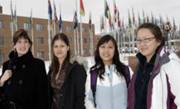
7 January, 2014
A new report says more and more international students are attending colleges and universities in the United States. It also notes a large increase in the number of international students from China.
These findings are from the latest Open Doors Report.
The report documents the record number of international students in the United
States during 2012, 2013 school year. It says more than seven hundred
sixty-four thousand four-hundred s uch
students were attending American colleges and universities during the last two
years. That represents an increase of almost six percent than one year earlier.
On the other hand, the number of Americans studying overseas (海外) increased by one percent, which reached nineteen thousand this year.
The report says one hundred ninety-four thousand students at American colleges and universities were from
China. That is an increase of more than twenty-three
percent over the year before. Peggy Blumenthal, an expert(专家) of international education, described the effect of
the increase in Chinese students.
"Now they have been coming for some time. But this year was the highest level ever." She says many Chinese families are able to pay for the highest-quality education for their children. The children mainly choose to study in America.
"We know many of them have enough income to be able to afford to send them anywhere in the world that they want to go. And for the most part, looking around the world, Chinese students still prefer to come to the United States as their choice."
Chinese students are not the only ones who want to attend American colleges and universities. After China, India sends the second largest number of students to the United States for higher education. India has about one hundred thousand students in American schools. South Korea is third with about seventy two thousand students.
Why do so many foreign students study in the United States? Peggy Blumenthal provides one reason.
"The advantage America has is that we have a huge system and a very perfect system. So there are over four thousand universities and colleges in the United States. Among them are some top ones in the world, and what that tells us is there is still a lot of room to host international students."
Foreign students represent less than four percent of the total student population in American higher education. And from Learning English, that's the VOA Special English Education Report. I'm Bob Doughty. Thanks for listening.
1.Bob Doughty seems to be ________.
A. an exchange student from the USA
B. an expert of international education
C. a viewer of VOA
D. a reporter from VOA
2.Which country below has the fewest students studying overseas?
A. South Korea B. India C. China D. America
3.Which is NOT the reason why so many Chinese students go to the USA for further study?
A. Lots of Chinese families are able to pay for the highest-quality education for their children
B. The USA has a huge and a very perfect education system.
C. There is a lot of room to host international students in the USA.
D. The USA has some top universities and colleges in the world.
4.Which of the following statement is true?
A. China has 122,000 more students than South Korea at American colleges and universities.
B. The number of Americans studying overseas is becoming smaller and smaller.
C. The number of Asian students has an increase of 6% over the past two years.
D. Most of the international students in the United States are Chinese.
5.This passage from VOA Special English is most likely to be ________.
A. An advertisement B. A radio programme C. A science report D. A tour guide
查看习题详情和答案>>