网址:http://m.1010jiajiao.com/timu_id_1692911[举报]
We use the Internet for many things: business, shopping, writing letters, talking to people, finding information and so on. In recent years, a new kind of English has grown on the Internet. There’s no real word for it yet, so we’ll call it e-talk. People don’t like typing too much. To save time, they turn phrases into a few letters (called acronyms). Acronyms are often used in chat rooms(聊天室). Some of them are:
BTW(by the way); BRB(be right back); LOL(laughing out loud); IMO(in my opinion)
People also use many abbreviations. They are shortened forms of words. Some common abbreviations are:
info(information); puter(computer); pic(picture); sec(second)
We ususally don’t see people when we communicate on the Internet, so people have new ways to show feelings. Most people use their keyboards to draw “feelings”, such as:
:-) (happy); ;-)(joking); :-((sad); :-O(surprised)
These days, many forums(论坛)have picture feelings. For example:


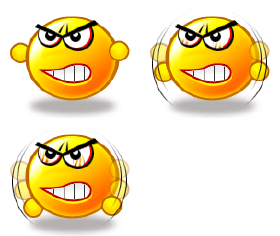
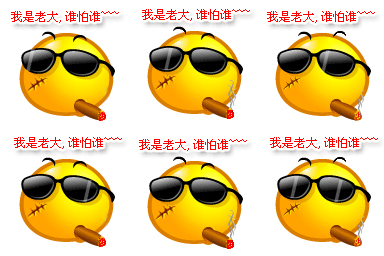
(happy) (sad) (angry) (cool)
There are even whole new words, like ”newbie’s” (someone who is new on a chat board or forum). When you write something bad about someone else, it’s called “flaming” the person.
It takes time for people to get used to e-talk. Also, different groups on the Net have their own special ways of communicating. Newbie’s sometimes have to ask other people what they mean. As the Internet grows, e-talk will continue to grow and change.
Why do people type acronyms?
A. To show their feelings. B. To make jokes.
C. To save time. D. In this way newbie’s won’t understand them.
What does “BTW, my computer is not working well, :-( ”mean?
A.The person is happy about getting a new computer.
B. The person has to go away from his/her computer.
C. The person is angry at somebody.
D. The person is sad that his computer is having problems.
If someone is angry, what may he type?
A. B. BRB C. LOL D.
E-talk will probably_______.
A. keep changing B. stay the same
C. be used by people on the telephone D. be easy for newbie’s to understand.
查看习题详情和答案>>We use the Internet for many things: business, shopping, writing letters, talking to people, finding information and so on. In recent years, a new kind of English has grown on the Internet. There’s no real word for it yet, so we’ll call it e-talk. People don’t like typing too much. To save time, they turn phrases into a few letters (called acronyms). Acronyms are often used in chat rooms(聊天室). Some of them are:
BTW(by the way); BRB(be right back); LOL(laughing out loud); IMO(in my opinion)
People also use many abbreviations. They are shortened forms of words. Some common abbreviations are:
info(information); puter(computer); pic(picture); sec(second)
We ususally don’t see people when we communicate on the Internet, so people have new ways to show feelings. Most people use their keyboards to draw “feelings”, such as:
:-) (happy); ;-)(joking); :-((sad); :-O(surprised)
These days, many forums(论坛)have picture feelings. For example:


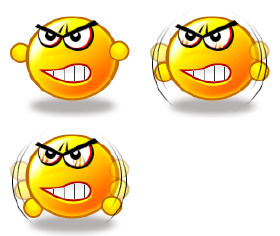

(happy) (sad) (angry) (cool)
There are even whole new words, like ”newbie’s” (someone who is new on a chat board or forum). When you write something bad about someone else, it’s called “flaming” the person.
It takes time for people to get used to e-talk. Also, different groups on the Net have their own special ways of communicating. Newbie’s sometimes have to ask other people what they mean. As the Internet grows, e-talk will continue to grow and change.
1.Why do people type acronyms?
A. To show their feelings. B. To make jokes.
C. To save time. D. In this way newbie’s won’t understand them.
2.What does “BTW, my computer is not working well, :-( ”mean?
A.The person is happy about getting a new computer.
B. The person has to go away from his/her computer.
C. The person is angry at somebody.
D. The person is sad that his computer is having problems.
3. If someone is angry, what may he type?
A. B.
BRB C.
LOL D.
4.E-talk will probably_______.
A. keep changing B. stay the same
C. be used by people on the telephone D. be easy for newbie’s to understand.
查看习题详情和答案>>
| 完形填空 | |||
| In the past, man did not have to think about the protection of his environment. There were few people on the earth, and natural resources seemed to be 1 . Today things are 2 , the world has become too 3 . We are using up our natural resources too quickly and at the same time we are 4 our environment with dangerous chemicals.If we continue to do this, human life on the earth 5 survive. Everyone 6 today that if too many fishes are taken from the sea, there will soon be none left. Yet, with modern fishing 7 , more and more fishes are caught. We know that if too many trees are cut down, 8 will disappear and nothing will grow on the earth. Yet we _9_ to use bigger and more powerful machines to 10 more and more trees. We realize that if rivers are polluted with waste products from factories, fish will die. 11 , in most countries wastes are 12 put into rivers or into the sea, and there are 13 laws to stop this. We know, too, that if the 14 of the world continues to rise at the present rate , in a few years there will not be enough 15 .What can we do to solve these problems? If we eat more vegetables and less 16 ,there will be more food for everyone. Land that is used to grow crops 17 five times more people than land where animals are kept. Our natural resources will 18 longer if we learn to recycle them. The world population will not rise so quickly if people use modern methods of birth 19 . Finally, if we educate people to think about the problems, we shall have a better and cleaner 20 in the future. | |||
| ( )1. A. beaut iful ( )2. A. common ( )3. A. crowded ( )4. A. protecting ( )5. A. may not ( )6. A. wonders ( )7. A. poles ( )8. A. mountains ( )9. A. continue ( )10. A. grow ( )11. A. Thus ( )12. A. s till ( )13. A. many ( )14. A. production ( )15. A. houses ( )16. A. fruit ( )17. A. feeds ( )18. A. use ( )19. A. control ( )20. A. nature |
B. unlimited B. the same B. small B. saving B. will not B. ealizes B. boats B. the sea B. have B. pick up B. however B. even B. no B. pollution B. vegetables B. meat B. increases B. stay B. born B. sea |
C. unusual C. changeable C. dirty C. polluting C. shall not C. considers C. methods C. trees C. ought C. save C. Generally C. also C. some C. population C. food C. fish C. supplies C. keep C. plan C. planet |
D. valuable D. different D. busy D. fighting D. could not D. discovers D. ideas D. forests D. decide D. cut down D. Therefore D. never D. few D. development D. places D. grain D. helps D. last D. pay D. fores |