网址:http://m.1010jiajiao.com/timu_id_1379048[举报]
阅读下面的短文,并根据短文内容和插图提示,在短文空格处填入适当的单词,每个空只能填写一个形式正确、意义相符的单词。
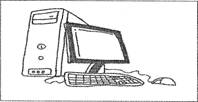
Computer plays an important part in our everyday life.It is one of the greatest (71)_________
in the world in the twentieth century.It works for us not only at home,in the offices and in big shops,(72)__________ also at schools.Today it is used(73)__________ many ways.It really(74)__________ large wealth(财富)and happiness to the world.
The first computer in the world was(75)__________ Enid.It was built in America in 1946.It was(76)__________ and heavy.(77)__________ it was born,it has been developing very fast.Until now it has gone through four periods(时期,阶段)and changed a lot.There’re many kinds of computers.Computers are getting smaller and smaller and computing faster and faster.It becomes more and more helpful.
The computer can do most of the things(78)__________ the people.It can help us know about the real world more quickly, learn(79)___________ we want to learn and think for ourselves.(80)__________ a student in the twenty-first century, you must work hard at it.
六、读写综合 (本大题分为A、B两部分,共20分)
查看习题详情和答案>>
Sometimes we feel good, such as when we get good grades or when something good happens.
Sometimes we feel bad, such as when we argue with our classmates or when the teachers criticize
(批评) us. Both kinds of feelings are common. Of course, we all enjoy good feelings, but when we feel
unhappy, sometimes we don't know what to do about it. Here is a plan that will help you when your
feelings are bothering you.
● ACCEPT your feelings. Say to yourself "I am sad. " "I am scared. " "I am angry. " "I am
embarrassed. " It's all right to have these feelings.
● RELAX and have a rest before you act. Take slow deep breath (呼吸) and relax your body.
Imagine that you are in a safe place. You can listen to some music or sing a beautiful song!
● THINK about ways to help yourself. Thinking helps you do something smart instead of hurting
yourself or making things worse.
● DO something to help yourself. Maybe you can talk to someone, or do something you enjoy. If it
doesn't work, go back to Step 3.
1. We feel unhappy when ___________.
A. we get good grades
B. everything goes well
C. someone is proud of us
D. we have a fight with our classmates
2. If you want to relax yourself before you act, you can ___________ .
A. say to yourself, "I am sad. "
B. listen to some music or sing a beautiful song
C. think about ways to help yourself
D. watch thrillers with your friends
3. The underlined part "If it doesn't work," in the passage probably means " ___________ ".
A. if it is broken
B. if it can't interest you
C. if it is wrong
D. if it can't help you
4. Which of the following is NOT true according to the passage?
A. We felt good when won the prize in the competition.
B. We felt bad when we lost our expensive things.
C. We can say to ourselves that we are pleased when we feel sad.
D. We can tell someone about our bad feelings when we are sad.
5.The passage tells us___________.
A. what we can do when we feel unhappy
B. we can do nothing when we feel bad
C. we all enjoy good feelings, but bad feelings are unusual to us
D. what we can do when we feel happy
A young American doctor was sleeping when suddenly his doorbell began to ring. It was already midnight, but what could the doctor do? He had to get up, put on his coat and go downstairs.
When he opened the door, he saw a man standing with a hat in his hand. “How do you do?” said the man,“ Can you come at once to a place out of town? It’s quite far but you have a car and I can show you the way.”
“Certainly,” said the doctor, “I’m quite ready. I can come at once.” After a few minutes the car was standing at the front door, the man got into the doctor’s car, and they drove off.
They drove on for a long time. Then the man said, “Here we are. This is my home. Now I can pay you and you can go back to town.”
“I must see the patient. How can I go back without seeing the patient?”
“There is no patient,” explained the man. “Nobody is ill. I live here, you see, and one must get home from a town, mustn’t he? There are no taxis this time of the night, but a doctor often makes night calls, so excuse me. Here is money. Thank you, doctor. Good night.”
1.The doctor ____ when the doorbell started to ring.
A. was sleeping upstairs B. was sleeping downstairs
C. was working upstairs D. was working downstairs
2. The man asked the doctor _____.
A. to go out for a walk B. to go to a place out of town
C. to see a patient D. to go for a vacation
3.They left _____.
A. on foot B. by bike C. by bus D. by car
4.What the man wanted to do was only _____.
A. to fool the doctor B. to give the doctor money
C. to get home in the doctor’s car D to invite the doctor to his home
5.The doctor must be ______ when he heard the man’s words.
A. happy B. angry C. sad D cry
查看习题详情和答案>>
In the UK, there are two different types of school. One is free for every child in the country; 41 kind makes you pay for your education.
The free schools are known as “state schools” and the schools that 42 are known as “public schools”.
The UK has many famous public schools, such as Eton (伊顿公学), Harrow (哈罗中学) and Winchester (温彻斯特中学). Children from around the world come to the UK to study at these schools. Prince William studied at Eton.
43 most kids go to state schools. Only about one in 10 goes to a public school. Fees (学费) at public schools can be very 44 . It can cost around 200,000 yuan for one year.
There are differences between state and public schools. Public schools generally attract better 45 , because they offer higher salaries(薪水).
Because public schools have 46 money to spend than state schools, they also have nicer facilities (设施). Some have football fields, gyms and swimming pools for their students to use.
Facilities in state schools are not usually as good. They often have to 47 with other nearby schools.
Despite (尽管) these differences, kids learn the same things, whichever type of school they go to. 48 schools must follow the National Curriculum, which is set by the government. It 49 teachers what they must teach their students.
This means that whether you are rich or poor, you will still receive a basic level of 50 .
1. A. other B. others C. another D. the other
2. A. cost B. pay C. spend D. take
3. A. And B. But C. Although D. Besides
4. A. high B. low C. expensive D. cheap
5. A. students B. teachers C. professors D. visitors
6. A. less B. little C. much D. more
7. A. share B. talk C. play D. help
8. A. Every B. Some C. Most D. All
9. A. says B. asks C. tells D. allows
10. A. living B. work C. education D. study
查看习题详情和答案>>
Jan:I have new photos of my family, but they' re not very good. This is my sister…
Mark:Where is she? Is she at the library?
Jan:No, she' s in the living room. She s doing her homework. And that s my brother.
Mark:Is he doing his homework, too? What's he eating?[来源:Zxxk.Com]
Jan:He' s watching a scary movie on TV and eating french fries.
This is a picture of my aunt and my mother.
Mark:Is that -your mother in the pool?[来源:学。科。网Z。X。X。K]
Jan:No, that's my aunt. My mother can't swim. And this is my mother and my aunt at the shop. They really like shopping and eating at the shop. Mark: Interesting photos.
1. The pictures are ______.
A. good B. interesting C. scary
2. Jan' s sister is doing her homework ______.
A. at the library B. at the pool C. in the living room
3. Jan' s brother isn' t ______.
A. doing his homework B. watching TV C. eating french fries [来源:]
4. Jan' s ______ can' t swim.
A. sister B. mother C. aunt [来源:ZXXK]
5. Jan' s mother and aunt like ______ at the shop.
A. eating french fries B. shopping C. swimming
查看习题详情和答案>>