网址:http://m.1010jiajiao.com/timu_id_1375193[举报]
What do you do if you're stranded(处于困境的)on a lonely island? Surely you need to find a way to get in touch with the outside world. Your best chance of doing this is to draw the attention of a passing plane.
Body signals(信号)
Pilots from different countries understand body signals if they have the correct training. When you wave your arms up and down in a straight line, it means "yes". When you point downwards and swing your arm from side to side, it means "no". If you want the pilot to know that it's safe to land, push your hands out in front of you and bend(弯曲)your knees. If you want to say that it's not safe to land, put your arms in the air and move them to one side.
Smoke signals
The smoke from a fire can be seen from far away, so it's a good way to draw attention. If the weather is dry, it isn't hard to start a fire. Remember, however, that fires can be very dangerous if they get out of control. Never light a fire unless you're sure that it can't spread. If the ground is dark, light smoke can be seen more easily. Green grass and leaves produce light smoke.
Ground-to-air signals
It's a good idea to build some signals, too. Use large pieces of wood to make the symbols(标记). If you can't find any wood, use earth. Some useful symbols are:
F "I need food and water."
II "I need medicine."
I "I am badly hurt."
X" I am unable to move from here."
Pilots' replies
If the pilot lowers the plane's wings from side to side, this means "message received and understood". (At night, the pilot flashes the plane's green lights.) If the pilots flies the plane in a clockwise circle, this means "message received but not understood".(At night, the pilot flashes the plane's red lights.)
However, there is no signal which means "message not received". Why not?
【小题1】 Which picture means "it's not safe land"?
【小题2】 What can we learn from the passage?
| A.Swinging your arm from side to side means "yes". |
| B.If the ground is dark, light smoke can't be seen. |
| C.If you need some medicine, make a symbol "II". |
| D.The pilots make replies with a blue light at night. |
| A.The explanation of building signals on an island. |
| B.The importance of making signals on an island. |
| C.Ways of sending out signals on a lonely island. |
| D.Ways of receiving signals from a lonely island |
完形填空(10分)阅读下列短文,选择可以填入空白处的最佳选项。
Water, it’s a problem for the whole world. A bottle (瓶) of water may not seem like much to us, 1 it can help the people who live in drought-hit (遭受旱灾的) areas in China.
In the past few months, many places in southwest China have 2 a serious drought. There has been very little 3 since last autumn. More than 20 million people are 4 trouble finding safe drinking water.
After learning about the drought, many people around the country helped by 5 away water, money and other resources (资源) to the people there.
Last week, the Young Pioneers and the Communist Youth League in China called on (号召) each student to give one bottle of water to the drought-hit area. In Xi’an, 900 students bought over 1000 bottles of water 6 their pocket money. They also wrote their 7 on the bottles. “I hope you get more rain there. I hope you are happy.”
A bottle of water isn’t much, but thousands of bottles will be very 8 . The serious drought has also made students 9 the importance of saving water. One student said, “I have decided to take a shower twice a week 10 every day to save water.”
| 【小题1】 |
|
| 【小题2】 |
|
| 【小题3】 |
|
| 【小题4】 |
|
| 【小题5】 |
|
| 【小题6】 |
|
| 【小题7】 |
|
| 【小题8】 |
|
| 【小题9】 |
|
| 【小题10】 |
|
We drink tea every day. But more than three hundred years ago most of the people in Europe (欧洲) did not know anything about tea. Some people heard about it, but very few of them know what to do with it.
There is a story about an English sailor (水手) who went to countries in the east,the west and the south. He went to India and China. One day he came home and brought some tea as a present for his mother. She told her friends about the present and asked them to a “tea party”. When her friends came to the “tea party”, the old woman offered (给) them brown tea-leaves (茶叶). The old woman’s friends began to eat them. Of course, nobody liked the tea-leaves.
At that time the sailor came in. He looked at the table and said, “Mother, what have you done with the tea?”
“I boiled (煮) it,as you said.”
“And what did you do with the water?”
“I threw it away, of course.” answered the old woman.
“Now you may throw away the leaves, too.” said her son.
( ) 1. Most of the people in Europe ________.
A. drank tea every day 300 years ago B. drink tea every day
C. know nothing about tea D. like to eat the tea-leaves
( ) 2. One day the English sailor brought his mother some tea from ________.
A. countries in the west B. countries in the south
C. India or China D. a tea shop in England
( ) 3. The sailor’s mother asked her friends to her house, because ________.
A. the sailor told her to
B. she wanted to ask her friends what to do with the tea
C. she liked to show off (炫耀)
D. she wanted to sample (品尝) the tea together with her friends
( ) 4. At the “tea party”,________.
A. all the woman’s friends spoke highly of the tea
B. nobody knew what to do with the tea
C. the woman offered her friends some dried (干的) tea
D. the woman gave her friends each a glass of tea water
( ) 5. What mistake did the old woman make? She ________.
A. boiled the tea B. did as the sailor said
C. poured away the water D. didn't throw away the tea-leaves
查看习题详情和答案>>
Body signals(信号)
Pilots from different countries understand body signals if they have the correct training. When you wave your arms up and down in a straight line, it means "yes". When you point downwards and swing your arm from side to side, it means "no". If you want the pilot to know that it's safe to land, push your hands out in front of you and bend(弯曲)your knees. If you want to say that it's not safe to land, put your arms in the air and move them to one side.
Smoke signals
The smoke from a fire can be seen from far away, so it's a good way to draw attention. If the weather is dry, it isn't hard to start a fire. Remember, however, that fires can be very dangerous if they get out of control. Never light a fire unless you're sure that it can't spread. If the ground is dark, light smoke can be seen more easily. Green grass and leaves produce light smoke.
Ground-to-air signals
It's a good idea to build some signals, too. Use large pieces of wood to make the symbols(标记). If you can't find any wood, use earth. Some useful symbols are:
F "I need food and water."
II "I need medicine."
I "I am badly hurt."
X" I am unable to move from here."
Pilots' replies
If the pilot lowers the plane's wings from side to side, this means "message received and understood". (At night, the pilot flashes the plane's green lights.) If the pilots flies the plane in a clockwise circle, this means "message received but not understood".(At night, the pilot flashes the plane's red lights.)
However, there is no signal which means "message not received". Why not?
【小题1】 Which picture means "it's not safe land"?
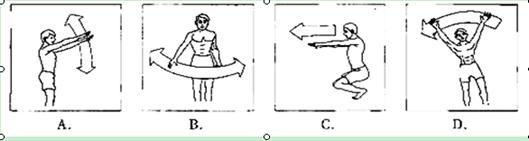
【小题2】 What can we learn from the passage?
| A.Swinging your arm from side to side means "yes". |
| B.If the ground is dark, light smoke can't be seen. |
| C.If you need some medicine, make a symbol "II". |
| D.The pilots make replies with a blue light at night. |
| A.The explanation of building signals on an island. |
| B.The importance of making signals on an island. |
| C.Ways of sending out signals on a lonely island. |
| D.Ways of receiving signals from a lonely island |
We drink tea every day. But more than three hundred years ago most of the people in Europe (欧洲) did not know anything about tea. Some people heard about it, but very few of them know what to do with it.
There is a story about an English sailor (水手) who went to countries in the east, the west and the south. He went to India and China. One day he came home and brought some tea as a present for his mother. She told her friends about the present and asked them to a "tea party". When her friends came to the "tea party", the old woman gave them brown tea-leaves. The old woman's friends began to eat them. Of course, nobody liked the tea-leaves.
At that time the sailor came in. He looked at the table and said, "Mother,what did you do with the tea?"
"I boiled it,as you said."
"And what did you do with the water?"
"I threw it away(扔掉),of course." answered the old woman.
"Now you may throw away the leaves,too," said her son.
【小题1】Most of the people in Europe ___300 years ago.
| A.drank tea every day | B.knew everything about tea |
| C.knew nothing about tea | D.liked to eat the tea-leaves |
| A.countries in the west | B.countries in the south |
| C.India or China | D.a tea shop in England |
A. the sailor told her to.
B she liked to show off (炫耀)
C. she wanted to ask her friends what to do with the tea
D. she wanted to taste the tea together with her friends
【小题4】At the "tea party",___.
| A.all the woman's friends spoke highly of (高度评价)the tea. |
| B.nobody knew what to do with the tea |
| C.the woman didn’t eat the tea-leaves |
| D.the woman gave her friends each a glass of tea water |
| A.boiled the tea | B.did as the sailor said |
| C.threw away the water | D.didn't throw away the tea-leaves |