网址:http://m.1010jiajiao.com/timu_id_1188401[举报]
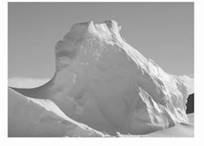 At the bottom of the world lies a mighty continent still wrapped in the Ice Age and, until recent times, unknown to man. It is a great landmass with mountain ranges whose extent and elevation are still uncertain. Much of the continent is a complete blank on our maps. Man has explored, on foot, less than one percent of its area.
Antarctica differs fundamentally from the Arctic regions. The Arctic is an ocean, covered with drifting packed ice and hemmed in by the landmasses of Europe, Asia, and North America. The Antarctica is a continent almost as large as Europe and Australia combined, centered roughly on the South Pole and surrounded by the most unobstructed water areas of the world—the Atlantic, Pacific, and Indian Oceans.
The continental ice sheet is more than two miles high in its center; thus, the air over the Antarctica is far more iced than it is over the Arctic regions. This cold air current from the land is so forceful that it makes the nearby seas the stormiest in the world and makes unlivable those regions whose counterparts (配对物) at the opposite end of the globe are livable. Thus, more than a million persons live within 2, 000 miles of the North Pole in an area that includes most of Alaska, Siberia, and Scandinavia—a region rich in forest and mining industries. Apart from a handful of weather stations, within the same distance of the South Pole there is not a single tree, industry or settlement.
66. The best title for this passage would be________ .
A. Iceland
B. Land of Opportunity
C. Utopia at Last
D. The Unknown Continent
67. At the time this article was written, our knowledge about Antarctica was______.
A. very limited B. vast
C. fairly rich D. non-existent
68. What’s the fundamental difference between Antarctica and the Arctic?
A. The Arctic is an ocean while Antarctica is a continent.
B. The Arctic is inhabited by people while Antarctica is uninhabitable.
C. The Arctic is covered with ice while Antarctica is surrounded by water.
D. The Arctic is surrounded by continents while Antarctica is bordered by oceans.
69. The Antarctica is made uninhabitable primarily by________.
A. ice B. calm seas
C. cold air D. lack of water
70. According to this article,________ .
A. 2, 000 people live on the Antarctica Continent
B. a million people live within 2, 000 miles of the South Pole
C. weather conditions make settlements impractical
D. only a handful of natives inhabit Antarctica
查看习题详情和答案>>At the time my son was born in 1956, I shared a hospital room with a young woman who bore a boy on the same day. Partly because my parents 46 a shop selling flowers, the room was soon 47 with the lovely scent of roses.
As the seventh floral arrangement was 48 , I was beginning to feel 49 , for no flowers had arrived for my roommate, Ann. She sat on the edge of her bed and leaned forward to admire the 50 bouquet. She was a pretty young woman, yet there was something about her large, brown eyes that made me think she had known too much 51 , too much sadness for one so young. I had the feeling she had always had to admire someone else’ 52 .
“I’m enjoying every 53 of this”, she said as though she had read my 54 and was trying to reassure me. “Wasn’t I the lucky one to get you for a 55 ?”
I still felt uncomfortable, however. 56 there were some magic button I could push to 57 the sadness in her eyes. Well, I thought, at least,I can see that she has some flowers. When my mother and father came to see me that day, I asked them to send 58 some.
The flowers arrived just 59 Ann and I were finishing supper.
“More flowers for you,” she said, 60 .
“No, not this time,” I said, looking at the 61 “These are for you.”
Ann stared at the blossoms a long time, not saying anything. She ran her 62 across the pale blue bouquets and 63 touched each of the sweet roses as though trying to engrave(刻画) them on her 64 .
“How can I ever thank you” she said softly.
I was almost embarrassed. It was such a little 65 on my part.
| 【小题1】 |
|
| 【小题2】 |
|
| 【小题3】 |
|
| 【小题4】 |
|
| 【小题5】 |
|
| 【小题6】 |
|
| 【小题7】 |
|
| 【小题8】 |
|
| 【小题9】 |
|
| 【小题10】 |
|
| 【小题11】 |
|
| 【小题12】 |
|
| 【小题13】 |
|
| 【小题14】 |
|
| 【小题15】 |
|
| 【小题16】 |
|
| 【小题17】 |
|
| 【小题18】 |
|
| 【小题19】 |
|
| 【小题20】 |
|
At the time my son was born in 1956, I shared a hospital room with a young woman who bore a boy on the same day. Partly because my parents 46 a shop selling flowers, the room was soon 47 with the lovely scent of roses.
As the seventh floral arrangement was 48 , I was beginning to feel 49 , for no flowers had arrived for my roommate, Ann. She sat on the edge of her bed and leaned forward to admire the 50 bouquet. She was a pretty young woman, yet there was something about her large, brown eyes that made me think she had known too much 51 , too much sadness for one so young. I had the feeling she had always had to admire someone else’ 52 .
“I’m enjoying every 53 of this”, she said as though she had read my 54 and was trying to reassure me. “Wasn’t I the lucky one to get you for a 55 ?”
I still felt uncomfortable, however. 56 there were some magic button I could push to 57 the sadness in her eyes. Well, I thought, at least,I can see that she has some flowers. When my mother and father came to see me that day, I asked them to send 58 some.
The flowers arrived just 59 Ann and I were finishing supper.
“More flowers for you,” she said, 60 .
“No, not this time,” I said, looking at the 61 “These are for you.”
Ann stared at the blossoms a long time, not saying anything. She ran her 62 across the pale blue bouquets and 63 touched each of the sweet roses as though trying to engrave(刻画) them on her 64 .
“How can I ever thank you” she said softly.
I was almost embarrassed. It was such a little 65 on my part.
|
1. |
|
|
2. |
|
|
3. |
|
|
4. |
|
|
5. |
|
|
6. |
|
|
7. |
|
|
8. |
|
|
9. |
|
|
10. |
|
|
11. |
|
|
12. |
|
|
13. |
|
|
14. |
|
|
15. |
|
|
16. |
|
|
17. |
|
|
18. |
|
|
19. |
|
|
20. |
|
查看习题详情和答案>>
At the time my son was born in 1956, I shared a hospital room with a young woman who bore a boy on the same day. Partly because my parents 1a shop selling flowers, the room was soon 2with the lovely scent of roses.
As the seventh floral arrangement was3, I was beginning to feel4, for no flowers had arrived for my roommate, Ann. She sat on the edge of her bed and leaned forward to admire the5bouquet. She was a pretty young woman, yet there was something about her large, brown eyes that made me think she had known too much6, too much sadness for one so young. I had the feeling she had always had to admire someone else’7.
“I’m enjoying every8of this”, she said as though she had read my9and was trying to reassure me. “Wasn’t I the lucky one to get you for a10?”
I still felt uncomfortable, however.11there were some magic button I could push to12 the sadness in her eyes. Well, I thought, at least,I can see that she has some flowers. When my mother and father came to see me that day, I asked them to send13some.
The flowers arrived just14Ann and I were finishing supper.
“More flowers for you,” she said,15.
“No, not this time,” I said, looking at the16“These are for you.”
Ann stared at the blossoms a long time, not saying anything. She ran her17across the pale blue bouquets and18touched each of the sweet roses as though trying to engrave(刻画) them on her19 .
“How can I ever thank you” she said softly.
I was almost embarrassed. It was such a little20on my part.
- 1.
- A.attended
- B.owed
- C.absorbed
- D.owned
- A.
- 2.
- A.full
- B.filled
- C.crowd
- D.involved
- A.
- 3.
- A.brought out
- B.brought up
- C.brought down
- D.brought in
- A.
- 4.
- A.convenient
- B.enjoyable
- C.attractive
- D.uncomfortable
- A.
- 5.
- A.newest
- B.last
- C.latest
- D.largest
- A.
- 6.
- A.struggling
- B.admiring
- C.delighting
- D.thrilling
- A.
- 7.
- A.bouquets
- B.shops
- C.family
- D.money
- A.
- 8.
- A.minute
- B.day
- C.week
- D.month
- A.
- 9.
- A.ideas
- B.opinions
- C.thoughts
- D.dreams
- A.
- 10.
- A.friend
- B.sister
- C.roommate
- D.colleague
- A.
- 11.
- A.Before long
- B.Long before
- C.If only
- D.Only if
- A.
- 12.
- A.take apart
- B.take away
- C.take out
- D.take in
- A.
- 13.
- A.her
- B.him
- C.them
- D.us
- A.
- 14.
- A.when
- B.while
- C.as
- D.before
- A.
- 15.
- A.wondering
- B.assisting
- C.laughing
- D.explaining
- A.
- 16.
- A.basket
- B.floor
- C.window
- D.card
- A.
- 17.
- A.mouth
- B.fingers
- C.face
- D.eyes
- A.
- 18.
- A.delightedly
- B.instantly
- C.curiously
- D.lightly
- A.
- 19.
- A.friendship
- B.memory
- C.feeling
- D.description
- A.
- 20.
- A.sympathy
- B.kindness
- C.emotion
- D.mercy
- A.
When we look at the sky and see a bright light moving quickly across it or coming towards the earth, we talk about seeing a “shooting star” or a “falling star”. These moving lights are not, in fact, stars at all. They are small pieces of matter from outer space, which burn up as they enter the Earth’s atmosphere. The correct name of them is meteoroids. Any pieces that make it to the Earth’s surface without completely burning up are known as meteorites. A meteor is actually the name given to the light we see when a meteoroid is burning up.
When a meteorite hits the Earth at speeds between 11 and 72 kilometers a second, it can do amazing damage. A very large meteorite could knock the earth out of its orbit. If this happened, all life on Earth would probably become extinct(灭绝). The path we follow around the Sun would change and as a result the Earth would become either much hotter or much colder. This change in temperature would affect sea levels and the amount of water in rivers. There would either be huge floods, which would cover most of the land with water, or the oceans would dry up and there would be a drought, which means a long period of time without rain. Either way, nothing could survive. If a large meteorite landed in the sea it would almost certainly cause tsunamis, which would race towards the land, destroying everything in their paths.
Although it is unlikely the Earth will be struck by a meteorite large enough to do that kind of damage, there is evidence of fairly large meteorites hitting the Earth in the past. In 1908 a large area of forest in Tunguska, Siberia was destroyed by a meteorite that came apart just before it hit the ground. The moon, however, has about three billion craters陨石坑caused by meteorites impacting影响 its surface. The reason more meteorites have reached the surface of the moon than the surface of the Earth is that the moon does not have enough atmosphere for the meteorites to burn up in. some of the meteorites that have reached the Earth’s surface have done considerable damage. Some scientists believe it was a change of climate caused by meteorites hitting the Earth that resulted in the extinction of the dinosaurs and other large prehistoric animals.
Scientists are especially interested in meteorites because they contain information about the solar system. It is widely believed by scientists that most meteorites are produced by collisions(碰撞) between asteroids (small planets). These collisions probably happened many billions of years ago. This means the physical and chemical structure of a meteorite can give scientists information about the early days of the universe.
【小题1】The story is about ___.
| A.floods caused by meteors |
| B.matter from outer space |
| C.life on Earth millions of years ago |
| D.meteorites that have damaged the moon |
| A.three billion craters |
| B.fewer craters than the moon |
| C.more craters than the moon |
| D.a thinner atmosphere than the moon |
| A.they were hit by meteors |
| B.meteorites landed on their nests |
| C.meteorites landed and changed the climate |
| D.they could no longer breathe the atmosphere |
| A.small planets |
| B.the same as asteroids |
| C.from broken parts of asteroids |
| D.the light we see when meteoroids hit our atmosphere |