网址:http://m.1010jiajiao.com/timu3_id_2905584[举报]
听力(30分)
Ⅰ.听句子,选择正确的图片。
(每小题1分,共5分)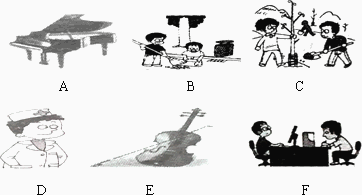
1.________ 2.________ 3.________ 4.________ 5.________
Ⅱ.
听句子,选择恰当的答语。(每小题1分,共5分)6.A.Thank you.
B.Of course not.
C.That's all right.
7.A.Turn off, and you’ll see it on your right.
B.It is very comfortable.
C.Don’t ask me.
8.A.It sounds beautiful.
B.No, I don’t.
C.Yes, I’d love to.
9.A.I like your hair.
B.My hair is black.
C.Yes, I did.
10.A.Because I like you.
B.I like watching TV.
C.Because it’s not a good idea.
Ⅲ.听对话,选择正确答案。
(每小题1分,共10分)听第一段对话,完成第11小题
11.Whom did Kate get her bag from?
A.Her parents.
B.Her uncle.
C.Her friend.
听第二段对话,完成第12小题
12.When will the plane take off?
A.At 10∶05.
B.At 10∶20.
C.At 10∶35
听第三段对话,完成第13小题
13.Where was Simon born?
A.In America.
B.In Australia.
C.In England.
听第四段对话,完成第14-15小题
14.Where are they probably?
A.In a classroom.
B.In a shop.
C.In a hospital.
15.How long has the man been like this?
A.For one day.
B.For two days.
C.For three days.
听第五段对话,完成第16-17小题
16.Who is collecting waste paper?
A.The girl.
B.Lin Tao.
C.Kangkang.
17.What is the advantage of collecting waste paper?
A.Protecting our environment.
B.Raising money.
C.Both A and B.
听第六段对话,完成第18-20小题
18.What does the boy want to know?
A.Chinese culture.
B.Chinese food.
C.Chinese students’ school life.
19.What do the Chinese students do on the morning of the school days?
A.They read Chinese or English.
B.They listen to the English tapes.
C.They do their homework.
20.What will they do after the talk?
A.They will learn English hard.
B.They will learn Chinese hard.
C.They will help each other in language learning.
Ⅳ.听短文,选择最佳答案。(每小题1分,共5分)
21.Life today has ________.
A.many problems.
B.few problems.
C.no problem.
22.One of the biggest problems today is ________.
A.population
B.pollution
C.education.
23.________ is the most serious kind of pollution.
A.Noise pollution.
B.Air pollution.
C.Water pollution.
24.The speaker mentions(提到)________ rules to fight pollution.
A.four.
B.five.
C.six.
25.________ makes us become angry more easily.
A.Air pollution.
B.Water pollution.
C.Noise pollution.
Ⅴ.听短文,完成下面表格。每空一词。(每小题1分,共5分)
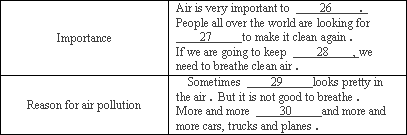
听力
Ⅰ.听句子,选出与句子意思相符的图片。每个句子读两遍。

1.________ 2.________ 3.________ 4.________ 5.________
Ⅱ.听对话,选答案。听下面
10段对话,每段对话后有一个或几个小题,从题中所给的A、B、C三个选项中选出最佳选项。每段对话读两遍。听第一段对话,回答第
6小题。6.What class is Li Lei in?
A.Class 3.
B.Class 4.
C.Class 5.
听第二段对话,回答第7小题。
7.How much is the watch?
A.24 dollars.
B.25 dollars.
C.52 dollars.
听第三段对话,回答第8小题。
8.What does the man think of the movie?
A.Wonderful.
B.Boring.
C.Interesting.
听第四段对话,回答第9小题。
9.Why does Jim have a headache?
A.He had a cold.
B.He was caught in a rain.
C.He went to bed late.
听第五段对话,回答第10小题。
10.How old is Kangkang's sister?
A.14.
B.16.
C.18.
听第六段对话,回答第11、12小题。
11.Where are the two speakers talking?
A.In a restaurant.
B.In a bus station.
C.In a shop.
12.What are they talking about?
A.A coat.
B.A dress.
C.A skirt.
听第七段对话,回答第13、14小题。
13.Where was the man last month?
A.Sydney and Paris.
B.Paris and Tokyo.
C.New York and Sydney.
14.What did the woman do last month?
A.She worked all the time.
B.She went to Australia.
C.She went home.
听第八段对话,回答第15、16小题。
15.What time will the woman leave?
A.At 2∶00.
B.At 12∶00.
C.At 11∶00.
16.How much is one ticket to New York?
A.$60.
B.$16.
C.$30.
听第九段对话,回答第17、18小题。
17.In Jim's opinion, what is the most useful invention?
A.Computer.
B.TV set.
C.Plane.
18.What will the speakers do right now?
A.Begin to make an invention.
B.Go to their teacher for some help.
C.Find some information on the Internet.
听第十段对话,回答第19、20小题。
19.Why is the boy happy?
A.He will spend the weekend with his friends.
B.He and his friend are going hiking on East Hill.
C.He got high marks in the last exam.
20.What will the girl do this weekend?
A.Go to a movie.
B.Study at home.
C.Watch TV at home.
Ⅲ.听短文,选择正确答案。听短文,从题中所给的A、B、C三个选项中选出最佳选项。短文读两遍。
21.Jane's uncle's farm is ________.
A.near her home
B.far away from her school
C.far away from her home
22.How many kinds of animals are mentioned(提到)?
A.Two.
B.Three.
C.Four.
23.Why do they like reading on the farm?
A.It is quiet there.
B.They can enjoy clean air.
C.They can watch the animals.
24.Where is the lake?
A.On the right.
B.On the left.
C.In the center.
25.What do they like doing at the weekend?
A.Swimming.
B.Skating.
C.Fishing.
Ⅳ.听短文填单词。听短文,根据短文内容在空格中填入恰当的单词(每空一词)。短文读三遍。

一、听录音:选择你所听到的字母或单词.每小题读一次.(本大题共5小题,每小题1分,共5分)
1.A.B
B.V
C.G
2.A.F
B.M
C.L
3.A.black
B.thank
C.bag
4.A.orange
B.dinner
C.ice cream
5.A.eight chickens
B.seven pears
C.seven carrots
二、你将听到5个句子,请选出与句子内容相符的图画选项.每小题读一次.(每小题1分,共5分)
6.

7.

8.

9.

10.

三、听问题,选出正确的答语.每小题读一次.(本大题共5小题,每小题1分,共5分)
11.A.Yes, this is.
B.Yes, I am.
C.No it isn’t.
12.A.Yes, it is.
B.No, I don’t.
C.Thank you.
13.A.Thank you.
B.OK.
C.You’re welcome.
14.A.Nice to meet you.
B.Fine, thank you.
C.How do you do?
15.A.No, it isn’t
B.It’s a watch.
C.Thank you.
四、听对话,回答问题.每小题读两次.(本大题共5小题,每小题1分,共5分)
听第一段对话,回答16-17小题.
16.What’s the boy’s family name?
A.Jim.
B.Kate.
C.Green
17.How many people are mentioned(提到)in the dialogue(对话)?
A.Three.
B.Four.
C.Five.
听第二段对话,回答18-20小题.
18.What’s the first name of the woman?
A.Henry
B.Helen
C.Brown
19.What’s the woman’s telephone number?
A.2809006.
B.2889006.
C.2880906.
20.Where do you think they’re talking(交谈)?
A.At the lost and found
B.In the shop
C.At home.
五、听对话,填入正确的词,使对话完整.每小题读两次.(本大题共5小题,每小题1分,共5分)
A:Hi, Jim!Do you 21 soccer?
B:Yes, I like soccer and basketball.
A:Do you like tennis too?
B:Yes, I do.My 22 and I play tennis.
A:Do you have a tennis racket?
B:Yes.But 23 is my tennis racket?
A:Oh, do you have a basketball?
B:Yes, I 24 .
A:OK, Let’s play basketball.
B:That 25 good!
出关与毕侍郎①笺(清)洪亮吉
自渡风陵,易车而骑,朝发蒲坂,夕宿盐池,阴云蔽亏,时雨凌厉。自河以东,与关内稍异。土逼若衖②,涂危入栈。原林黯惨,疑披谷口之雾;衢歌哀怨,恍聆山阴之笛。
日在西隅,始展黄君仲则殡于运城西寺,见其遗棺七尺,枕书满箧,抚其吟案,则阿妳③之遗笺尚存;披其繐帷④,则城东之小史既去。盖相如病肺⑤,经月而难痊;昌谷⑥呕心,临终而始悔者也。犹复丹锅狼藉,几案纷披,手不能书,画之以指。此则杜鹃欲化,犹振哀音,鸷鸟将亡,冀留劲羽,遗弃一世之务,留连身后之名者也。
伏念明公生则为营薄宦,死则为恤衰亲,复发德音,欲梓遗集。一士之成,玉成终始,闻之者动容,受之者沦髓⑦。冀其游岱之魂,感恩而西顾;返洛之旐⑧,衔酸而东指。又况龚生竟夭,尚有故人;元伯虽亡,不无死友。他日传公风义,勉其遗孤,风兹来祀⑨,亦盛事也。
今谨上其诗及乐府共四大册。此君平生与亮吉雅故,惟持论不同,尝戏谓亮吉曰:“予不幸早死,集经君订定,必乖余之旨趣矣。”省其遗言,为之堕泪。今不敢辄加朱墨,皆封送阁下,暨与述庵廉使、东友侍读,共删定之。即其所就,已有可传,方乎古人,无愧作者。惟稿草皆其手写,别无副本,梓后尚望付其遗孤,以为手泽耳。
亮吉十九日已抵潼关,马上率启,不宣⑩。
【注】 ①毕侍郎:毕沅,乾隆时进士,官至湖广总督。②衖,同“巷”。 ③阿妳:母亲。④繐帷:灵账。 ⑤相如病肺:据《史记》载,司马相如“常有消渴疾。”消渴疾,如糖尿病,古人误以为肺病。⑥昌谷:唐朝诗人李贺 ⑦论髓:即沦肌浃髓,比喻感受之深。⑧旐:画龙蛇的旗,此指出丧时的灵旌。⑨风兹来祀:即劝勉后人。风“同讽”,劝。⑩率启:草率地禀告。不宣:不尽,即书不尽意的意思,旧书信的结尾词。
【小题1】对下列句子中加点的词的解释,不正确的一项是(3分)( )
| A.自渡风陵,易车而骑易:改换 | B.盖相如病肺病:疾病 |
| C.复发德音,欲梓遗集。梓:出版 | D.必乖余之旨趣矣。乖:背离 |
①遗弃一世之务,留连身后之名者也 ②生则为营薄宦
③省其遗言,为之堕泪 ④死则为恤衰亲
⑤复发德音,欲梓遗集 ⑥梓后尚望付其遗孤,以为手泽耳
| A.①②⑥ | B.①③④ | C.③④⑤ | D.②④⑤ |
| A.文章开始写旅途匆匆行踪,挚友新亡,心中苦悲;但作者没有孤立地去写这种心情,而是在描述沿途景象中,在情景交融中表现了哀伤之情。 |
| B.文章第二段将料理丧事的经过写得比较简单,但在泛泛地讲述事情时将丧事的处理和对挚友的回忆、评价、悼念,紧密结合在一起;同时也表达了对毕侍郎的感激之情。 |
| C.信中说:“盖相如病肺,经月而难痊;昌谷呕心,临终而始悔者也。”即是对黄仲则刻苦作诗的赞扬,也是对他不爱护身体的委婉批评。平日这样刻苦作诗,临终时必然对自己的诗作非常重视了,所以信中又说:“杜鹃欲化,犹振哀音;鸷鸟将亡,冀留劲羽。” |
| D.这封信感情诚挚,用典贴切,生动感人,从中不仅可以学习为文之法,也可以学习为友之道。 |
(1)见其遗棺七尺,枕书满箧,抚其吟案,则阿妳之遗笺尚存。(3分)
(2)此君平生与亮吉雅故,惟持论不同,尝戏谓亮吉曰。(3分) 查看习题详情和答案>>
听力
(共20小题;每小题1分,满分20分)A)听句子,根据所听内容,将下列图片排序,有一幅图片是多余的。(听两遍)

1.________ 2.________ 3.________ 4.________ 5.________
B)听对话,选择最佳答案。(听两遍)
6.Which club does Kate join?
A.The Singing Club.
B.The Reading Club.
C.The Dancing Club.
7.Which subject is Helen’s favourite?
A.Maths.
B.Computer Studies.
C.Geography.
8.Who is the tallest boy in Mike’s class?
A.Jim.
B.Simon.
C.Mike.
9.Who has the most flowers of the three?
A.Tom.
B.Kate.
C.Ann.
10.Which city is Mr.Tang’s hometown?
A.Shanghai.
B.Nanjing.
C.Beijing.
C)听对话和短文回答问题。(听两遍)
听第一段对话,回答
1-2题11.What is Jack doing?
A.He is writing a book about animals.
B.He is reading a book about wild animals.
C.He is reading a storybook.
12.Why does Jack like squirrels best?
A.Because they are beautiful.
B.Because they sing songs nicely.
C.Because they prepare food for the future.
听第二段对话,回答3-5题
13.What are they talking about?
A.The weather of the weekend.
B.Going swimming at the weekend.
C.Their plans for the weekend.
14.What will the weather be like at the weekend?
A.Sunny.
B.Rainy.
C.Cloudy.
15.What would Millie like to do?
A.Go swimming.
B.Go shopping.
C.Stay at home.
D)听一篇短文,回答6-10题。(听两遍)
16.Where did Jim and his friends meet on Sunday morning?
A.In front of the school building.
B.Outside the school gate.
C.At the bus stop.
17.How did they go to the mountains?
A.On foot.
B.By bus.
C.By bike.
18.When did they get to the mountains?
A.At 6∶30 a. m.
B.At 10∶00 a. m.
C.At 6∶00 p. m.
19.What did they see after they got to the mountains?
A.There were thousands of apple trees.
B.The river was full of fish.
C.The birds were singing in the trees.
20.What did Jim find in the mountains?
A.A strange stone.
B.Some hot drinks.
C.A beautiful picture.