网址:http://m.1010jiajiao.com/timu3_id_2847079[举报]
A person has been badly injured in a car accident. It is necessary to give him a transfusion (输血) because he has lost much blood in the accident. However, special care must be taken in selecting new blood for him. If the blood is too different from his own, the transfusion can kill him.
There are four basic blood groups: A, B, AB and O. A single test can tell us a person’s blood group. Everybody is born with one of these four blood groups. People’s blood group, like hair colour, is inherited (继承) from parents.
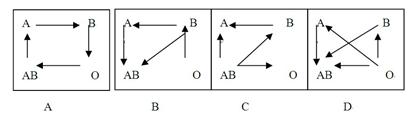
Because the substances contained in each group are different, transfusion must be given carefully. Basically, A and B cannot be mixed. A and B cannot receive AB, but AB may receive A or B. O can be given to any other group, so it is often called the universal donor. On the contrary, AB is sometimes called the universal recipient (接受者). However, before being given the transfusion, patients usually receive only salt or plasma (血浆) until their blood can be matched as exactly as possible. In this way, it is possible to avoid any bad results of the transfusion.
There is a relationship between our blood groups and our nationalities. Among the Europeans, about 42 percent are blood group A while 45 percent are blood group O. The rarest is blood group AB. However, some American Indian groups are nearly 100 percent blood group O.
1.Which of the following shows the correct relationship in blood transfusion? (→ =" giving" blood to)

2.Usually, before being given a transfusion, ________.
A.a person needs to receive salt or plasma first
B.a person needs to have a good rest
C.a person needs to have a lot of food and water
D.a person needs to find the person with the same blood group as him
3.The third most common blood type among the Europeans is _______.
A.A B.B C.AB D.O
4.Which is NOT right according to the passage?
A. A person’s blood group depends on his parents.
B. There is only one kind of blood group in a person’s body.
C. About 13 percent of the Europeans have blood group AB.
D. Most of American Indians can be universal blood donors.
5.Which is the best title for the passage?
A.Blood transfusion B.Blood groups
C.Car accidents D.Blood group and nationalities
查看习题详情和答案>>
A person has been badly injured in a car accident. It is necessary to give him a transfusion (输血) because he has lost much blood in the accident. However, special care must be taken in selecting new blood for him. If the blood is too different from his own, the transfusion can kill him.
There are four basic blood groups: A, B, AB and O. A single test can tell us a person’s blood group. Everybody is born with one of these four blood groups. People’s blood group, like hair colour, is inherited (继承) from parents.
Because the substances contained in each group are different, transfusion must be given carefully. Basically, A and B cannot be mixed. A and B cannot receive AB, but AB may receive A or B. O can be given to any other group, so it is often called the universal donor. On the contrary, AB is sometimes called the universal recipient (接受者). However, before being given the transfusion, patients usually receive only salt or plasma (血浆) until their blood can be matched as exactly as possible. In this way, it is possible to avoid any bad results of the transfusion.
There is a relationship between our blood groups and our nationalities. Among the Europeans, about 42 percent are blood group A while 45 percent are blood group O. The rarest is blood group AB. However, some American Indian groups are nearly 100 percent blood group O.
【小题1】Which of the following shows the correct relationship in blood transfusion? (→ =" giving" blood to) 
【小题2】Usually, before being given a transfusion, ________.
| A.a person needs to receive salt or plasma first |
| B.a person needs to have a good rest |
| C.a person needs to have a lot of food and water |
| D.a person needs to find the person with the same blood group as him |
| A.A | B.B | C.AB | D.O |
A. A person’s blood group depends on his parents.
B. There is only one kind of blood group in a person’s body.
C. About 13 percent of the Europeans have blood group AB.
D. Most of American Indians can be universal blood donors.
【小题5】Which is the best title for the passage?
| A.Blood transfusion | B.Blood groups |
| C.Car accidents | D.Blood group and nationalities |
Much of our good health depends on the cooperation(协同作用) between substances(物质). When they work together ,chemical reactions(反应) take place smoothly. Body systems are kept in balance. Some of the most important helpers in the job of good health are the substances we call vitamins.
Vitamin A is needed to produce a light –sensitive substance in the eyes. People who do not get enough vitamin A can’t see well in the dark. The best source(来源) of vitamin A is fish liver oil. It is also found in the yellow part of eggs. What’s more, squash, sweet potatoes, carrots and other darkly colored fruits and vegetables contain substances that the body can change into vitamin A.
Vitamin B-1 is also called thiamine. It changes starchy foods into energy. It also helps the heart and nervous system work smoothly. Without it, we would be weak and would not grow. Thiamine is found not just in whole grains like brown rice, but also in other foods. These include beans and peas, nuts and meat and fish.
VitaminB-12 is needed so folic acid can do its work. Together , they help produce red blood cells. Without them, a person suffers from anemia(贫血)。VitaminB-12 is found naturally in foods such as eggs, meat, fish and milk products.
Vitamin C is necessary for strong bones and teeth, and for healthy blood vessels. It also helps wounds heal quickly. The body stores very little Vitamin C. so we must get it very day in foods such as citrus, tomatoes and uncooked cabbage.
Vitamins
| Kinds of vitamins | Functions | ___1____ | Problems caused by lack of of it |
| Vitamin A | Helping prevent poor2__ at night. | Fish liver oil, vegetables Colored fruits, etc. | Unable to _3__ well at night |
| Vitamin B-1 | Helping the digestive system, good for the smooth work Of the __4_____ and _5____ systems | Whole grains, beans, nuts meat and fish | Poor health and slow _6__ |
| Vitamin B-12 | Helping prevent a __7__dieasease called anemia | _8__foods like eggs, meat,fish and milk products | Anemia |
| Vitamin C | A must for strong bones and teeth and healthy blood vessels | The body doesn’t store __9____. From citrus, tomatoes and uncooked cabbages. | Not to be _10_____ |
There are four basic blood groups: A, B, AB and O. A single test can tell us a person’s blood group. Everybody is born with one of these four blood groups. People’s blood group, like hair colour, is inherited (继承) from parents.
Because the substances contained in each group are different, transfusion must be given carefully. Basically, A and B cannot be mixed. A and B cannot receive AB, but AB may receive A or B. O can be given to any other group, so it is often called the universal donor. On the contrary, AB is sometimes called the universal recipient (接受者). However, before being given the transfusion, patients usually receive only salt or plasma (血浆) until their blood can be matched as exactly as possible. In this way, it is possible to avoid any bad results of the transfusion.
There is a relationship between our blood groups and our nationalities. Among the Europeans, about 42 percent are blood group A while 45 percent are blood group O. The rarest is blood group AB. However, some American Indian groups are nearly 100 percent blood group O.
小题1:Which of the following shows the correct relationship in blood transfusion? (→ =" giving" blood to)
小题2:Usually, before being given a transfusion, ________.
| A.a person needs to receive salt or plasma first |
| B.a person needs to have a good rest |
| C.a person needs to have a lot of food and water |
| D.a person needs to find the person with the same blood group as him |
| A.A | B.B | C.AB | D.O |
A. A person’s blood group depends on his parents.
B. There is only one kind of blood group in a person’s body.
C. About 13 percent of the Europeans have blood group AB.
D. Most of American Indians can be universal blood donors.
小题5:Which is the best title for the passage?
| A.Blood transfusion | B.Blood groups |
| C.Car accidents | D.Blood group and nationalities |
2, 000 years ago, the Greek doctor Hippocrates advised his patients to chew on the bark and leaves of the willow. The tree contains a chemical called salicin. In the 1800s, researchers discovered how to make salicylic acid from the chemical. In 1897, a chemist named Felix Hoffmann at Friedrich Bayer and Company in Germany created acetyl salicylic acid. Later, it became the active substance in a medicine that Bayer called aspirin. The "a" came from acetyl. The "spir" came from the spirea plant, which also produces salicin. And the "in" ? That is a common way to end medicine names.
In 1982, a British scientist shared the Nobel Prize in Medicine in part for discovering how aspirin works. Sir John Vane found that aspirin prevents the body from making the natural substances called prostaglandins. Prostaglandins have several effects on the body. Some cause pain and swelling(肿). Prostaglandins also make the heart, kidneys(肾) and blood vessels work well. So there is a problem. Aspirin works against all prostaglandins, good and bad. It can also harm the inside of the stomach, and sometimes it can cause bleeding.
But a British study released in 2009 suggested that taking another drug with a small amount of aspirin may help reduce the risk of bleeding. If this proves true, it would help thousands of people who are seeking to prevent life-threatening conditions.
小题1: The writer wrote this passage to______.| A.tell us the harm of aspirin |
| B.help us know aspirin better |
| C.explain why aspirin is useful |
| D.prove that aspirin is a good medicine |
小题2:What do we learn about aspirin from Paragraph 1?| A.It is not used until recent years. |
| B.Using it for a long time may lead to cancer. |
| C.It is very dangerous if it is used in the wrong way, |
| D.It has gained important new uses in recent years. |
| A.about 2,000 years ago. | B.In the early 1800s. |
| C.In the late 1800s | D.In recent years |
| A.The bleeding caused by taking aspirin. |
| B.How to reduce the risk of getting colorectal cancer. |
| C.How to help patients with colon cancer live longer |
| D.The problem of low body temperature caused by taking aspirin |