网址:http://m.1010jiajiao.com/timu3_id_2845290[举报]
请根据下面图片和对话内容,选择最佳答案。
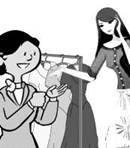
|
On Sale T-shirts 88 yuan 65 yuan Dresses 185 yuan 158 yuan Pants 90 yuan 70 yuan Skirts 60 yuan 56 yuan |
Saleswoman: May I help you, Madam?
Kailey: Yes, please. This dress looks very nice. How much is it?
Saleswoman: It’s only 158 yuan.
Kailey: Really? Is it on sale?
Saleswoman: Yes, it’s usually 185 yuan, but only 158 yuan on Sundays.
Kailey: Great. I’ll buy two dresses for my cousins. They like this kind of dresses.
Saleswoman: What color do they like?
Kailey: Red.
Saleswoman: Oh, I’m sorry. We don’t have any red ones. How about the blue ones?
Kailey: All right. I’ll take them.
Saleswoman: Thanks.
1. Two T-shirts are on Monday.
A.130 yuan. B.176 yuan.
C.120 yuan. D.112 yuan.
2.文中划线词语“on sale”的汉语意思为 .
A.减价销售 B.正常营业 C.高价回收 D.非卖品
3.Kailey buys two for her cousins.
A.white pants B.green shirts
C.blue dresses D.T-shirts
4.If Kailey buys three on Sunday here, they will cost(花费)her 168 yuan.
A.T-shirts B.dresses C.pants D.skirts
5.Which is RIGHT?
A.They are at home now.
B.The T-shirt is only 56 yuan.
C.Kailey’s cousins like red.
D.The skirts are 60 yuan on Sunday
查看习题详情和答案>>
看图填空,一空一词(含缩写词)。

1.What time is it now?
It' s o' clock in the .
2.How' s the weather?
a day.
3.Where are these people?
They are at a
4.Is the place in this picture a busy and crowded one?
No, it __, because only persons are there.
5.What do you think they are doing?
I think they are a bus.
查看习题详情和答案>>
请认真阅读下面短文,并根据短文内容回答问题。
Dear Helen,
Thanks for your last letter. Yes, I’m enjoying myself on my exchange program in France. It’s even better than I thought it would be. I was a bit nervous before I arrived here, but there was no reason to be. My host family are really nice. They go out of their way to make me feel at home. And you wouldn’t believe how quickly my French has improved! I’m very comfortable speaking French now. Although I still make lots of mistakes, it doesn’t make me worried as it used to. My biggest challenge (挑战) is learning how to behave (表现) at the dinner table. As you can imagine, things are really not the same as the way they are at home. For example, you shouldn’t put your bread on your plate. You should put it on the table! I thought that was very strange at first, but now I’m used to it. You shouldn’t eat anything with your hands except bread, not even fruit! (You have to cut it up and eat it with a fork.) Another thing is that it is very rude to say you’re full. If you don’t want any more food, you should just say, “It was delicious.” Also, it’s rude to put your hands in your lap. You should always keep your hands, but not your elbows (肘部), on the table. I have to say, I find it difficult to remember everything, but I’m gradually getting used to things and don’t find them so strange any more.
I’ll write soon and tell you more about life in France. Hope you’re having a good school year.
Yours,
Li Ying
【小题1】Where is Li Ying now?
【小题2】What does Li Ying think of her host family?
【小题3】How does Li Ying feel while she is speaking French now?
【小题4】When can Li Ying eat things with her hands there?
【小题5】Why do you want to go there if you have the chance to take part in an exchange program?
(请自拟一句话作答)
Mobile phone use among children has become a problem for the schools this year. Several children have got mobile phones as Christmas presents, and more students want them.
Mary Bluett, an official(官员), said mobile phone use is a distraction(分心) to students during school hours and it also gives teachers so much trouble in their classrooms. Teachers were also saying that sometimes students might use phone messages to cheat during exams.
She said some schools had tried to ban mobile phones. Some parents felt unhappy, because they couldn’t get in touch with their children.
Many teachers said students should not have mobile phones at school, but if there was a good reason, they could leave their phones at school office. They also said there were many reasons why the students should not have mobile phones at school; they were easy to lose and were a distraction from studies.
Many people say that they understand why parents would like their children to have phones, but they think schools should let the students know when they can use their mobile phones.
【小题1】Some middle schools in Australia have banned students from carrying mobile phones ____.
| A.because they are students | B.when they are free |
| C.when they are at school | D.because they are children |
| A.the makers and sellers |
| B.the passers-by and strangers |
| C.their parents and friends |
| D.some mobile phone users |
| A.聊天 | B.核对 | C.查询 | D.作弊 |
| A.use their mobile phones |
| B.leave their mobile phones at school office |
| C.help the teachers with their work |
| D.get in touch with their children |
| A.students shouldn’t have mobile phones at school except for some special reasons |
| B.it is impossible to ban students from using mobile phone at school |
| C.some parents felt unhappy because they couldn’t Use their phones at school |
| D.parents should teach their children how to use mobile phones during school hours |
Alice is an American girl. She has two good friends. One is Tom, the other is Jim. They come from the same country. They are studying in Beijing now. They are at the same school-- No.2 Middle School. They have a lot of Chinese friends here. They go to school from Monday to Friday. They go to school at seven in the morning. They all go to school by subway. In the evening, they do their homework and learn Chinese. On Saturdays and Sundays they go to their friends’ homes. There they learn more Chinese from their Chinese friends and their friends learn English from them.
Sometimes they write to their parents in America. They tell them about China and their life in China. They all like living here . They want their parents to come to China one day.
【小题1】Alice , Tom and Jim come from .
| A.England | B.Europe | C.the USA | D.different countries |
| A.Four. | B.Five | C.Six | D.Seven |
| A.They want to eat Chinese food at their homes. |
| B.They want to play with them. |
| C.They want to make friends with their parents. |
| D.They want to learn Chinese from them. |
| A.In America. | B.In England. | C.In China. | D.We don’t know. |
A. Something about China. B.Their life in China.
C. To ask their parents to come to China. D.A,B and C. 查看习题详情和答案>>