网址:http://m.1010jiajiao.com/timu3_id_2842580[举报]
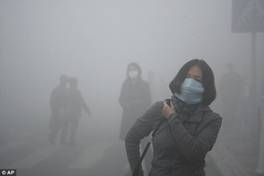
The air pollution was so bad in Harbin, in China, on October 21,2013 that the city had to close roads and schools, and cancel* hundreds of flights from its airport.
News reports said the smog (a mixture of smoke and fog) was so thick that people couldn’t see more than 10 or 20 metres in front of them.
It is also said that people could not even see the person standing next to them. The city’s website said: “You can’t see your own fingers in front of you.”
The local people said there was a “burning” smell in the air. Many people covered their noses and mouths with scarves or masks*.
The pollution was caused on several factors* including: farmers burning off old corn stalks* and crop stubble*; coal*-fired heating systems; and low winds that allowed the smoke to remain over the city.
The smog had been building up for several days. It became worse when the city turned on the public heating system, which uses coal to heat millions of homes and offices in the city.
Harbin has a population of more than 10 million people. It lies in northeastern China, where cold winter weather can last up to six months. The main fuel* there is coal, because it is cheaper than other types of fuel.
Air pollution from burning coal can cause health problems like heart disease. During the smog crisis* in Harbin, the number of people taken to the hospital with breathing problems was 30% higher than usual.
The city government is trying to reduce its use of coal by adding more insulation* and better roofs and windows to buildings to reduce heating needs. It has also used cleaner fuel for cars and factories.
1.The roads and schools in Harbin had to be closed on October 21, 2013 because of ____
A. the heavy rain B. the strong wind C. the serious smog D. the terrible snow
2.There are many reasons for the air pollution EXCEPT____________.
A. farmers burn off old corn stalks and crop stubble
B. people use coal to heat millions of homes and offices
C. The smoke remains over the city because of low winds
D. Many buses and cars use cleaner fuel and so do factories.
3. What is the government trying to do when the air pollution get worse?
A. To offer cars new fuel. 
B. To give people more masks.
C. To reduce its use of coal.
D. To ask people to stay at home.
4.What does the passage mainly tell us?
A. The serious air pollution in China
B. Coal-fired heating systems
C. The population crisis in Harbin
D. The reasons for heart disease
查看习题详情和答案>>

The air pollution was so bad in Harbin, in China, on October 21,2013 that the city had to close roads and schools, and cancel* hundreds of flights from its airport.
News reports said the smog (a mixture of smoke and fog) was so thick that people couldn’t see more than 10 or 20 metres in front of them.
It is also said that people could not even see the person standing next to them. The city’s website said: “You can’t see your own fingers in front of you.”
The local people said there was a “burning” smell in the air. Many people covered their noses and mouths with scarves or masks*.
The pollution was caused on several factors* including: farmers burning off old corn stalks* and crop stubble*; coal*-fired heating systems; and low winds that allowed the smoke to remain over the city.
The smog had been building up for several days. It became worse when the city turned on the public heating system, which uses coal to heat millions of homes and offices in the city.
Harbin has a population of more than 10 million people. It lies in northeastern China, where cold winter weather can last up to six months. The main fuel* there is coal, because it is cheaper than other types of fuel.
Air pollution from burning coal can cause health problems like heart disease. During the smog crisis* in Harbin, the number of people taken to the hospital with breathing problems was 30% higher than usual.
The city government is trying to reduce its use of coal by adding more insulation* and better roofs and windows to buildings to reduce heating needs. It has also used cleaner fuel for cars and factories.
小题1:The roads and schools in Harbin had to be closed on October 21, 2013 because of ____
| A.the heavy rain | B.the strong wind | C.the serious smog | D. the terrible snow |
| A.farmers burn off old corn stalks and crop stubble |
| B.people use coal to heat millions of homes and offices |
| C.The smoke remains over the city because of low winds |
| D.Many buses and cars use cleaner fuel and so do factories. |
| A.To offer cars new fuel. |
| B.To give people more masks. |
| C.To reduce its use of coal. |
| D.To ask people to stay at home. |
| A.The serious air pollution in China |
| B.Coal-fired heating systems |
| C.The population crisis in Harbin |
| D.The reasons for heart disease |
On Saturday, heavy haze(霾)still covered north and east China. Highways were closed and couldn’t take off on time.
The smoggy weather the country’s land from north to south, including Beijing, Hebei, Shandong, and 6 other provinces. People could only see clearly than 50 meters in some areas.
Cities Shanghai and Nanjing have been covered by the gray sky for the past several days. Many walkers in the street had to wear . In the Lukou airport in Nanjing, more than 60 flights were canceled(取消) on Saturday the haze, which also made primary and middle schools and kindergartens stop on Thursday and Friday in Nanjing.
The office worker of Environmental Protection said earlier this week that there were several reasons behind the widespread haze: unpleasant weather conditions making difficult for smog to disappear, motor vehicle exhaust(尾气), and coal use for winter heating.
To fight pollution, the Chinese government now plans to clean up the air by cutting coal use, some factories, and removing 6 million old cars from the roads.
“We must face up to the facts,” said Yan Naiqiang, a professor of environmental science at Shanghai Jiao Tong University. “The treatment of smog will be a long fight. From now on, if we use buses or cars less and do more riding, we believe a clear sky is not a faraway dream.”
| 小题1: |
|
| 小题2: |
|
| 小题3: |
|
| 小题4: |
|
| 小题5: |
|
| 小题6: |
|
| 小题7: |
|
| 小题8: |
|
| 小题9: |
|
| 小题10: |
|