网址:http://m.1010jiajiao.com/timu3_id_2835863[举报]
听力 共20分
第一节 听小对话,选择符合对话内容的图片(5分)
1.Which present will the man buy for his sister?
A.
B.
C.
2.What would the woman like to collect?
A.
B.
C.
3.Where is Jack going this weekend?
A.
B.
C.
4.What was Betty doing when the accident happened?
A.
B.
C.
5.What will the weather be like tomorrow?
A.
B.
C.
第二节 听较长的对话,选择最佳答案。(5分)
听第一个较长对话,回答第6-7小题。
6.When is the girl's mom's birthday?
A.May 11th
B.May 12th
C.May 13th
7.How does the girl's mom usually go to work?
A.By bike
B.By bus
C.On foot
听下面一段较长对话,回答第8-10小题。
8.What's wrong with Peter?
A.He had a bad cold.
B.His arm was broken.
C.His leg was broken.
9.Where did the accident happen?
A.In the street.
B.In the school.
C.In the hospital.
10.How long does Peter have to stay in hospital?
A.A few days.
B.A few weeks
C.A few months.
第三节 听独白,完成信息记录表(10分)

11.
A.For 2 years
B.For 3 years
C.For 4 years
12.
A.In China
B.In America
C.In Africa
13.
A.Interesting and cheap
B.Cute and special
C.Cute and cheap
14.
A.Wash dishes
B.Read newspapers
C.Clean the room
15.
A.Every day
B.On Wednesday
C.On weekends
听力(20分)
第一节:听小对话,请从A、B、C三个选项中选择符合对话内容的图片。(本题共5分,每小题1分)。
1.What is the boy going to buy tomorrow?
A.
B.
C.
2.What does Bob want to be?
A.
B.
C.
3.What will the weather be like tomorrow?
A.
B.
C.
4.Which city will Alice travel to if she is free?
A.
B.
C.
5.What's John's favorite sport ?
A.
B.
C.
第二节:听小对话.,请从A、B、C三个选项中选择最佳的选项(本题共5分,每小题1分)
6.What are the students doing?
A.Playing football
B.Playing basketball
C.Playing table tennis
7.Will the woman buy a small car?
A.Yes, she does
B.No, she won't.
C.Yes, she will.
8.How will the man go to Beijing?
A.By bus.
B.By plane..
C.By train
9.What is Linda going to do this Sunday?
A.She is going to visit her grandparents.
B.She is going to visit her mother.
C.She is going to visit the Forbidden City
10.What's Daming's favourite festival?
A.Mid-autumn Day
B.Spring Festival.
C.Christmas.
第三节:听独白,请从A、B、C三个选项中选择正确的选项,完成信息记录表。(本题共10分,每小题2分)

11.A.1
B.3
C.5
12.A.my teacher
B.my father
C.my mother
13.A.wishes and love
B.wishes and hobbies
C.hobbies and love
14.A.at least 60
B.at least 80
C.at least 100
15.A.before Monday
B.before Sunday
C.before Saturday
听力理解
一、听对话,选择与对话内容相符的图片,将代表图片的字母填写在相应序号后的括号内。每段对话读两遍。(共6分,每小题1分)
请看第一组的四幅图片,听三段对话,回答第1~3小题。

请看第二组的四幅图片,听三段对话,回答第4~6小题。

二、听对话或独白,根据对话或独白内容,从下列各题所给的选项中,选择正确答案。对话或独白朗读两遍。(共12分,每小题1.5分)
听第一段对话,回答第7~8小题。
7.Where are the two speakers?
A.In a classroom.
B.In a bank.
C.In a shop.
8.What does the woman want to do?
A.To change a sweater.
B.To borrow a sweater.
C.To wash a sweater.
听第二段对话,回答第9~11小题。
9.How does the man go to Chicago?
A.By air.
B.By train.
C.By sea.
10.Which meal does the man want to have?
A.Breakfast.
B.Lunch.
C.Supper.
11.How soon will the man be at home?
A.In two hours.
B.In three hours.
C.In four hours.
听一段独白,回答第12~14小题。
12.What’s the new problem in the country?
A.“Left-behind”children seldom get care from the government.
B.“Left-behind”children seldom get together with their parents.
C.“Left-behind”children cannot get any love from their parents.
13.Who probably look after the children whose parents have moved to work in cities?
A.Their teachers.
B.Their neighbours.
C.Their grandparents.
14.What does Wen Jiabao require local(当地的)governments to do?
A.To do more for“left-behind”children and their parents.
B.To let the schools in cities receive“left-behind”children.
C.To make the local people stop going to work in cities.
三、听下面的一段独白,根据题目要求在相应题号后的横线上记录关键信息。独白读三遍。(共8分,每小题2分)(注:生词manners礼貌,礼节)

听力部分(共20分)
第一节:听录音,选出你所听到的音标。(每小题念两遍,5分)
1.
A./nais/
B./ka:/
C./fain/
2.
A./hed/
B./fel/
C./gud/
3.
A./ru:l/
B./g?:l/
C./blu:/
4.
A./gri:n/
B./pen/
C./ki:/
5.
A./si:/
B./pig/
C./big/
第二节:听句子,选出与你所听内容相符的图片。(每小题念两遍,5分)
6.
A.
B.
C.
7.
A.
B.
C.
8.
A.
B.
C.
9.
A.
B.
C.
10.
A.
B.
C.
第三节:听句子,选择相应的答语。(每小题念两遍,5分)
11.
A.S-O-N.
B.He's a son.
C.I'm my parents’ son.
12.
A.Yes, she is.
B.Yes, he is.
C.No, she isn't.
13.
A.Yes, he is.
B.No, it isn't.
C.Yes, they are.
14.
A.It's a photo.
B.Yes, it's a ring.
C.She's my sister.
15.
A.It's a photo of my family.
B.You’re welcome.
C.He's my father.
第四节:听对话,回答问题。(每小题念两遍,5分)
16.What color is Kate's hat?
A.red
B.green
C.yellow来
17.How old is Gina?
A.13
B.12
C.11
18.What's the boy's family name?
A.Tom
B.Tom Smith
C.Smith
19.What's Linda's telephone number?
A.7658-432
B.7658-342
C.6757-349
20.Who is that?
A.His cousin
B.His father
C.His uncle
听力(25分)
一、听对话选图片(本题共5小题,每题1分,共5分)
第一节、听小对话,选择图片(本题有5小题,每题1分,共5分)
1.Which is Kate’s favorite sport?

2.How’s the weather now?

3.What does Emma want to be?

4.Which city is Ann going for holiday?

5.What’s wrong with the woman?

第二节、听对话,回答问题(本题共5小题,每题2分,共10分)
6.What are Jenny’s favorite animals?
A.Koalas
B.Monkeys
C.Pandas
7.What time does the shop close every afternoon?
A.At seven
B.At six.
C.At eight
8.Where’s the woman?
A.In a hotel.
B.In a hospital.
C.At a train station
9.How long does the man have to wait for the next subway?
A.Ten minutes.
B.Fifteen minutes.
C.Twenty minutes.
10.Who’s Linda?
A.The girl in a red coat.
B.The girl in a yellow sweater.
C.We don’t know.
第三节、听独白,请根据问题从A、B、C三个选项中选择正确的选项,完成信息记录表。(本题共5小题,每题2分,共10分)
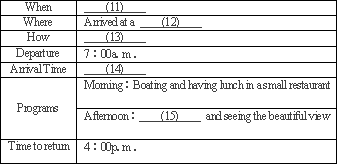
11.A.October 5
B.October 3
C.October 13
12.A.a lake
B.a mountain
C.a restaurant
13.A.by bus
B.by bike
C.by train
14.A.6∶00p. m.
B.7∶00a. m.
C.8∶00a. m.
15.A.picking apples
B.climbing a mountain
C.seeing some pictures