网址:http://m.1010jiajiao.com/timu3_id_2831145[举报]

However, he lost his courage when a lovely young woman opened the door. He only asked for a drink of water. She thought he looked hungry so she brought him a large glass of milk. He drank it slowly, and then asked, "How much do I pay you?"
"You don't pay me anything," she replied. "Mother has taught me never to accept the pay for a kindness." He said, "Then I thank you from the bottom of my heart." As Howard Kelly left that house, he not only felt stronger physically*, but it also increased his believe in God and the whole human. He was about to give up and stop before this point.
Years later the young woman became fairly ill. The local doctors had no idea to deal with her illness. They finally sent her to the big city, where specialists* can be called in to study her strange disease. Dr. Howard Kelly, now famous was called in for the consultation*. When he heard the name of the town she came from, a light filled his eyes. Immediately, he got up and went down through the hospital hall into her room. Dressed in his doctor's uniform he went in to see her. He recognized her at once. He went back to the consultation room and decided to do his best to save her life. From that day on, he gave special attention to her.
After Howard Kelly and his workmates worked hard for a long time, they won and the woman was saved. Dr. Kelly asked the business office to pass the final bill to him for agreement. He looked at it and then wrote something on the side. The bill was sent to her room. She was afraid to open it because she was sure that it would take the rest of her life to pay it off. Finally she looked, and the note on the side of the bill caught her attention. She read these words:
"Paid." (Signed) Dr. Howard Kelly
Tears of happiness came down out of her eyes as she prayed* silently: "Thank You, God. Your love has reached everywhere through hearts and hands of the human beings."
小题1:Little Kelly felt when the woman opened the door for him.
| A.surprised | B.excited | C.upset | D.happy |
| A.she wasn’t badly ill |
| B.Dr. Kelly helped her a lot and paid for her cost |
| C.the cost for her disease is only the cost for a glass of milk |
| D.other people knew that she was kind and gave her a hand |
| A.Dr. Kelly lived a poor life when he was young. |
| B.Little Kelly was thankful when he left the woman’s house. |
| C.Dr. Kelly didn’t remember the woman at all. |
| D.The woman believed in God very much when she saw the words written by Dr. Kelly. |
| A.The Boy And The Woman | B.A Glass of Milk |
| C.A Sick Woman | D.A Strange Disease |
Suddenly she saw an old woman by the side of the road, holding her hand out as if (好像) she wanted
a lift.
“I can’t leave her out in this weather,” the woman said to herself, so she stopped the car and
opened the door.
“Do you want a lift?” she asked. The old woman nodded (点头) and climbed into the car. After
a while, she said to the old woman, “Have you been waiting for a long time?” The old woman moved
her head from side to side. “Strange,” thought the young woman. She tried again. “Bad weather for
the time of year,” she said. The old woman nodded. No matter what the young woman said, the
hitchhiker (搭便车的人) gave no answer except
 for a nod of the head.
Then the young woman noticed the hitchhiker’s hands, which were large and hairy. Suddenly she
realized the hitchhiker was in fact a man! She stopped the car. “There is something wrong with the car,” she said, “Would you mind getting off and helping me?” The hitchhiker nodded and opened the door.
As soon as the hitchhiker was out of the car, the frightened young woman raced off.
When she got to the next village she stopped her car. She noticed that the hitchhiker had left his
handbag behind. She picked it up and opened it. To her surprise, there was a gun (枪) inside the bag.
B. she knew the old woman very well
C. she knew where the old woman lived
D. she wanted to help the old woman o
 ut
B. a ride in the car
C. an offer of cleaning cars
D. something run by electricity
B. The fact that the “old woman” was unable to speak.
C. The fact that the “old woman” gave no answer to her questions.
D. The fact that the “old woman” had large and hairy hands.
B. there was something wrong with her car
C. the hitchhiker had a gun in his handbag
D. the hitchhiker knew how to drive her car
B. he didn’t expect (料想) the woman would drive the car away without him
C. he wanted to warn the young woman not to drive to the police station
D. he wanted to kill the young woman and her family with the gun
Twenty years ago, I drove a taxi for a living. One night I went to pick up a passenger at 2:30 AM. When I arrived there, I walked to the door and knocked, “Just a minute,” answered a weak, elderly voice.
After a long pause, the door opened. A small woman in her eighties stood before me. By her side was a small suitcase.
When we got into the taxi, she gave me an address, and then asked, “Could you drive through downtown?”
“It’s not the shortest way,” I answered quickly.
“Oh, I’m in no hurry,” she said. “I’m on my way to a hospice(临终医院). I don’t have any family left. The doctor says I don’t have very long.”
I quietly reached over and shut off the meter(计价器).
For the next two hours, we drove through the city. She showed me the building where she had once worked, the neighborhood where she had lived, and the furniture shop that had once been a ballroom where she had gone dancing as a girl.
Sometimes she’d ask me to slow down in front of a special building and would sit staring into the darkness, saying nothing.
In the early morning, she suddenly said,” I’m tired. Let’s go now.”
We drove in silence to the address she had given me.
“How much do I pay you?” she asked.
“Nothing.” I said.
“You have to make a living,” she answered. “Oh, there are other passengers,” I answered.
Almost without thinking, I gave her a hug(拥抱). She held on me and said, “You gave an old woman a little moment of joy.”【小题1】The old woman chose to ride through the city in order to ______.
| A.show she was familiar with the city |
| B.see some places for the last time |
| C.let the driver earn more money |
| D.reach the destination on time |
【小题2】The taxi driver did not get the money because he ______.| A.wanted to give her a hand |
| B.shut off the meter by mistake |
| C.had received her payment already |
| D.was in a hurry to take other passengers |
【小题3】What can we learn from the story?| A.No pains, no gains. |
| B.People should respect(尊重) each other. |
| C.An act of kindness can bring people great joy. |
| D.People should learn to enjoy our life. |
When you cough or sneeze, you’d better turn your head away from others and cover your mouth with the full part of your hand. And then, you should say, “Excuse me.”
This seems so simple, but it is surprising how many kids have never been told to do this. Actually, I notice adults all the time who cough and sneeze in public without placing a hand over the mouth. One important thing I point out to the kids is that after they sneeze or cough on their hands, they should wash their hands as soon as possible. If not, they will be passing those germs(细菌)along to everything and everyone they touch.
If you come to a door and someone is following you, hold the door. If the door opens by pulling, pull it open, stand to the side, and allow the other person to pass.
After a few weeks of seeing kids try to get through doors in the school and watching them enter restaurants as the door hit other people, I knew I had to discuss the problem with my students. Teaching them small acts of kindness, such as letting someone else go through a door first as they hold it open, may seem unimportant, but it can go a long way toward helping students realize how to be polite and think others. Once they’ve been told, they’re halfway there.
When we have to go up moving stairs, we will stand to the right. That will give others who are in a hurry a choice of walking up the left-hand side of the moving stairs. When we are going to enter a lift, the underground, of a doorway, we will wait for others to exit before we enter.
After college when I moved to London, I was surprised at how polite everyone was in the subways. I was even more touched when I traveled to Japan. In both places, people made effort to make way for others. On moving stairs, everyone stood to the right and walked to the left. On lifts, everyone would stand over to the side and allow others to exit before they would begin to enter.
【小题1】When you cough or sneeze, you should _________.
| A.touch everything | B.cover your mouth |
| C.point out to the kids | D.pass the germs to others |
| A.hold the door | B.pass through | C.close the door | D.stand to the side |
| A.doctor | B.traveler | C.parent | D.teacher |
| A.the rules of behavior in public |
| B.the ways of communication |
| C.the acts of kindness among people |
| D.the knowledge of social life |
When you cough or sneeze, you’d better turn your head away from others and cover your mouth with the full part of your hand. And then, you should say, “Excuse me.”
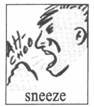
This seems so simple, but it is surprising how many kids have never been told to do this. Actually, I notice adults all the time who cough and sneeze in public without placing a hand over the mouth. One important thing I point out to the kids is that after they sneeze or cough on their hands, they should wash their hands as soon as possible. If not, they will be passing those germs (细菌) along to everything and everyone they touch.
If you come to a door and someone is following you, hold the door. If the door opens by pulling, pull it open, stand to the side, and allow the other person to pass through first, then you can walk through. If the door opens by pushing, hold the door after you pass through.
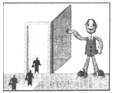
After a few weeks of seeing kids try to get through doors in the school and watching them enter restaurants as the door hit other people, I knew I had to discuss the problem with my students. Teaching them small acts of kindness, such as letting someone else go through a door first as they hold it open, may seem unimportant, but it can go along way toward helping students realize hot to be polite and thank others. Once they’ve been told, they’re halfway there.
When we have to go up moving stairs, we will stand to the right. That will give others who are in a hurry a choice of walking up the left-hand side of the moving stairs. When we are going to enter a lift, the underground, or a doorway, we will wait for others to exit before we enter.
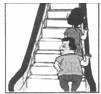
After college when I moved to London, I was surprised at how polite everyone was in the subways. I was even more touched when I traveled to Japan. In both places, people made efforts to make way for others. On moving stairs, everyone stood to the right and walked to the left. On lifts, everyone would stand over to the side and allow others to exit before they would begin to enter.
1. When you cough or sneeze, you should ________.
A. touch everything B. cover your mouth
C. point out to the kids D. pass the germs to others
2. If you come to a door and someone is following you, you’d better _______.
A. hold the door B. pass through
C. close the door D. stand to the side
3. From the passage we ca know the writer is a ________.
A. doctor B. traveler C. parent D. teacher
4. A. The passage is mainly about ______.
A. the rules of behavior in public B. the easy of communication
C. the acts of kindness among people D. the knowledge of social life
查看习题详情和答案>>