网址:http://m.1010jiajiao.com/timu3_id_2815162[举报]
I don’t remember much about we learned in her class, but my mother once told me that we write a lot. And I would bring back what I wrote and she could see there were so many mistakes. no red corrections. And always a star. Sometimes even a Good! It worried my mother, so one day she went to Mrs White and asked her why she corrected my mistakes.
And my mother says Mrs White said “The children are just to get excited about using words, about forming sentences. I don’t want to lose the interests with red ink(墨水). and grammar can wait. The wonder of won’t... ”.Maybe she didn’t say it exactly like that at that moment. And what my mother gave me was the main idea of what she could remember.
I now and think Mrs White must have been a rather teacher. She encouraged joy, wonder and excitement — even if our expression of it was . Because she believed a bud(花蕾)once nipped(掐断) never opens.
I used to misspell “beautiful” a lot. Never could quite remember that the e went the a. It annoyed my teacher in high school very much. If I was going to use the word so often, she considered the I could do was spell it right. Finally the e’s and a’s were in their right places. Am glad I didn’t wait on them though. Pretty is to spell but it doesn’t hold as much as you mean sometimes.
And Mrs White I had no worries about writing what I meant. Because Life isn’t Pretty. It’s Baeutiful.
| 小题1: |
|
| 小题2: |
|
| 小题3: |
|
| 小题4: |
|
| 小题5: |
|
| 小题6: |
|
| 小题7: |
|
| 小题8: |
|
| 小题9: |
|
| 小题10: |
|
| 小题11: |
|
| 小题12: |
|
| 小题13: |
|
| 小题14: |
|
| 小题15: |
|
| |||||||||||||||||||||||||||||||||||||||||||||||||||||||||||||||||||||||||
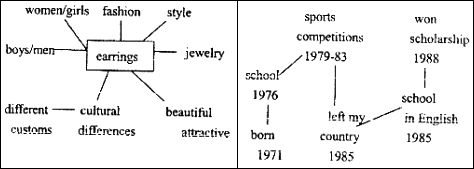
( )2.Did your teacher give you any advice?
( )3.What advice?
( )4.What do you do with your spelling?
( )5.How about your grammar and vocabulary?
A.Yes,he did.
B.About speaking more English in class or after class.
C.Oh,I always practise doing more reading and more exercises about them.
D.It's my English study plan,I am going to work hard this year.
E.I always check my spelling with a dictionary.
Reading comprehension(阅读理解)
“Memorize these words.” “Learn this spelling rule.” “Don't forget tomorrow's quiz(测验).” You remember things every day, but how do you do it?
You find a telephone number in the phone book, dial it, and then forget it. This is your short-term memory. It lasts less than 30 seconds. However, you don't look in the phone book for a friend's number. You know it. This is long-term memory. Your long-term memory has everything that you remember.
Why do you forget something? What is the reason? You did not learn it in the beginning. This is the major reason for forgetting. For example, you meet some new people, and you forget their names. You hear the names, but you do not learn them. Then you forget them.
You can remember better. Here are some ideas.
a.Move information from your short-term memory to your long-term memory. Practice the information. Say the information to yourself. Think about it. Spend time on it.
b.Over learn. After you learn something, study it some more. Learn it more than you need to. For example, when you know a list of new words, don't stop. Practice the words a few more times.
c.Be sure that you understand the information. It is difficult to memorize something you don't understand.
d.Do only one thing at a time. Study in a quiet place.
e.Try to connect the new information with something you already know. For example, when you learn the name of a new kind of food, think of a similar kind of food.
f.Divide(分开) the information into parts. Do not have more than seven parts. Learn one part and stop for a few minutes. Don't try to learn all the parts at the same time.
g.Make a picture in your mind. For example, maybe you see a new word. It is a kind of fruit. Make a picture in your mind of this fruit. Remember what it looks like.
h.Try to relax(放松) when you study. Enjoy it. You cannot remember things when you are tired or unhappy.
Some people have a photographic(照相机般的) memory. They see everything like a picture. Later they can see the picture in their mind again and describe everything in it. They can remember long lists of numbers and thousands of other things. Would you like to have a photographic memory?
True or False(判断下列句子是否符合短文内容,符合的用T表示,不符合的用F表示)
1.It is easy to memorize things that we don't understand.
( )
2.A short-term memory lasts only a minute.
( )
3.Your address is in your long-term memory.
( )
4.A photographer has a photographic memory.
( )
5.You can remember things well when you are glad and healthy.
( )
6.People who have a photographic memory can usually remember better.
( )
查看习题详情和答案>>I am a student in Grade Three. I began to learn English three years ago. English isn’t very 16 to learn. But I like it very much.
17 do I study English?
In the first year, I found 18 very difficult to memorize new words. At first I 19 a lot of time on them. I learned new words only 20 reading and writing. 21 a few days later I forgot them. Later, with the help of my teachers, I came to know how to do it well. I paid more attention to 22 and spelling. For example:

23 , I have learned a lot of new words. Every morning after I get up, I do some reading. At school I 24 to speak English with my classmates and go over 25 I have learned.
Nothing is too hard if you put your heart into it.
1.A.hard B. excited C. easy D. fast
2.A.Why B. What C. Unless D. How
3.A.this B. it C. that D. /
4.A.took B. paid C. spent D. cost
5.A.with B. for C. as D. by
6.A.And B. But C. Then D. However
7.A.pronunciation B. words C. reading D. writing
8.A.By the way B. In this way C. To begin with D. Later on
9.A.join B. lose C. try D. realize
10.A.that B. what C. which D. when
查看习题详情和答案>>