网址:http://m.1010jiajiao.com/timu3_id_2759562[举报]
Never go into a supermarket hungry! This is a good piece of advice. If you go shopping for food before lunchtime, you’ll probably buy more than you plan to. Unfortunately, however, just this advice isn’t enough for shoppers these days. Modern shoppers need an education in how and how not to buy things at the store. First, you check the weekly newspaper ads. Find out the items that are on sale and decide if you really need these things. In other words, don’t buy anything just because it’s cheaper than usual! Second, never let “New and Improved!” or “All Natural” on the front of a package influence you. Instead, read the list of contents on the back. Third,compare prices: that is, you should examine the prices of both different brands(品牌)and different sizes of the same brand.
Another suggestion for shoppers is to buy ordinary items instead of famous brands. Ordinary items in supermarkets come in plain packages. These products are cheaper because producers don’t spend much money on packing or advertising. However, they are still of high quality. In the same way, in buying clothes, you can often find high quality and low prices in brands that are not famous. Shopping in discount clothing stores can help you save a lot of money. Although these stores aren’t very attractive, and they usually do not have individual dressing rooms, not only are the prices low, but you can often find the same famous brands that you find in high-priced department stores.
Wise shoppers read magazine ads and watch TV commercials(商业广告),but they do this with one advantage: knowledge of the psychology behind the ads. In other words, will-informed shoppers watch for information and check for misinformation. They ask themselves questions: Is the advertiser hiding something in small print at the bottom of the page? Is there any real information in the commercial, or is the advertiser simply showing an attractive image? With the answers to these questions, shoppers can make a wise choice.
1. The author gives ________ suggestions to the shoppers in the passage.
A. Three B. Four C. Five D. Six
2.We can learn from the passage that ____________________.
A. ordinary items are not so attractive because of the lower prices .
B. we can’t buy items with words like “New and Improved” or “All Natural”.
C. the advertisers are always showing misinformation in the commercial.
D. the quality of ordinary items can be as good as that of famous brands.
3.The author’s main purpose of writing the passage is to advise shoppers _________________.
A. to buy ordinary items instead of famous brands
B. how to buy ordinary things in supermarkets
C. how to make a proper decision while shopping
D. not to believe advertisements or commercials
查看习题详情和答案>>
Raising virtual(虚拟) pets is a popular online game among teenagers.“More than 20 of my classmates have adopted(领养) pets online,??? ? last year the number was just 10,” said Wang, a 15-year-old student.
If you go to some websites, you can adopt virtual pets like penguins(企鹅), chickens, dogs and elephants. You can feed, wash, talk ?? ?? and play with your pet. Dai Yingshuang of Chongqing ??? ?? pets on Kaixin001.com. She said it was great ??? . She thinks that by looking after her pet she has also learned how to ??? ?? others.
But raising an online pet means one needs to ??? ?? a lot of time online. If one doesn’t feed and look after the pet, it becomes unhappy and unhealthy. There are? ??? ?? things an online carer must do. Some parents feel ??? ? . They are afraid that their children may be neglecting(忽视) their studies.
Wang Zhaotong of Anhui, has been raising a penguin on QQ.com since last year. The 14-year-old takes good care of the penguin, which is ??? ? healthy and happy. She said her parents knew about the penguin and think it’s okay. “They believe I can keep the balance between studying and playing,” said Wang. “During the school period, I ??? ? go online and see my penguin at the weekends.”
1.A. but?????????????? B. when?????????? C. or??????????? D. then
2.A. about???????????? B. to?? ?????????? C. of??????????? D. over
3.A. buys????????????? B. raises?????????? C. borrows?????? D. wants
4.A. fun?????????????? B. funny?????????? C. boring??????? D. frustrating
5.A. stay with????????? B. take care of?????? C. take care????? D. get on with
6.A. take????????????? B. pay???????????? C. spend???????? D. cost
7.A. the other????????? B. many other?????? C. the others????? D. others
8.A. worried?????????? B. happy?????????? C. tired????????? D. sad
9.A. neither??????????? B. nor???????????? C. both????????? D. either
10.A. also????????????? B. only???????????? C. always??????? D. never
查看习题详情和答案>>
根据短文内容判断句子正(T)误(F)。
Welcome to our school. Our school is on Xianyang Street. It’s next to the Xinhua Library. There is a big garden across from our school. The payphone is between our school and the post office. There are three buildings in our school, the students’ building, the teachers’ building and a library. The teachers in our school are good. Our school yard is very beautiful. If you come to our school from the airport, take a taxi and go along the highway until you see a bridge. Go across the bridge and turn left. Then go straight along the Bridge Street. Our school is on the right.
1.Our school is between the post office and the garden.
2.The big garden is on Xiangyang Street.
3.The pay phone is next to the post office.
4.If you go straight along the highway, you can get to our school.
5.The market is across from our school.
查看习题详情和答案>>
| |||||
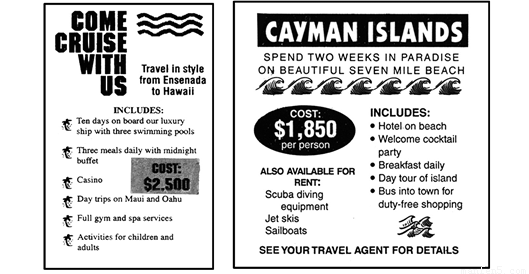
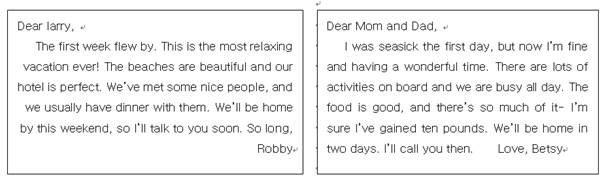
1.How long will you travel if you go to Cayman Islands?
A.Two weeks. B.Ten days. C.One day. D.Three days.
2.Where is Betsy travelling?
A.From Ensenada to Hawaii. B.On Cayman Islands.
C.On beach. D.At a shop.
3.Who is having a vacation on Cayman Island?
A.Betsy. B.Betsy’s parents. C.Larry. D.Robby.
查看习题详情和答案>>