摘要:III. 1. C 2. E 3. A 4. D 5. B
网址:http://m.1010jiajiao.com/timu3_id_2746942[举报]
从Ⅱ栏中找出与Ⅰ栏相对的答语。(5分)
| I | II | ||||
| 小题1:What’s her name? 小题2:Are you Alan? 小题3:What color is this? 小题4:What’s his telephone number? 小题5:Hello, I’m Jack. |
|
从II 栏中找出 I 栏的相应答语把编号写在前面的括号中。 10%
| I | II | ||||
| 小题1:What’s your name? 小题2:Is this your cousin? 小题3:What’s the weather like today? 小题4:How old is your friend Tom? 小题5:What color are your shoes? 小题6:Is there a sports hall at your school? 小题7:Has she got any beef at home? 小题8:What’s on the classroom wall? 小题9:Are Linda and Betty your friends? 小题10:What’s your mother? |
F. No, she hasn’t. G. A nurse. H. A map. I. Yes, it is. J. Fourteen. |
为研究细胞分裂素的生理作用,研究者将菜豆幼苗制成的插条插入蒸馏水中(图1).对插条的处理方法及结粱见图2.
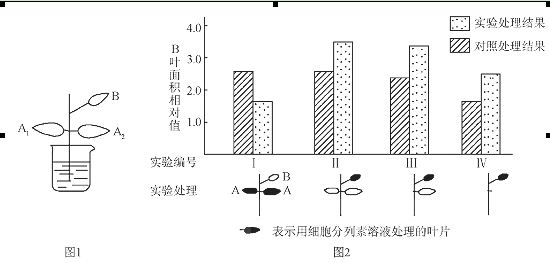
(1)细胞分裂素足一种植物激素。它是由植物体的特定部位_______,再被运输到作用部位,对生长发育起________作用的__________有机物。
(2)制备插条时除去根系和幼芽的主要目的是________:插条插在蒸馏水中而不是营养液中培养的原因是___________·
(3)从图2中可知,对插条进行的实验处理包括_______________。
(4)在实验I中,对A叶进行实验处理,导致B叶__________.该实验的对照处理是________。
(5)实验 、III、IV的结果表明,B叶的生长与A叶的关系是: ___________。
(6)研究者推测“细胞分裂素能够引起营养物质向细胞分裂素所在部位运输”。为证明此推侧,用图I所示插条去除B叶后进行实验,实验组应选择的操作最少包括______
(填选项前的符号).
a.用细胞分裂素溶液涂抹A1叶
b.用细胞分裂素溶液涂抹A2叶
c.用14C-淀粉溶液涂抹A1叶
d. 用14C-淀粉溶液涂抹A2叶
e. 用14C-氨基酸溶液涂抹A2叶
f. 用14C-细胞分裂素溶液涂抹A2叶
g. 检测A1叶的放肘性强度 查看习题详情和答案>>
(1)细胞分裂素足一种植物激素。它是由植物体的特定部位_______,再被运输到作用部位,对生长发育起________作用的__________有机物。
(2)制备插条时除去根系和幼芽的主要目的是________:插条插在蒸馏水中而不是营养液中培养的原因是___________·
(3)从图2中可知,对插条进行的实验处理包括_______________。
(4)在实验I中,对A叶进行实验处理,导致B叶__________.该实验的对照处理是________。
(5)实验
 、III、IV的结果表明,B叶的生长与A叶的关系是: ___________。
(6)研究者推测“细胞分裂素能够引起营养物质向细胞分裂素所在部位运输”。为证明此推侧,用图I所示插条去除B叶后进行实验,实验组应选择的操作最少包括______
(填选项前的符号).
a.用细胞分裂素溶液涂抹A1叶
b.用细胞分裂素溶液涂抹A2叶
c.用14C-淀粉溶液涂抹A1叶
d. 用14C-淀粉溶液涂抹A2叶
e. 用14C-氨基酸溶液涂抹A2叶
f. 用14C-细胞分裂素溶液涂抹A2叶
g. 检测A1叶的放肘性强度 查看习题详情和答案>>
从II栏选出与I栏相对应的答语
| I | II | ||||
| 小题1:How often do you go to the movies? 小题2:Are you as friendly as your sister? 小题3:Why can’t you go to the baseball game? 小题4:Where are you going to move? 小题5:Do you go shopping? |
|

Earthquake Intensity & Observed Effects(强度与现象)
I. Felt by only a few people under very special conditions.
II. Felt by only a few people at rest, especially on the upper floors of buildings.
III. Felt noticeably indoors, especially on upper floors of buildings.
IV. Felt indoors by many people, outdoors by a few; some awaked.
V. Felt by nearly everyone; many awaked; dishes and windows break; plaster (灰泥) cracks (开裂).
VI. Felt by everyone; many frightened and run outdoors; heavy furniture such as tables and shelves moves.
VII. Everyone runs outdoors; small to moderate (中等的) damage(损毁) in usual buildings.
VIII. Considerable (相当大的) damage in usual buildings; monuments(碑) fall.
IX. Considerable damage in all buildings; ground cracks; underground pipes (管道) break.
X. Most buildings damaged; rails bend(弯曲); landslides (山崩) take place; water splashes(溅落) over banks.
XI. Few buildings left standing; bridges damaged; wide cracks in the ground; underground pipes break.
XII. Damage total; waves seen on ground; objects thrown into air.
小题1:According to the picture, what is the possible position of the earthquake’s epicenter?
| A.36°N, 90°W. | B.36°N, 90°E. | C.90°N, 36°W. | D.90°N, 36°E. |
| A.Everyone runs outdoors. |
| B.Only a few people feel it. |
| C.Many people who stay indoors feel it. |
| D.Felt by people on the upper floors of buildings. |
| A.Cincinnati. | B.Louisville. | C.Pittsburgh. | D.Nashville. |
| A.Felt indoors by few people under very special conditions. |
| B.Few buildings left standing. |
| C.Felt noticeably indoors, especially on upper floors of buildings. |
| D.Felt indoors by many people, outdoors by a few, some awaked. |
| A.Nashville. | B.Louisville. | C.Syracuse. | D.Cincinnati. |