网址:http://m.1010jiajiao.com/timu3_id_2706367[举报]
is trying (努力) to study and speak it. He often tries to speak Chinese to his Chinese friends. Sometimes
they don't understand (理解) him, because he can't speak Chinese well.
One Saturday morning, Mike goes out. He is on his way to the park. He is going there to see a flower
show (展览). But he doesn't know how to get there. He asks a Chinese boy. The boy can't understand him.
Then he takes out a pen and some paper. He draws flowers on it, gives the picture to the boy and says
something about it. The boy smiles and then shows (指给) Mike the way to the park.
B. England
C. China
B. a little
C. little
B. speaking, friends
C. speaking, teachers
B. To see some flowers.
C. To a park.
B. He asks the way with a sigh (标志).
C. He draws a picture to ask the way.
| |||||||||||||||||||||||||||||||||||||||||||||||||||||||||||||||||||||||||
in Beijing. Though he enjoys his work, it is hard for him for relax after work."For a long time, I had no choice
except going to a bar for a drink and karaoke to relax myself," he said.
One day when he saw many toys in a toy shop, he had an idea. "Why not do some kind of things and relax
myself?" Then he began to make model planes, model ships and something else. The thing he has made by
himself doesn't look as professionally made as those in the shop, but he likes doing it."It is not as much fun
to play with things which are bought expensively from the shops," he said. Now his bookshelves are full of
many kinds of things he has made. They are very beautiful and friends like them very much.
More and more people are like Yang, making or creating things on their own. They like to do it themselves.
Though making things with our own hands, may take much time, some people, now known as DI Yers...
do-it-yourselfers, enjoy doing it very much. They can make all kinds of things they like.
DIY is becoming more and more popular in China. It may be to the young, yet many people remember
when it was once a way of life.
During 1960s and 1970s, when there were not enough living things for people to live on, they had to use
their own hands to do many things. Whitewashing the wall or making clothes was a part of life because there
was no other choice. If you want something done, you had to do it yourself, and if you needed something you
made it yourself. But times have changed and DIY has a1so different meanings.
B. Going to a bar for a drink and karaoke.
C. Whitewashing the wall.
D. Making something by himself.
B. they do it for fun
C. they need them in their life
D. they can't buy them anywhere
B. more and more people began to make model planes
C. between 1960s and 1970s, people liked making things themselves
D. more and more people begin to like Yang Chen
B. Planes bought from the shops are too expensive.
C. DIY is a good way of life.
D. DIY was a part of life in the past.
B. People had to make things by themselves during 1960s and 1970s.
C. DIY has different meaning now.
D. Yang wants to find a way to relax himself.
听力测试(25分)
(一)听问句,选答语。句子读一遍。
1.A.No, I collect stamps.
B.Yes, I do.I collect tickets.
C.No, I don’t collect painting.
2.A.Yes, I’m from London.
B.No, I’m from Beijing
C.I’m studying Chinese
3.A.We have a picnic
B.It’s raining now
C.It’s going to be sunny.
4.A.Watch the news.
B.See films
C.Listen to songs
5.A.Because I was ill
B.Because I didn’t have breakfast
C.Because I was afraid of dog.
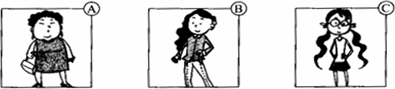
(二)听下面5段小对话.每段对话后有一个问题,从题中所给的A、B、C三幅图中,选出一幅与你所听内容相符合的选项。每段对话读两遍。
6.A.
B.
C.
7.A.
B.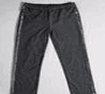
C.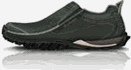
8.A.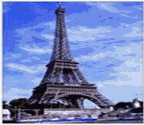
B.
C.
9.A.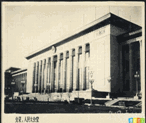
B.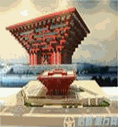
C.
10.A.
B.
C.
(三)听下面5段小对话。每段对话后有一个问题,从题中所给的A、B、C三个选项中选出最佳选项。每段对话读两遍。
11.A.Mary is doing his homework
B.Mary is playing cards.
C.Mary is playing the games.
12.A.Tom is playing computer games too much
B.Peter is chatting online too much
C.Peter is doing a lot of homework
13.A.England
B.China.
C.America
14.A.Yes, he was.
B.No.he wasn’t
C.No, he was a doctor.
15.A.In his uncle’s car
B.By plane
C.By ship
(四)听两段长对话,每段对话后都设有几个问题,从题中所给的A、B、C三个选项中选出最佳选项。每段对话读两遍。
听下面一段对话,回答16-17小题。
16.What does the girl want to send her friend for her birthday?
A.an e-mail
B.a letter
C.an e-card
17.Does Jenny’s father know how to send an e-card?
A.Yes, he does.
B.No, he doesn’t
C.It’s very easy.
再听第二段对话,回答18-20小题。
18.Why didn’t Adam like traveling?
A.Because he didn’t like flying.
B.Because he didn’t like taking ship
C.Because he didn’t like taking train.
19.Where did Adam want to go?
A.Paris
B.Australia
C.London
20.Who did Helen especially want to see?
A.Mum
B.Dad
C.Granny
(五)听录音,根据短文内容填入所缺的单词。
New Year’s Eve is a 21.________ time for us.We live in New York, and we often go to a big New Year’s Eve 22.________ in Times Square.We 23.________ with our friends and sing traditional songs while we wait for the New Year.Then suddenly, just before midnight, the music stops.We all 24.________ from ten to zero.Then the 25.________ begin.I love the bright lights, but the noise makes me jump.We all say “Happy New Year” to our friends.
听力(共30小题;每小题1分,满分30分)
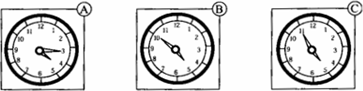
A.听对话,选出与所听意思相符的图画。听两遍。
1.What is Tom doing now?
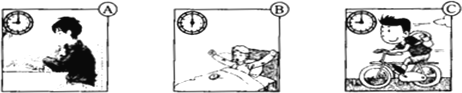
2.Where are the girls now?
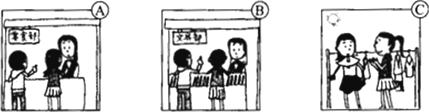
3.Which festival are they talking about?
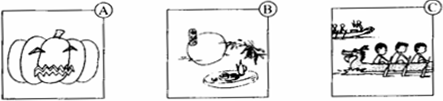
4.Who are they talking about?
5.What time is it now?
B.听下面七段对话,回答问题。听两遍。
6.Who likes playing computer games?
A.Jack’s brother.
B.Jack.
C.Nobody.
7.When can the man do some shopping?
A.On Tuesday afternoon.
B.On Thursday afternoon.
C.On Wednesday afternoon.
8.Who can’t go to Lee’s birthday party?
A.Jack.
B.Susan.
C.We don’t know.
9.What is the boy’s mother?
A.A driver.
B.A teacher.
C.A dancer.
10.When will the football match start?
A.After supper.
B.Right now.
C.At 2∶00 next morning.
11.Where is the boy?
A.In the football field.
B.In the street.
C.At the woman’s home.
12.What does the woman do every Sunday afternoon?
A.She runs around the lake.
B.She walks her dog.
C.She cleans her room.
C.听短文,完成13-15题信息记录。听两遍。
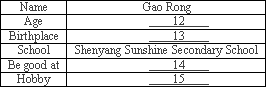
13.A.Shengyang
B.Shanghai
C.England
14.A.Chinese
B.English
C.Maths
15.A.basketball
B.football
C.volleyball
D.听下面的几段对话,回答问题。听两遍。
听第一段对话,回答16~18题。
16.How many restaurants are there?
A.One.
B.Two.
C.Three.
17.What kind of food does the man like to eat?
A.Chinese food.
B.Western food.
C.English food.
18.Where is the Chinese restaurant?
On the third floor.
B.On the seventh floor.
C.On the second floor.
听第二段对话,回答19~20题。
19.Where are they talking?
At home.
B.At school.
C.In a park.
20.What would Jack like to eat?
A.Some fish.
B.Some meat.
C.Some cakes.
听第三段对话,回答21~22题。
21.Where is the restaurant?
A.It’s in front of the school.
B.It’s next to the shop.
C.It’s behind the hospital.
22.Who does the woman go to the restaurant with?
A.Her son.
B.Her daughter.
C.Her father.
听第四段对话,回答23~25题。
23.Why is David so fat?
A.Because he doesn’t exercise.
B.Because he eats too much at lunchtime.
C.Because he watches TV all day.
24.What do we know about David?
A.He has too much for lunch.
B.He is busy but always does exercise.
C.He works all day for many hours.
25.What must David do to keep strong?
A.Work hard all day.
B.Play basketball.
C.Do exercise in the morning and evening.
E.听短文,回答26~30题。听两遍。
26.What is Ann doing in China?
A.She’s working.
B.She’s studying in a school.
C.She’s teaching in a school.
27.Who does Ann often play games with?
A.Her Chinese friends.
B.Her father and mother.
C.Her English friends.
28.What does her father do in China?
A.He is a driver.
B.He is a teacher.
C.He is a doctor.
29.What do Ann and her father like about China?
A.Only the Chinese food.
B.Only the Chinese people.
C.Food and people.
30.Which city do they live in?
A.Shanghai.
B.London.
C.Beijing.