Mohandas Karamchand Gandhi

  Mohandas Karamchand Gandhi “Father of the nation”-Mahatma Gandhi Born October 2,1869 Porbandar, Gujarat, India Died January 30,1948 New Delhi, India Mohandas Karamchand Gandhi(October 2,1869-January 30,1948),(Devanagari), called Mahatma Gandhi, was the Charismatic(有魅力的;有吸引力的)leader who brought the cause of India’s independence from British colonial(殖民)rule to world attention.His philosophy(哲学)of non-violence, for which he has influenced(影响)both nationalist and international movements for peaceful change.

  By means of non-violent civil struggle(非暴力反抗), an idea he developed from the teachings of Leo Tolstoy and Henry David Thoreau, Gandhi helped bring about India’s independence from British rule.

  Early life Mohandas Karamchand Gandhi was born into a Hindu family in Porbandar, Gujarat, India.They were descendants(后代)of traders(the word “Gandhi”means grocer).

  Gandhi was an ordinary student in his youth at Porbandar and later Rajkot, and almost passed the exam for the University of Bombay in 1887, joining Samaldas College.

  At the age of 19, Gandhi went to University College, of the University of London, to train as a barrister.His time in London, was influenced by a vow(发誓)he had made to his mother on leaving India to observe the Hindu giving up meat and alcohol.Although Gandhi experimented with becoming “English”, taking dancing lessons for example, he couldn’t stomach his landlady’s mutton and cabbage.She pointed him towards one of London’s vegetarian restaurants.Rather than simply going along with his mother’s wishes, he read about, and became vegetarianism(素食主义).He joined the Vegetarian Society, was elected to its Executive Committee(执行委员会), and founded a local chapter(草案).He later treasured(珍惜)this with giving him valuable experience in organising and running institutions(协会).Some of the vegetarians he met were members of the Theosophical Society, which had been founded in 1875 by H.P.Blavatsky to further brotherhood.Although he hadn’t shown a particular interest in religion(宗教)before then, he began to read works of, and about, Hinduismand other religions.

[问题导入]How do you think of “father of the nation”?

A father’s view:“Father of the nation”must be given a person who has done lots of unusal things.

A leader’s view:The name is not for an ordinary person.

A journalist’s view:Sun Zhongshan is Chinese people’s “Father of the nation”.I admired him.

A teacher’s view:Sun Zhongshan can’t be considered as Gandhi who was an Indian person.

A worker’s view:I think their hard struggle and suffering is not worth the name “Father of the nation”.

My view:________

阅读理解

Nelson Mandela

  Nelson Mandela is one of the great political leaders of our time.His lifelong efforts to the fight against racial(种族)oppression(压迫)in his country won him the admiration(钦慕)of millions worldwide, as well as the 1993 Nobel Peace Prize.As the leader of South Africa’s anti-partheid(反种族隔离)movement, Mandela was a key player in helping to move his country toward multiracial government(多民族政府)and majority rule.

  Mandela’s long, hard struggle is a victory of dignity(尊严)and hope.He’s a man of true courage.If determination and patience were considered talents, Mandela would win hands down in any sort of competition.

  accomplishments(成就)& fame(名誉)

  Nelson Mandela’s greatest accomplishments were his role in ending apartheid, and becoming South Africa’s first elected black president.He has been the recipient(收件人)of dozens upon dozens of awards, prizes and honors from countless associations and organizations, but perhaps none more prestigious(声望很高)than the Nobel Peace Prize, which he shared with former South African President Frederik W.de Klerk, in 1993.

  He has been awarded several other major peace prizes, such as the UNESCO(United Nations Educational, Scientific and Cultural Organization)Peace Prize in 1991(also shared with F.W.de Klerk); the Africa Peace Award in 1995 and the International Gandhi Peace Prize in 2002.

  Mr.Mandela also received dozens of honorary degrees(名誉学位)from universities the world over, including the Universities of Bristol, Cambridge, Glasgow, London, Nottingham, and Oxford, as well as an Honorary Doctorate from the Sorbonne University in Paris(all in July 1996), and Harvard Business School’s Statesman of the Year Award in 1995-to name but a few.He has also been presented(赠送)with the key to cities such as Rome, Rio de Janeiro, London, Dublin, and Sydney, Australia(where he became the first person ever to receive the Freedom of that city).In July of 2002, he received the Presidential Medal of Freedom, the United States highest civilian(公民)award.

  Model

  There’s something admirable about having been a leader fighting for a people’s freedom and equality in an unjust society.Mandela has become a worldwide symbol(楷模)of the struggle of the oppressed(被压迫者)over the oppressor.He has been celebrated in song by artists the world over, in many different languages.One entitled “Nelson Mandela”was recorded by British 2-Tone group The Special A.K.A(formerly The Specials); making the top 10 in the UK and a few other European nations in 1984.

  Personal style

  As a president, Mandela sported the typical garb(服饰)of high-ranking government officials: expensive, well-tailored(缝制精致的)suits.Now retired(退役)from public life, Mandela the elder statesman dresses in an ordinary way.

  He attends many activities, often where he is the guest of honor, in bright, colorfully patterned(典型的)traditional African robes(长袍)or shirts all the better for getting down when the music begins.

(1)

Mandel was not only admired(钦慕)for his long fight against ________but also for ________.

(2)

How many peaceful prize has Mandela got?He has got________ in 1991, ________in 1995 and ________ in 2002.

(3)

Mandela is a man full of ________and his greatest success was to play a part in getting rid of ________ and to be elected ________.

  Qinghai Red Cross Society Takes Active Part in Disaster Relief(救灾).The natural conditions in Qinghai are harsh(粗糙的),and its medicine and hygiene(健康)are backward.Therefore, the tasks faced by the local Red Cross workers are kind and warmhearted.In 1988, Nima was elected vice president of the Red Cross Qinghai Branch, and has instilled(慢慢的灌输)great vitality(活力)into this organization.

  Nima is Tibetan(西藏人).She loves her hometown very much, and has always sincerely wanted to do something for victims, both in her hometown and elsewhere, of natural calamities(灾难).She is therefore devoted(投入)to her work at the Red Cross, and says that the Red Cross is a lofty(高高的)undertaking to which she will devote her whole life.Nima always takes the lead in donating(捐献)money and goods during disaster relief(慰问)activities.She once told her fellow Red Cross workers, “It does not seem much if you only donate one brick.But if everyone donates a brick, we can put up a wall.The purpose of the Red Cross is to pool the power of the general public to help the relatively few who are suffering.”By working hard herself, she inspires the Red Cross workers around her with her self-sacrificing(自我牺牲)spirit.“Since Nima came, people have began to realize the importance of the organization.She puts a sense of mission into people’s hearts, ”said Li Yuning, the deputy(代表)secretary-general of Qinghai Red Cross Branch.

  Inside tents in remote(遥远的)pastoral areas, Red Cross members work tirelessly, giving treatment to herdsmen who have been hurt in natural disasters.

  Lying in a remote and economically backward(经济落后)area, Qinghai Province itself is badly in need of aid.However, in the knowledge that people in other places hit by natural calamities(大灾难)have a greater need, the people of Qinghai do not hesitate to give their help.In recent years, the local people organized by the Red Cross have made great contributions to the victims(遇难者)of forest fires in the greater Hinggan mountains and earthquake-stricken areas, including Zhangbei and Hualian in.When the Yangtze, Songhuajiang and Nenjiang Rivers were flooded in 1998, the Red Cross Qinghai Branch donated 600 000-yuan-worth of money and materials, the largest donation(捐献)it has ever made.

[想一想]本文介绍的是青海省——中国西部经济不发达的地区在领导的带领下,如何将红十字会发展壮大的,并且如何献出他们的爱心的.当人们需要帮助和支援时,你是否能献出一点爱心?

________

Mr.Ulin wrote, “I stumble(困惑)…like one dated December 6, 1996, calling for a 6.0-7.0 along the west coast of Mexico within a month(a 6.8 hit just off the coast of Michoacan on January 11, 1997, only six days late)”(P27 Col.1).I understand him because this unsuccessful prediction(预言)I had made was reported as “the largest earthquake in this general area since a magnitude(量级)7.0 event on Apr.30, 1986.”by the USGS.Comparing 6 days with the 10-year period, the error(错误)is negligible(可以忽略的).But I do not understand why he did not stumble on my successful predictions, for example, the 6.1 Afghanistan earthquake(on Feb.4, 1998)prediction(2)that has a probability 13%, and a “not weather cloud”(according to the meteorologist)as its precursor in the satellite image(1).If Mr.Ulin stumbled on my unsuccessful prediction, he should stumble more on this successful prediction, so he should recommend it and its precursor as two powerful positive examples to support his title word “science”; on the other hand, if he did not stumble on this successful prediction, he should expose the both as undoubted negative examples to explain what the meteorologist does not know, and to prove why it belongs to his so-called “lunatic logic of earthquake prediction”to support his other title word “pseudoscience(伪科学)”.Mr.Ulin neighter put the both as positive(积极的)examples, nor negative(消极的)examples, which makes me confused(迷惑不解).

[问题导入]Do you think it is useful to foretell the nature disaster and why?

A senior scientist’s view:Do further researches on earthquakes in order to predict exactly when and where an earthquake will happen.

A local man’s view:It is impossible to predict when and where the earthquake will happen.

A worker’s view:It’s important to retell the earthquake and it can reduce some lose.

A leader’s view:What we can do to predict the earthquake is important.

A writer’s view:What can we do to keep ourselves safe from an earthquake is necessary if we can’t predict when the earthquake will happen.

My view:________

  I think I must be part gypsy(吉卜赛人)because I love to take trips.My eyes love taking in new sights, whether it is landscapes(地域),or cultural events, or sometimes even just a new store.Even driving down a new country road make my heart flutter(七上八下).

  Because of this, I take small trips as often as possible.Day trips have become the stay of my travels.I drive up to four hours in a direction, stop and visit pack the truck with my tent and sleeping bag, and make it an overnighter.Sometimes, I just go to a county park about 15 miles from home to camp, just to get out.

  I have found that keeping a journal on a trip or vacation provides some of the richest journaling.Maybe it’s because I’ve stepped outside my normal(正常)life and have the chance to view my own life from a new vista.Maybe it’s because traveling releases me from whatever ruts I was in at home.Maybe it’s just because I feel more excited to write, to catch the feeling and experience of the trip.

  I often take a day trip on the weekend when my personal life is getting intense.There is something magical for me about turning my back nervely at home(or work)and putting some physical distance between me and them.No matter how upset I am, I find that after a few minutes of driving away from home, my focus changes away from my problems to the excitement of the trip.What I find is that when I return, I’m stronger and I have a different views on my life.While I may not come home with the solutions to my problems, I arrive feeling refreshed and with new enthusiasm(热情)to face them.

  Let me share some of my tips and techniques for keeping a travel journal so you can experiment with this on your next trip.

  On longer trips, I may determine that it is time to start in a new journal.And I generally make many more daily talks about where I stop to eat, things I see, the times and mileage for just about every milestone(里程碑)of the trip.I have found these details help me to reconnect with what I was feeling at each point along the trip, and let me relive the trip with more cheer.

  I write more on long trips, but much of it is quick words or phrases quickly scribbled.Because of that, I find I take time to write at least one long entry each day.With the mundane details already in place, I can reflect on my experience in the longer entries, or use this time to jump into a deeper discussion of any topic on my mind.

  When the trip is more than a few days, or when I experience an important change in my position on things, I find that writing in my journal can become upset(不安).When that happens, I stop writing except for the daily details.Then, when I get home, I will immediately sit down with my tape recorder and dictate my journal entry.I just talk about things as I remember them.No editing, no thoughts about organizing information, just an audio brain dump of the trip.I have several of these tapes in my stereo cabinet, labeled with the trip dates and destination.I have never really transcribed the tapes, although I suppose it could be done.Once I find I’m out of things to say for the tape, my need to journal on the topic is gone.I’m content just to have the information on tape.In fact, I very seldom review these tapes although I frequently reread my journals.

[想一想]Do you think tourism makes you interested?

________

  Today I went on a trip to the Perfume Pagoda(香山寺),a famous Buddhist temple(Chinese influenced(受影响),unlike Champa, which is Indian influenced).There was a thick crowd of worshipers(朝拜者),who did not respect the temple in our western way, they ate, drank, and smoked in the temple.

  While I was on a train I could not find a place to throw away the orange peel and asked conductor.She showed on the floor, there was no garbage can on the train.When people in my rail car finished breakfast(it was included in ticket price)they throw away plastic caps, boxes and other stuff through the window.There are piles of garbage on all the road shoulders here.It is not only here, everywhere in Asia except for Japan and Singapore.By contrast(相反),the rice fields through which these roads go, are very clean, green and just beautiful.I did not see any agricultural machinery(农业机械).Everything is done by hands, they even pump water from water canals(渠)to fields by water buckets(桶).

  According to Vietnamese whom I speak with, the peasants works 12-14 hours a day with no holidays or vacations.Just like my wife, however, she don’t have to stand in cold water like rice farmers do.Some of my readers was offended(冒犯)by my attraction to local food.I should explain that it is not that I sold my soul to pho.com and forgot our native hamburgers.I simply tried to use an easy to understand food examples to show my observation.The point is that the people of large countries such as USA or Russia are less willing and able to understand culture, customs and cousin of other people, then people of small countries such as Benelux.Because I travel a lot, I think I am more adaptable(适应),but up to a point.After I finished my soup, I noticed few caps with red liquid in them.I asked soup lady what is this.She showed me what it is.It was a blood.Even for me it was too much.Talking about blood, in the morning my sheets were spotted with blood from the wounds from fallings from the bicycle, from sea needles(针)and from sun burns.

[问题导入]What do you think of Tourism?

A tourist’s view:Tourism keeps us healthy and happy.

A manager’s view:Tourism can bring on a lot money and make the place known.

A foreigner’s view:Tourism needs a lot of money to spend.

A journalist’s view:Tourism can bring about some problems including environment pollution.

An actor’s view:Tourism can bring about the danger of life.

My view: ________

阅读理解

  Eggs and Easter have almost become synonymous(同义的).But what is so special in an egg?

  Myths(神话)coming down to us from a very distant past have shown man's relationship with the egg to be a very deep seated one.This is caught in old Latin proverb(谚语):Omne vivum ex ovo, which means“all life comes from an egg”.Not just the Latin saying, eggs are just laid well over all corners of the world.There are reports of myths of the whole universe created out of an egg.Thus, it is not unusual that in almost all ancient cultures eggs had been held as an emblem(象征)of life.

  Easter bunnies have become the most favorite Easter symbol(象征).It's universal and attractive to children.And, most important of all, it relates to Easter historically.However, one fact has got to be made clear.It is the hare(野兔),and not the rabbit, that should be treated as the true symbol of Easter.Though both of them belong to the same family and have most of things in common, there are some differences.If you go by the history, since the ancient times the hare has been a symbol for the moon.Not the rabbit.

  Who doesn't love to have the nice white lily(百合)as part of the Easter gift?

  In fact, the lovely white trumpet(喇叭)lily has been enjoying a great favor in being included as a principal item for church decoration for quite some time.A perfect gift of nature to beautify our Easter.Isn't it?
(1)

Easter eggs are symbols of ________.

(2)

The word bunny refers to ________ by children.

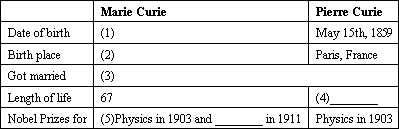
  Marie Curie(1867-1934)

  Marie Curie, Polish scientist, was born in Warsaw, on November 7th, 1867, and died in France, on 4th July 1934.Her single name was Marie Sklodowska.Her parents were teachers, and she learned at an early age the importance of education.In Paris, Marie graduated in Mathematical and Physical Sciences.She got married in 1895 with the French physicist, Pierre Curie.In 1896, H.Becquerel suggested the theme(主题)of her Ph.D.thesis(论文)the study of natural radiation(放射)from uranium(铀)salts.During her work, the Curie couple discovered a new radioactive element(元素)named polonium(钋)in honor to Marie's homeland.A few months later, they were able to discover radium(镭)for the first time.Together with Becquerel, she won the Nobel Prize for Physics in 1903.She founded the Radium Institute of Paris, and was the main responsible until her death.In 1911 she was awarded the Nobel Prize for Chemistry.

  Pierre Curie(1859-1906)

  Pierre Curie, French physicist, was born in Paris, on May 15th 1859 and died on April 19th 1906 on a coach(马车)accident.Before his research work in radioactivity, Pierre discovered, along with his brother Jacques, the piezoelectricity(压电现象)and the laws of paramagnetic(顺磁性的)objects.This work led to his Ph.D.thesis in 1895.Along with his wife Marie Curie, he discovered polonium in 1898 and radium a few months later.The Curie couple was awarded with the Nobel Prize, together with Becquerel.

Reading Comprehension

Read the following passages, and choose the lest answer that can answer the question.

  Mary and Peter were having a picnic with some friends near a river when, Mary noticed an object overhead. “Look,” she shouted to her friends, "That's a spaceship up there and it's going to land here”. Frightened by the strange silver colored spaceship, most of the young people got in their cars and drove away quickly. Peter. was fond of Mary and always stayed close to her. They, more curious than frightened, watched the spaceship land and saw a door open. When nobody came out, they went to the spaceship and peered inside. In the center of the floor, there was a pile of food. Peter followed Mary into the spaceship and did not hear the door close behind him. The temperature fell rapidly and the two young people lost consciousness.

  When they woke up, they were surprised to see that they were back by the river again. The spaceship had gone. Their car was nearby.

  “What happened?” asked Mary.

  Peter scratched his head saying slowly, “Don't ask me. Perhaps we had a dream. Did you see a spaceship?”

  “Yes,” said Mary. “And we both went into it.” Then, she looked at her wrist. “That's funny. My watch has stopped. Oh well, come on. It's time to go home.” Driving about fifty meters, they found their way blocked by a thick wall made of something like glass. They got out of the car and tried to find their way round the wall but discovered that they were inside a circular wall. It was like a mirror and prevented them from seeing through it.

  On the other side of the wall, strange creatures walked past slowly. A few stopped to stare through the wall and read a new notice which, translated into English, said:“new arrivals at the zoo:a pair of Earthlings in their natural surroundings with their mobile house.”

1.When the spaceship arrived, why didn't Peter drive away?

[  ]

A.He did not like leaving Mary.

B.He knew that the spaceship was harmless.

C.He was too frightened to drive.

D.There was a wall blocking the road.

2.Why did Peter enter the spaceship?

[  ]

A.He saw the food and was hungry.

B.Mary told him to enter it.

C.He just followed Mary.

D.He want to study it.

3.Peter scratched his head so we knew that ________.

[  ]

A.he had lost consciousness

B.he was puzzled and did not know what to say to Mary

C.he had lost his memory

D.he was still half asleep

4.What are the words “strange creatures” meant to tell us?

[  ]

A.They were held animals in a zoo.

B.They were robbers.

C.They had landed on Earth in a spaceship and lived there.

D.The young couple were on another planet.

5.Which word in the notice tells us that Mary and Peter were not on earth?

[  ]

A.natural
B.surroundings
C.Earthlings
D.house
下面是一篇杂志文章,请将标有A-F的段落插入文章中标号1-5的合适位置,使这篇文章意义完整,结构连贯;其中有一个段落是多余的。?

For three groups of explorers formed by college students and young white collars,it started out as a wonderful trip.[1] _________

The drama unfolded during the May Day holiday.One girl did not make it before the students were rescued.[2] _________

GPS,or Global Positioning System,is a satellite?based navigation system made up of a network of 24 satellites.It was originally created for military use by the US in 1980s but is now available for civilian use.[3] _________

[4] _________A GPS receiver must be locked on to the signals of at least three ?satellites to calculate the latitude and longitude of its location.Once the user's position has been determined,the GPS receiver can calculate other information,such as speed, direction,distance to destination,and a whole lot more.

A.GPS will be fitted on all the cars.

B.They were enjoying themselves exploring the Inner Mongolian desert.But when the sandstorm came,the trip became a disaster.

C.GPS works in any weather conditions,anywhere in the world,24 hours a day.And the service is free.

D.With four or more satellites in view,the receiver can determine the user's altitude.?

E.GPS are only produced in China.

F.GPS satellites circle the earth twice a day and transmit signals and information to the earth.GPS receivers take this information and calculate the user's exact location.?

G.The group was eventually found with the help of a GPS receiver.

 0  76862  76870  76876  76880  76886  76888  76892  76898  76900  76906  76912  76916  76918  76922  76928  76930  76936  76940  76942  76946  76948  76952  76954  76956  76957  76958  76960  76961  76962  76964  76966  76970  76972  76976  76978  76982  76988  76990  76996  77000  77002  77006  77012  77018  77020  77026  77030  77032  77038  77042  77048  77056  151629 

违法和不良信息举报电话:027-86699610 举报邮箱:58377363@163.com

精英家教网