阅读理解

  Because plants cannot move or talk , most people believe that they have no feelings and that they cannot receive signals (信号) from outside. However, this may not be completely true.

  People who studied plants have found out that plants carry a small electrical charge (电荷).It's possible to measure this charge with a small piece of equipment called “galvanometer” . The galvanometer is placed on a leaf of the plant, and it records any changes in the electrical field of the leaf. Humans have a similar field which can change when we are shocked or frightened.

  A man called Backster used a galvanometer for his studies of plants and was very surprised at his results. He found that if he had two or more plants in a room and he began to destroy one of themperhaps by pulling off its leaves or by pulling it out of its potthen the galvanometer on the leaves of the other plants showed a change in the electrical Geld. It seemed as if the plants were signalling a feeling of shock. This happened not only when Backster started to destroy plants , but also when he destroyed other living things such as insects(昆虫).

  Backster said that the plants also knew if someone had destroyed a living thing some distance away, because they signalled when a man who had just cut down a tree entered the room.

  Another scientist, named Sauvin, achieved similar results to Backster's. He kept galvanomenters fixed to his plants all the time and checked regularly to see what the plants were doing. If he was out of the office, he telephoned to find out about the signals the plants were sending. In this way , he found that the plants were sending out signals at the exact times when he felt strong pleasure or pain. In fact, Sauvin could cause a change in the electrical field of his plants over a distance of a few miles simply by thinking about them.

1.Most people believe that plants have no feelings because ________.

[  ]

A.they do not move or speak

B.they cannot receive signals from outside

C.this may not be completely true

D.this is unbelievable

2.Backster was surprised at the results of his studies because ________.

[  ]

A.he destroyed an insect

B.he destroyed a plant by pulling off its leaves

C.he found that plants could express feelings of shock

D.he found that plants could move and speak after all

3.The plants sent out signals ________.

[  ]

A.only when Backster started to destroy plants

B.when Backster destroyed plants or other living things

C.only when he destroyed things such as insects

D.only when Backster placed the galvanometer on the leaves of the plants

4.The scientist called Sauvin ________.

[  ]

A.did not agree with Backster's ideas

B.did not get the same sort of results as Backster did

C.got different results from Backster's

D.found out some of the same things that Backster did

5.Which of the following is true according to the passage?

[  ]

A.The electrical charge plants carry may shock or frighten us.

B.A tree will signal when it has been cut down.

C.Sauvin could make his plants send out signals some distance away.

D.Plants have feelings because they can receive signals without moving.

阅读理解

  During the early years of this century, wheat was seen as the very lifeblood of Western Canada. When the crops were good , the economy was good ; when the crops failed , there was depression. People on city streets watched the fields and the price of wheat with almost as much feeling as if they were growers. The marketing of wheat became an increasingly favorite topic of conversation.

  War set the stage for the most dramatic events in marketing the western crop. For years, farmers mistrusted speculative grain selling as carried on through the Winnipeg Grain Exchange. Wheat prices were generally low in the autumn, but farmers could not wait for markets to improve. It had happened too often that they sold their wheat soon after harvest when farm debts were coming due, only to see prices rising and speculators getting rich. On various occasions, producer groups asked for firmer controls , but governments had no wish to become involved , at least not until wartime wheat prices threatened to run wild.

  Anxious to check inflation and rising living costs, the federal government appointed a board of grain supervisors to handle deliveries from the crops of 1917 and 1918. Grain Exchange trading was suspended , and farmers sold at prices fixed by the board. To handle the crop of 1919 , the government appointed the first Canadian Wheat Board, with full authority to buy, sell and set prices.

1.What is the main purpose of the passage?

[  ]

A.To explain how wheat is marketed today.

B.To justify suspension of trading on the Grain Exchange.

C.To describe the origins of the Canadian Wheat Board.

D.To argue for further reforms on the Canadian Wheat Board.

2.According to the passage , most farmers debts had to be paid ________.

[  ]

A.when the autumn harvest had just been completed

B.because markets started to improve

C.as soon as the Winnipeg Grain Exchange demanded payment

D.unless crop failure caused depression

3.According to the passage, wheat prices became unmanageable because of conditions caused by ________.

[  ]

A.farmers
B.supervisors
C.weather
D.war

4.In Paragraph 3 , the word “check” could best be replaced by which of the following?

[  ]

A.control
B.investigate
C.finance
D.reinforce

5.According to the passage, a preliminary (初步的) step in the creation of the. Canadian Wheat Board was the appointment of ________.

[  ]

A.the Winnipeg Grain Exchange

B.a board of supervisors

C.several producer groups

D.a new government

  The arrival of computers has brought with it a new set of opportunities for trouble and crime. Today , computers are easy to come by and many people know how computer technology works. More importantly, the growing use of computer networks can increase a gap of security, making larger numbers of people more vulnerable (易受攻击的) than would be the case if they were using single , stand-alone computers.

  What's more , computer experts agree thatdespite recent widespread publicitycomputer viruses (病毒) are only one of many computer security problems facing the nation.

  The US Defense Advanced Research Project Agency has requested that the Research Council's Computer Science and Technology Board evaluate (评估) the security problems caused by computer technology, see what solutions (解决办法) may already exist, review research efforts aimed at avoiding security problems in the future, and evaluate existing policies connected with computer security. The study group will examine the problem of security for a broad sepctrum of users, including the business, national security, and academic communities, as well as the general public.

  David D.Clark , senior research scientist , Laboratory for Computer Science , Massachusetts Institute of Technology , will chair the group of experts in electronic security , network security , computer law , software engineering , cryptography , and operating systems. The group will also include computer users from the defense and banking industries.

  The study is expected to be completed by late 2000.

1.It can be inferred that to use single , stand-alone computers would ________.

[  ]

A.be easily harmed

B.not be well protected

C.avoid injury and crime

D.be easy and controllable

2.Although computer viruses are well known to the public , experts insist that ________.

[  ]

A.many other kinds of computer security problems do exist

B.computer viruses are the only problem facing the computer networks

C.computers are easy to come by

D.the growing use of computer networks can increase a gap of security

3.The aim of the Research Council's Computer Science and Technology Board is to ________.

[  ]

A.evaluate existing policies concerned with computer security

B.consider and judge research efforts aimed at keeping away from security problems in the future

C.evaluate the security problems put forward by computer technology

D.all of the above

4.The world “spectrum” in Paragraph 3 means “________”.

[  ]

A.area
B.limits
C.use
D.spreading

5.The best title for the passage is ________.

[  ]

A.Computer Viruses
B.Computer Networks
C.Computer Users
D.Computer Security

阅读理解

  Maggie was very glad that James was not a frequent visitor to the house. In the children's opinion, they had something that they couldn't explain or understand about him and that excited their imagination. He stirred Maggie's anger, however, so that she often said to her husband, “It's a mercy that brother of yours doesn't come oftener.”

  In fact James came once a year, unexpectedly, around eight o'clock in the evening, and he stayed for six hours of close discussion with his brother. His arrival was a signal to the children that their bedtime would be delayed. Not that he ever spoke to them or played with them. He took no notice of them , as if he was unable to see children , at least until the time came for him to go. Indeed , after his first greeting and a careless kiss , James took no notice of Maggie either , except to add ,”You'll be getting on with the supper, Maggie.” Such was his regard for her.

  Maggie paid him back in her own way. She kept the children up , the four of them , to keep her Gompany, she said, but of course they sang and made a noise and broke the endless sound of James' voice. Very late, they dropped off to sleep in their chairs. Then, when James was about to go, Maggie woke them up and so more or less forced him to part with four shillings before he left. That gave her some satisfaction , for James , though rich , was unwilling to give or share what he had. He always went home by the last train, just after two o'clock.

  Maggie's children secretly stared at their uncle. They could not forget that he had , in their mother's words , “lost two wives and taken a third” . They wandered about those two unfortunate , lost ladies. They asked each other what their fate (命运) had been , and if neither could ever be found again. James never brought his third wife with him nor ever mentioned her. The children decided that he must be so frightened of losing her that he never allowed her outside the door.

1.Maggie never prepared anything special for James because ________.

[  ]

A.he was a man difficult to please

B.she never knew when he was coming

C.she was too busy looking after her children

D.he never stayed long enough for a meal

2.What do we know about James' behaviour?

[  ]

A.He was a kind man, with love for the family.

B.He was unselfish, especially towards his brother.

C.He was anxious to please the family, especially the children.

D.He was rude to his sister-in-law.

3.Maggie felt pleased when ________.

[  ]

A.she paid James the money that she owed him

B.James gave some money to the children

C.she had to wake James up to catch his train

D.James thanked her for the nice supper

4.The children did not realize that two of James' wives ________.

[  ]

A.were dead

B.suffered from loss of memory

C.had run away from him

D.might reappear one day

5.From the text we know Maggie was ________.

[  ]

A.open-minded
B.warm-hearted
C.rich
D.impolite

  There is that strong conviction in life that one can learn from failure, figure out what went wrong and correct it. One has the power to change.

  Scrutiny (反思) of defeat is critical. One has to confront his failure to avoid repeating it.

  There are four most common reasons for failure:

  (1) Lack of social skills. You can have academic intelligence and still lack social intelligence.

  This is the ability to be a good listener, to be sensitive to others, to give and take criticisms well.

  People with high social intelligence admit their mistakes, take their share of blame and move on. They can get over serious mistakes.

  Social intelligence is an acquired skill. The more one practices, the better he gets. Like good manners, it can be learned.

  (2) Absence of commitment (许诺,保证).If a lawyer readily admits that he really has not achieved his expectations, he finds an excuse for himself against failure by never really trying.

  Lack of confidence is a basic cause of failure. To be committed , indeed , to be successful at anything, one has to believe he can do it. People who lack self-confidence , although they may do all the right things , often say them with a question mark in their voices.

  One can get better at projecting a sense of self-confidence, even if he does not really feel it. Like an actor in play, one has to monitor his voice and actions to be sure he/she sounds self-confident.

  (3) Scattered focus. Some people do so many things that they end up doing none of them well. They try to do many things that they lose focus and fail to settle priorities (优先考虑的事). Whatever activity that strikes their fancy at a given time is the one that they would attend to. The solution to this is to refocus, sort what one does best; to recognize limitations and establish prioritiesall these are essential to success.

  (4) Bad luck. Many times , things happen that one just cannot help. In his job , though no fault of his own , he is forced out or fired without due process.

  What must be done? First , do not blame yourself if anything wrong happens. Second , remember that you always have choices, even if some are not obvious.

  Smart people should not feel downhearted when they fail. The best of people experience that. What is most special is learning from failureand smart people should learn that.

1.If one has high social skill, ________.

[  ]

A.he can get high mark in the examination

B.he will never make mistakes

C.he will have a good sense of hearing

D.he can give criticism in a suitable way

2.When one is fired without due process , though no fault of his own in his job , ________.

[  ]

A.he should blame himself deeply

B.he should believe there are still opportunities in the life

C.he should condemn the boss severely in public

D.he should beg the boss mercy

3.Successful people are those ________when they make mistakes.

[  ]

A.who lose their confidence

B.who criticize others severely

C.who face them bravely and try to avoid repeating them

D.who never take responsibilities

4.Which is the moral lesson contained here?

[  ]

A.Avoid failures at all costs.

B.Failure can be a stepping stone to success.

C.Take failure lightly.

D.Failure is necessary.

5.One can get better at projecting a sense of self-confidence, even if he does not really feel it. The underlined word in this sentence most probably means ________.

[  ]

A.making plans for
B.throwing
C.standing out
D.establishing

  阅读理解

    A poor traveller stopped under the tree to eat the boiled rice and vegetables which he had brought with him. A few metres away , there was a small shop by the side of the road where a woman was frying (油炸) fish and selling it to travellers. The woman watched the poor traveller carefully, and when he finished his food and began to go, she shouted rudely, “You haven't paid me for the fried fish!”

  “But I have not had any fried fish!” he said.

  “But everyone can see that you enjoyed the smell of my fried fish with your rice and vegetables ,” said the woman , “If you had not smelled the fish , your meal would not have been so pleasant!”

  Soon a crowd collected, and although they supported the poor traveller, they had to admit that wind was blowing from the shop to the place where he had eaten, and that it had carried the smell of the fried fish to him.

  Finally, the woman took the poor traveller to a judge , who said , “The woman says that the traveller ate his meal with the smell of her fried fish. The traveller agrees that the wind was blowing from the woman's shop to the place where he ate his rice and vegetables and that it carried the smell of her fried fish to his nose while he was eating, so he must pay for it. What does your fried fish cost” he asked the woman.

  “Twenty-five cents a plate ,” she answered , delighted.

  “Then go outside together,” said the judge. “There the traveller must hold up a twenty-five cent piece so that its shadow (影子) falls on the woman's hand. The price of the smell of a plate of fried fish is the shadow of twenty-five cents.”

1.Why did the traveller refuse to pay the woman for the fried fish? Because ________.

[  ]

A.he was poor

B.he was rude

C.he was supported by a crowd

D.he hadn't eaten her fried fish at all

2.When the judge asked the woman a question, she felt ________.

[  ]

A.excited
B.anxious
C.glad
D.angry

3.Which of the followng statements is true?

[  ]

A.The traveller bought the boiled rice and vegetables and ate them by the side of the road.

B.The judge had no idea what the woman meant.

C.In the fifth paragraph , the first “it” has the same meaning as the second “it” .

D.The woman got nothing but the shadow of twenty-five cents in the end.

4.What do you think of the judge after reading the passage?

[  ]

A.He was foolish.

B.He was clever.

C.He was neither foolish nor clever.

D.He was kind enough to give the woman twenty-five cents.

5.What is the best title for the passage?

[  ]

A.The Smell and the Shadow

B.A Poor Traveller

C.A Rude Woman

D.A Woman and a Traveller

阅读理解:

阅读下列短文,从每题所给的四个选项(A、B、C、D)中,选出最佳选项。

  Growing up, I wasted a lot of time being afraid and embarrassed (尴尬的) over the smallest things and thinking I was near death from my many allergies and troubles. My attitude changed, however, when I was a teenager.

  I had gone to a wonderful birthday party, and the girl's parents served hamburgers with mustard (芥末). I ate one even though I'm very allergic to mustard. I soon felt an attack coming on but tried to hide it. When the party was over, I made it to my parents' car, but then it happenedI got sick out of the car window and was caught in the light of all the other car-lights. I wanted to die. After that, nothing seemed quite so embarrassing again. I'd learned an important lesson: You can't really die of embarrassment. It just feels fatal (致命的).

  I have failed with dozens of shows, including “Me and the Chimp” and “Blansky's Beauties”. The important thing was that each time I got up the next day and tried to think of another show.

  Most people try to beat down their flaws (缺陷) or deny (否认) them altogether. I've always found it best to say, “Here are my flaws. Now I have to find something I'm good at. ” Don't use your flaws as an excuse to give up. If fear doesn't beat you off and if you can work under pressure, then you've got a shot at success.

1.The word “allergic” most probably means ________.

[  ]

A.hateful
B.oversensitive
C.glad
D.fond

2.What did the writer do during a wonderful birthday party?

[  ]

A.He ate a hamburger which he liked very much.

B.He tried to hide the hamburger given to him by the parents of the girl.

C.He was attacked by someone with a hamburger with mustard.

D.He ate a hamburger with mustard and felt sick.

3.The lesson the writer learned is: ________.

[  ]

A.You can't avoid embarrassment

B.Embarrassment is fatal

C.When you are embarrassed, you want to die

D.Embarrassment is not as fatal as it seems

4.The advice given in the story is: ________.

[  ]

A.Never show your flaws because they might be embarrassing

B.Deny your flaws and do something you are good at

C.Never use your flaws as an excuse to give up

D.Sometimes fear can beat you off

阅读理解:

阅读下列短文,从每题所给的四个选项(A、B、C、D)中,选出最佳选项。

  There are different ways in which people try to deal with (处理) the problem of energy. One way is the greater production of common energy sources (能源), such as coal, oil and gas. The trouble with these sources, however, is that they are not renewable (可更新的,可再生的).

  Another way is energy conservation (节能), which means using energy more efficiently (有效地). In some very cold countries people build special houses to save energy. They place materials (原料,材料) between the inside and the outside of the walls of the house to keep the cold out and the warmth in. The house is heated by the lights, the body heat of the people and the other equipment in it.

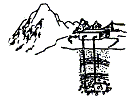
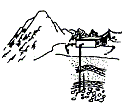
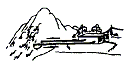
  Finally, renewable energy sources are used even though they are often expensive to develop. One form of these is geothermal energy. In certain parts of the world the temperature of the earth increases thirty degrees centigrade (摄氏) with each kilometer down. At a result, at six kilometers, it rises to nearly two hundred degrees. To get the heat, water is pumped (压;抽) down into the rocks and back up to the surface (表面). Heat from the earth is already used in certain countries.

1.How many ways of dealing with the energy problem are discussed in the text?

[  ]

A.Two.
B.Three.
C.Four.
D.Five.

2.From the text we learn that coal ________.

[  ]

A.is quite easy to produce

B.is not used most

C.is the most common source of energy

D.could be renewed only by new technology (技术)

3.The underlined words geothermal energy in the third paragraph mean ________.

[  ]

A.renewable source
B.underground source
C.heat inside the earth
D.temperature of the earth

4.Which of the following drawings shows the right way to get geothermal energy?

[  ]

A.
B.
C.
D.

5.At a place where the surface temperature is 15℃, how deep do you have to dig so as to get a temperature of 75℃?

[  ]

A.One km.
B.Two km.
C.Three km.
D.Four km.

阅读理解:

阅读下列短文,从每题所给的四个选项(A、B、C、D)中,选出最佳选项。

  I had just gone to bed after a very hard day when the phone rang. It was an eccentric (怪僻的) farmer. I had never met him before although I had often heard people talk about him. He sounded quite nervous and he had been talking for a minute or so before I understood anything. Even then all I could make out was that someone called Milly had had a very bad accident. I hadn't the slightest idea who she was but I obviously had to go.

  It had been snowing heavily that day and I didn't know the way. I had been driving for at least an hour when I finally found his place. He was standing there, waiting for me. It seemed Milly had died. “She meant more to me than anyone... even my own wife!” he said. I could see that he had been crying. I thought something terrible had taken place, a possible scandal (丑闻). I was even more shocked (surprised) when he told me he had put her in the barn (厩). “I wouldn't leave her out in the cold!” he said.

  Milly had clearly been a secret lover of his. I was about to tell him he could not expect (期望) me to cover anything up when he opened the barn door. He lifted his candle and I saw a dark figure on the ground. “She was such a good cow! I wouldn't let anyone but a doctor touch her!” he said, and burst into tears again.

1.Before he arrived at the farmer's house, the writer expected to see Milly lying ________.

[  ]

A.on the ground of a barn
B.on the floor of a room
C.in bed in a room
D.in bed in a barn

2.What do we know about Milly from the story?

[  ]

A.She had met with an accident.
B.She had caused a scandal.
C.She was seriously ill.
D.She was hidden somewhere.

3.The farmer wished that the writer might ________.

[  ]

A.look into the matter
B.free him from a scandal
C.bring Milly back to life
D.keep the whole thing a secret

阅读理解:

阅读下列短文,从每题所给的四个选项(A、B、C、D)中,选出最佳选项。

  Nearly all energy comes from the sun, either in a roundabout (迂回的) way or straight from it, in the form of heat and light. The light from the moon, too, comes from the sun. The moon can be said to be like a large mirror which throws back the sun's light to the earth.

  Electrical energy comes from the sun in a roundabout way. It can come from the power of water falling down mountains. The water falls there as rain, and we know that rain is made by the sun's heat evaporating (使蒸发) the water on the earth's surface. This water vapor (蒸气) rises, condenses (凝结) on cooling, and falls as rain.

  The light and heat energy from coal also comes from the sun in a roundabout way. Coal was made by the rocks pressing on trees and plants which died millions of years ago. Those trees and plants grew with the aid of sunlight, from which they made carbohydrates (碳水化合物), in this way changing the sun's energy into chemical energy. When we burn coal, some of this energy is set free.

  Energy which we use to drive car engines comes from petrol, which also was made with the aid of the sun in a roundabout way. Plants, and animals which ate the plants, died millions of years ago, and the parts of them that were left were pressed under the rocks in the earth. These parts left from dead animals made petroleum, from which petrol and oil are now produced.

  Thus we can say that the sun is the place where nearly all energy comes from, and that without the sun's heat and light, there could be no life on earth.

1.The power of water falling down mountains comes from the sun because ________.

[  ]

A.the sun heats the water in the mountains

B.the water comes from the rain which is heated by the sun

C.the water comes from vapor, which is made by the sun's heat

D.the water is heated by the sun

2.When coal is burnt, some of the chemical energy is ________.

[  ]

A.condensed
B.cooled
C.released
D.lost

3.Which of the following is NOT true?

[  ]

A.Petrol can be used as energy to drive car engines.

B.Coal was formed by trees and plants which died millions of years ago.

C.Plants and animals which died millions of years ago formed oil.

D.The sun's heat and light caused dead animals and plants to become oil.

4.The main purpose of the passage is to tell us that ________.

[  ]

A.the sun can be said to be the source (来源) of nearly all energy

B.rain is made by the sun's heat evaporating the water on the earth's surface

C.many forms of energy are received indirectly from the sun

D.human beings cannot live without the sun

 0  70133  70141  70147  70151  70157  70159  70163  70169  70171  70177  70183  70187  70189  70193  70199  70201  70207  70211  70213  70217  70219  70223  70225  70227  70228  70229  70231  70232  70233  70235  70237  70241  70243  70247  70249  70253  70259  70261  70267  70271  70273  70277  70283  70289  70291  70297  70301  70303  70309  70313  70319  70327  151629 

违法和不良信息举报电话:027-86699610 举报邮箱:58377363@163.com

精英家教网