Here’ s an unusual story: a diamond ring

 was recently found in an egg. The    


magician, Liu Qian, discovered it, in front          

of an audience of millions at CCTV’ s Spring

Festival Gala. Liu’ s magic tricks have made the centuries-old art of magic fashionable once again, and made him the hottest magician in China.

As a seasoned young magician from Taiwan, Liu is popular worldwide for his magic shows. Countries he has performed in include the U

nited States, Japan, South Korea and the UK.

Witnessing something impossible happen right before your eyes is the root of people’ s love for magic.

 “It’ s actually thinking rather than one’ s manipulation(操作)skills; that is more important to achieving a successful magic show. We think carefully about how to design the shows creatively, to make them appear more interesting.  ”Liu said.

    Liu Qian’ s success dated back to his childhood. Born in 1976 in Taiwan, he found himself attracted to a magic toy in a shop when he was seven years old. At the age of 12, he won Taiwan’ s Youth Magic Contest, which was judged by the great American magician, David Copperfield.

Yet, Liu never planned on becoming a professional magician. He studied Japanese literature at university and only hoped to be an amateur  (业余的) magician in his spare time. However, his failure to find a proper job after graduation pushed him towards magic as a career.

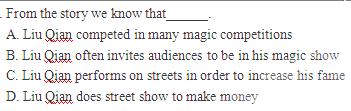
    To refine his performing skills, he has performed on streets, roads and fields for passers-by, policemen and farmers.

     “Street shows are the biggest challenge for us magicians. We have to deal with unexpected situations and tough crowds, ” Liu said.

What does the underlined word  “seasoned ” in Paragraph 2 mean?

A. 季节性的        B. 刚出道的         C. 老练的         D. 职业的

The story is about_____.

A. how Liu Qian became China’ s hottest magician

B. why people love magic

C. what magic tricks are

D. how fashionable the magic is

People love to watch magic because_____.

A. they can’ t figure out the secret of magic

B. it arouses their curiosity

C. they love watching magicians make the impossible happen

D. it is a centuries-old art

Which of the following is the key reason that Liu Qian decided to make magic his career?

A. He was interested in magic when he was little.

B. He had won Taiwan’ s Youth Magic Contest.

C. He became an amateur magician in his spare time.

D. He couldn’ t find an acceptable job after graduation


完形填空(共20小题;每小题1.5分,满分30分)

    When I was a young girl, I spent a lot of time with my grandparents, who lived in a community especially for the elderly and near to an old people's home. They used to tell me that few volunteers would go there and said if someone elderly engages me in  36  ,I'd better make time for them. As a result,I   37  be the only person they got to talk to that day. I've never forgotten this and still  38   time to chat with elderly people.

    So when I   39  a 100-dollar prize in the kindness competition for my community, I  40 thought of the elderly! I then  41  my local community centre and told them how I'd made a suggestion that if I had 100 dollars to  42  my community, I would use it for the elderly who were living    43  . I asked, "Could you do something a bit  44  so that they could all get something from this   45  ?”"Yes, of course, we could do a buffet (自助餐)and dance,”the centre manager told me.

    I thought this was a fantastic   46  and a very worthwhile use of the   47  .We bought food and beverages (饮料) enough to serve about 30 elderly residents. A poster was    48  to announce it and it was   49  for an afternoon.

    I went up to see how it was all  50  and it turned out to be a very enjoyable afternoon. I was very  51  to see that the people I wanted to serve had a wonderful and enjoyable times. It  52  me that one is never too   53  to have fun! I knew my grandparents would have been very  54 of me. It also helped me to remember that whatever is going on in the world,we can still make a(n) 55 to other people's lives.

A. walking               B. argument          C. conversation            D. shopping

A. might                   B. must                C. would                     D. should

A. consume               B. spare                C. devote                     D. share

A. won                     B. admitted           C. impressed                D. paid

A. eventually             B. usually             C. immediately             D. always

A. recognized            B. joined               C. contacted                 D. congratulated

A. purchase               B. create               C. benefit                    D. match

A. freely                   B. comfortably      C. lonely                      D. alone

A. adventurous       B. strange             C. special                     D. merciful

A donation               B. movement         C. collection                D. recreation

A. promise               B. idea                 C. discovery                 D. comment

A. community          B. competition      C. money                     D. space

A. thought of           B. put up              C. agreed on                D. sent up

A. known                B. applied             C. arranged                  D. read

A. going                  B. existing            C. preparing                 D. ending

A. pleased                   B. hopeful            C. curious                    D. anxious

A. provided             B. challenged               C. reminded                 D. puzzled

A. young                 B. busy                 C. poor                        D. old

A. proud                 B. ashamed .         C. cautious                   D. aware

【小题20】A. fortune            B. influence          C. promise                D. contribution

A new research has uncovered that culture is a determining factor when interpreting facial emotions (情感).The study reveals that in cultures where emotional control is the standard, such as Japan, focus is placed on the eyes to interpret emotions.Whereas in cultures where emotion is  openly expressed, such as the United States, the focus is on the mouth to interpret emotion.

       "These findings go against the popular theory that the facial expressions of basic emotions can be universally recognized," said University of Alberta researcher Dr.Takahiko Masuda."A person's culture plays a very strong role in determining how they will read emotions and needs to be considered when interpreting facial expression."

       These cultural differences are even noticeable in computer emoticons (情感符号), which are used to convey a writer's emotions over email and text messaging.The Japanese emoticons for happiness and sadness vary in terms of how the eyes are drawn, while American emoticons vary with the direction of the mouth.In the United States the emoticons :) and :-) show a happy face, whereas the emoticons  : ( or : -(  show a sad face.However, Japanese tend to use the symbol ( ' ' ) to indicate a happy face, and ( ;_; )to indicate a sad face.

       "We think it is quite interesting and appropriate that a culture tends to mask its emotions.The Japanese would focus on a person's eyes when determining emotion, as eyes tend to be quite subtle (微妙的)," said Masuda."In the United States, where open emotion is quite common, it makes sense to focus on the mouth, which is the most expressive feature on a person's face."

The text mainly tells us that __________.

       A.cultural differences are expressed in emotions

       B.culture is the key to interpreting facial emotions

       C.different emoticons are preferred in different cultures

       D.people from different cultures express emotions differently

Which emoticon is used by Americans to show a happy face?

       A.(;_;)            B.:-)         C.:-(                D.: (

If a Japanese wants to detect whether a smile is true or false, he will probably_______.

       A.read the whole face  B.focus on the mouth

       C.look into the eyes    D.judge by the voice

People used to believe that _______.

       A.some facial expressions of emotions were too complex to be recognized

       B.people in the world interpreted basic emotions in different ways

       C.people could only recognize the facial expressions of basic emotions

       D.people all over the world understood basic emotions in the same way

 0  20139  20147  20153  20157  20163  20165  20169  20175  20177  20183  20189  20193  20195  20199  20205  20207  20213  20217  20219  20223  20225  20229  20231  20233  20234  20235  20237  20238  20239  20241  20243  20247  20249  20253  20255  20259  20265  20267  20273  20277  20279  20283  20289  20295  20297  20303  20307  20309  20315  20319  20325  20333  151629 

违法和不良信息举报电话:027-86699610 举报邮箱:58377363@163.com

精英家教网