On Christmas, children are curious about what to be in the stockings (长筒袜). It might be safe to think children will ask Santa for an extensive list of toys, games and big dinners. But a survey of their lists for Father Christmas has shown many have more serious concerns, requesting "a dad" instead. Despite their material requests, a 'dad' is tenth most popular Christmas list request for children who would be happy to give up the latest iPad, toy or new pet, a survey of 2,000 British parents has found.
Most children will put a new baby brother or sister at the top of their Christmas list, closely followed by a request for a real-life reindeer (驯鹿). A "pet horse" was the third most popular choice, with a "car" at number four.
The survey also found children aged 3 to 12 years also wanted a dog, chocolate and a stick of rock. Traditional hopes for a white Christmas were represented by a wish for "snow" in ninth place, with sensible youngsters also requesting a "house". Of the top 50 festive requests, 17 related to pets and animals, with some imaginative children hoping for a chicken and an elephant. iPhones and iPads also appeared on the list, with some quirky children asking for the moon, a time machine, and a pond cover. A request for a "mum" reached number 23 on the list.

1. What’s the No.1 on the children’s Christmas list?
A. A new baby brother or sister. B. A real-life reindeer.
C. A pet horse. D. A house.
2. Which of the following is not included on the Christmas list?
A. A car. B. A chicken.
C. A stick of rock. D. A monkey.
3. What do quirky children in Paragraph 3 probably mean?
A. Children with quick reaction. B. Children with wild ideas.
C. Children with cleverness. D. Children with good manners.
4.Which of the statements is Not True according to the passage?
A. Some children would rather request a dad than the latest iPad for Christmas.
B. Children of different character or ages may ask for different Christmas gifts.
C. A real-life reindeer is next to a car on children’s Christmas list.
D. According to the survey, a ‘dad” is tenth most popular Christmas list request.
Blogs have become an important part of life. Millions of people have blogs. Perhaps you would like to have one; you would like to improve your blog; perhaps you would like to make your blog as a means of earning money or attracting more people. Whatever your aim is, this course shows you how to become better bloggers. You will learn how to find the right tone for your blog, set it up and keep it, write something that are effective and worth reading, and attract people from all over the world to your blog. While it’s simple to start a blog, it takes energy and skill to do it really well, as is true of any kind of writing.
Among the topics covered: introduction to the blog, the benefits of blogging, focusing on your blog concept, how to set up and keep a page, tips for effective blog writing and drawing visitors to your blog.
Course offered
How to blog
In this four-week course, a blogging expert will guide you through the process of designing, setting up, writing, and improving a blog. Each student will talk with the expert on blog, then set up a “live” blog and introduce it to the rest of the class for suggestions. Students will also have chances to ask the expert questions.
Online classes
Tuition(学费): $ 125. Registration(注册): $ 25.
Each class is strictly limited to 25 students aged 18 and up.

Start | New Lecture | Location | Time |
Jan.12 | Wednesday | Online | 24 hrs. a day |
Feb. 9 | Wednesday | Online | 24 hrs. a day |
Mar. 16 | Wednesday | Online | 24 hrs. a day |
1. In the course, you will learn something Except _________.
A. focusing on your blog concept B. how to set up a blog
C. the benefits of blogging D. how to follow others’ blog
2. What do we know about the course?
A. There are more than 25 students in each class.
B. The course is intended for teenagers under 18.
C. It will cost you $ 150 to learn the course.
D. New lectures are given each day.
3.The passage is mainly about _________.
A. an online course about how to blog
B. an online plan on writing
C. an online program about blog history
D. an online competition in writing blogs
4.Which word can be used to describe the course for bloggers?
A. Difficult. B. Helpful. C. Simple. D. Boring.

English is currently one of the most widely spoken and written languages worldwide, with some 380 million native speakers, who live in the UK, the USA, Australia, New Zealand, South Africa and other countries. It is spoken as an official language or second language in countries such as India and Nigeria. In these countries, English is the language of the government, newspapers, radios and TV stations. Besides, it is one of the working languages of the UN as well.
And there are some other facts about English you might be interested in knowing.
Over 700 million people, speak English, as a foreign language.
Did you know that of all the world's languages (over 2,700), English is the richest in vocabulary; and that the Oxford English Dictionary lists about 500,000 words,
Five of the largest broadcasting companies in the world (CBS, NBC, ABC, BBC and CBC) broadcast in English, reaching millions and millions of people all over the world.
It is said that over 90 percent of Internet web pages and over 80 per cent of the world’s emails are in English.
As a foreign language, it is learnt in almost all non- English speaking countries. In China, for example, it is not just students who learn English, but also many adults.
Although there are some differences between the English spoken in different countries, people from these countries usually have no problems communicating with each other.
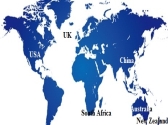
English is one of the most widely 1. languages. | |
Facts | Detailed information |
English-speaking countries | The UK, the USA, Australia, New Zealand, South Africa… |
Official or working language | India, Nigeria and 2. |
Widespread use | On the radio, on the web page, and in 3. |
4. | With 500,000 words in Oxford English Dictionary |
Conclusion | Despite the 5. that exist, people have no difficulty in communicating. |