题目内容
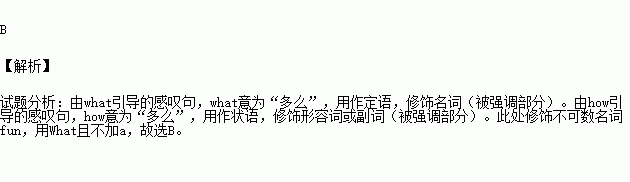
________ great fun they had!
A. What aB. WhatC. HowD. How a
He is so busy. He cannot afford enough time with his son ________ he wants to.
A.even if B.as if
C.because D.before
短文改错
假定英语课上老师要求同桌间交换修改作文,请你修改你同桌写的以下作文。文中共有10处语言错误,每句中最多有两处。每处错误仅涉及一个单词的增加、删除或修改。
增加:在缺词处加一个漏字符号(∧),并在其下面写出该加的词。
删除:把多余的词用斜线(\)划掉。
修改:在错的词下画一横线,并在该词下面写出修改后的词。
注意:1.每处错误及其修改均仅限一词;
2.只允许修改10处,多者(从第11处起)不计分。
As is often the case, when people are attending to meetings, having meals or waiting for buses, you can always find them addicting to their phones, completely ignoring others.
This is really a commonly phenomenon in our life. The reason is why smart phones nowadays can be used for people to play mobile games and kept in touch with friends through QQ and WeChat. Therefore, too much exposure to phones are bad for people in terms of health. Moreover, people involved in phones fail to communicate well with these around them.
As far as I am concerned, people should wisely make use of their phones to help their work and study. Meanwhile, care much about their family and friends rather than mobile phones.
Two of the saddest words in the English language are “if only”. I live my life with the goal of never having to say those words, because they convey regret, lost opportunities, mistakes, and disappointment.
My father is famous in our family for saying, “Take the extra minute to do it right.” I always try to live by the “extra minute” rule. When my children were young and likely to cause accidents, I always thought about what I could do to avoid an “if only” moment, whether it was something minor like moving a cup full of hot coffee away from the edge of a computer, or something that required a little more work such as taping padding (衬垫) onto the sharp corners of a glass coffee table.
I don’t only avoid those “if only” moments when it comes to safety. It’s equally important to avoid “if only” in our personal relationships . We all know people who lost a loved one and regretted that they had foregone an opportunity to say “I love you” or “I forgive you”. When my father announced he was going to the eye doctor across from my office on Good Friday, I told him that it was a holiday for my company and I wouldn’t be there. But then I thought about the fact that he’s 84 years old and I realized that I shouldn’t give up an opportunity to see him. I called him and told him I had decided to go to work on my day off after all.
I know there will still be occasions when I have to say “if only” about something, but my life is definitely better because of my policy of doing everything possible to avoid that eventuality(可能发生的事). And even though it takes an extra minute to do something right, or it occasionally takes an hour or two in my busy schedule to make a personal connection, I know that I’m doing the right thing. I’m buying myself peace of mind and that’s the best kind of insurance for my emotional well-being.
1.Which of the following is an example of the “extra minute” rule?
A. Start the car the moment everyone is seated.
B. Leave the room for a minute with the iron working .
C. Wait for an extra minute so that the steak tastes better.
D. Move an object out of the way before it trips someone.
2.The author decided to go to her office on Good Friday to ________.
A. keep her appointment with the eye doctor
B. meet her father who was already an old man
C. join in the holiday celebration of the company
D. finish her work before the deadline approaching
3.The underlined word “foregone” in Paragraph 3 is closed in meaning to “________”.
A. abandonedB. lackedC. avoidedD. wasted
4.What is the best title for the passage ?
A. The Emotional Well-beingB. The Two Saddest Words
C. The Most Useful RuleD. The Peace of Mind
On October 31st, 2009, Chinese famous scientist Qian Xuesen, died in Beijing when he was 98 years old. He is famous as “the country’s father of space technology and king of rocketry”.
Qian was born in 1911 in Hangzhou. He left for the United States after winning a scholarship to graduate school in 1936. He studied at the Massachusetts Institute of Technology and later at the California Institute of Technology.
Qian began his career in the US and was regarded as one of the brightest minds in the new field of aeronautics(航空学) before returning to China in 1955.
After he returned, Qian set up the first missile(导弹)and rocket research institute(学院) of China. The institute later helped start Chinese space program. He led the development of China's first nuclear-armed ballistic missile (弹道导弹) and worked on its first satellite.
He retired in the year before Chinese manned space program was launched in 1992. But his research formed the basis(形成基础)for the Long March CZ -2F rocket that carried astronaut Yang Liwei into orbit in 2003.
In August, 2009, Chinese Premier Wen Jiabao visited Qian and praised him for devoting his life to Chinese defense technologies. Qian told him, “I'm trying to live to be 100 years old”.
1.Qian was regarded as ________ before returning to China.
A. a father of space technology
B. king of rocketry
C. one of the brightest minds in the new field of aeronautics
D. one of the best-known scientists
2.When did Qian Xuesen retire?
A. In 1970.B. In 1991.C. In 1992.D. In 2009.
3.What does the underlined word mean in Chinese?
A. 发奖品B. 批评C. 赞扬D. 鼓励
4.List the following things in correct orders. Which is the correct?
①left for the United States
②won a scholarship to graduate school
③returned to China from the United States
④set up the first missile and rocket research institute of China
⑤studied at the Massachusetts Institute of Technology
A. ②①③④⑤B. ②①⑤③④
C. ⑤③④②①D. ⑤②①③④
5.Which of the following is TRUE according to the passage?
A. Qian was born in 1936 in Hangzhou.
B. Qian began his career in China.
C. The long March CZ-2Frocket carried YangLiwei into orbit in 2009.
D. Wen Jiabao visited QianXuesen in August 2009.
Every one of us went to the zoo ________ Tom. He was ill.
A. except B. besides C. including D. and
Mary’s never been here before, ________ she?
A. doB. wasC. doesD. has
第一节 词性转换
1.admit →(n.)_______________
2.poison → (a.)______________
3.recover → (n.)______________
4.describe → (n.)______________
5.publish → (n.)______________
6. injure → (n.)______________
7.energy → (a.)______________
8.symbol → (v.)______________
9.criticism → (v.)______________
10.combine → (a.)______________
One advantage of living on the top floor is that you can get a good ______.
A. sight B. view
C. scene D. scenery

 春雨教育同步作文系列答案春雨教育同步作文系列答案