The experiment needs fifty people divided into two groups of the same size.Group A is to take part in a 7-week exercise, while Group B is not allowed to do any exercise during those seven weeks.On the day before the experiment began, all fifty men took part in a step-test.They were told to step up and down on a 16-inch-long bench at 30 steps a minute for five minutes.After the test each man's heart-beating was taken and recorded.Then during the seven weeks men in Group A rode a sort of bike like exercise machine for 15 minutes a day.During the first day ride they were asked to ride very slowly.For the next three days, they were permitted to ride a bit more quickly.And the speed of riding was increased every few days until the end of the experiment, when both Group A and Group B were given the step-test again and the heart beating was taken again, too.Heart-beating of Group A members was to have dropped an average of 30 heart beats per minute while that of Group B members remained the same or almost unchanged.
(1)
How many people were in each group?
[ ]
A.
100.
B.
50.
C.
25.
D.
15.
(2)
The step-test was given ________.
[ ]
A.
after each exercise period
B.
only once, at the beginning of the seven-week period
C.
at the beginning and at the end of the seven-week period
D.
twice to the men in Group A and once to the men in Group B
(3)
The exercise was planned so that the amount of quick riding ________.
[ ]
A.
increased every few days
B.
changed every other day
C.
increased every other day
D.
increased every exercise period
(4)
What did Group A do in their experiment? They ________.
[ ]
A.
stepped up and down on a bench each day
B.
pushed and pulled the bikes every day
C.
were prevented from doing any exercise
D.
rode on an exercise machine
(5)
It seemed that ________ during the whole experiment.
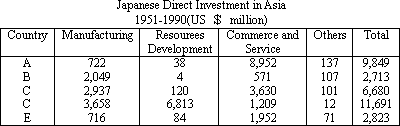
The chart above shows Japanese direct investment(投资)in five Asian countries or areas(A, B, C, D and E)from 1951 till 1990.The value of Japanese investment in manufacturing(制造业)was roughly the same in Hong Kong and in China, but in commerce(商业)and services Hong Kong was over China by seven billion dollars(=7,000million dollars).In resources development, Japan didn't show great interest in Singapore and even smaller attention was paid to Taiwan which received exactly one third as much money as Singapore.In total the biggest investment by Japan was made in Indonesia.
(1)
In total Japan invested ________ more in Hong Kong than in Singapore.
[ ]
A.
about 3.2 billion dollars
B.
about 7.1 billion dollars
C.
about 8.7 billion dollars
D.
about 4.1 billion dollars
(2)
________ attracted Japan most in terms of resources development.
[ ]
A.
China
B.
Hong Kong
C.
Indonesia
D.
Singapore
(3)
Taiwan was the only area where Japan's investment was larger in ________ than in any other field.
[ ]
A.
commerce and service
B.
manufacturing
C.
"Others"
D.
resources development
(4)
Which is RIGHT according to the passage?
[ ]
A.
In total Japan invested more in Taiwan than in Singapore.
B.
Japan's investment in commerce and services in Singapore was about three times that in Indonesia.
C.
Regarding Indonesia, Japan invested more than twice as much money in resources development as in manufacturing.
D.
In the field of "Others", Hong Kong ranked second.
阅读理解
The "Thumbs-Up"
While Western culture has become used to the thumbs-up as a good signal(probably coming from World War II pilots using the signal to show that they were "good to go" with ground crews), there are cultures where a thumbs-up may land you in trouble.In West Africa, as well as Greece, Italy and Middle East, the thumbs-up is pretty much the biggest insult(侮辱).
Rather more interesting is a thumbs-up in Germany and in parts of Japan-they just see it as the hand signal for the number one.
The "A-OK"
This sign is mainly used by divers(潜水员)to mean "OK"(to prevent being confused with the thumbs-up sign, which means "rise").Basically the meaning comes out as "great", or "completely fine".However, in a few countries in Europe, people may think you抮e telling them that you think they抮e a 'zero挘?/P>
The "V Sign"
The sign comes in two formats:one with the palm(手掌)faced outwards, and one with the palm inwards.In America they mean the same thing -"victory".However, if the outside of your hand is facing your target(目标), you抮e giving somebody a long-built insult in Great Britain and many English-speaking countries such as Australia, Ireland and New Zealand.Winston Churchill famously used the "incorrect" version of the V sign during the early years of the war, turning the outside inside later.The V sign is also considered rude in Italy.
The "Corna"
The corna hand gesture has most recently been adopted by fans of rock and heavy metal music.Nowadays many Americans use the gesture simply to mean "rock on", or in support of the University of Texas in Austin(known as the "Hook抏m Horns").Today it is still popular in Spain, Brazil and Slovakia.Historically, however, the symbol possibly dates back to Ancient Greece.
(1)
Which of the following signs doesn抰 have an insulting meaning?
[ ]
A.
The "Thumbs-Up".
B.
The "A-OK".
C.
The "V Sign".
D.
The "Corna".
(2)
What information can we get from the passage?
[ ]
A.
The "V Sign" was first used by Winston Churchill.
B.
Italians often use the "Thumbs-Up" to praise others.
C.
You are most likely to see the "Corna" in a heavy metal music concert.
D.
The "A-OK" and the "Thumbs-Up" have the same meaning to divers.
(3)
If you travel abroad, you 抎 better not use the "V Sign" in ________.