For most of us, dieting is an annoying fact life, With so much information available, it can be difficult to tell which weight-loss strategies really work.Let’s start by taking a look at some confusing myths(荒谬)。
1.All calories are created equal
What you eat, not how much, is the main factor behind weight gain, In fact, the body burns many more calories digesting carbohydrates than it does digesting fat, For every 100 calories of carbohydrates we consume in excess(超过)of our daily requirement, only 75 are turned into body fat.But 97 of every 100 excess fat calories fat calories are turned into body fat.
2.Desserts and fast foods are forbidden.
Some experts advise against describing foods as “ good ”and “bad ”Even cakes, pies, and ice cream can be worked into a diet, Moderation is the key.Besides, a plain hamburger on a bun is still a healthful choice, So is baked chicken or a green salad with low–cal, dressing, But watch out for French fries, and fried chicken of fish.
3.It makes no difference whether you’re top or bottom–heavy
In fact, where weight is distributed makes all the difference, Recent studies suggest that people who store fat on the upper body(apple shape)rather than on hips and thighs(大腿)脚(pear shape) may have an increased rick of heart disease, There is probably little you can do to change how your body is genetically programmed to store fat, But you can lost excess weight overall.
4.Fasting is the fastest diet.
Some studies suggest that suddenly reducing calorie intake puts the body into “starvation mode ”,which causes it to conserve calories and decreases the rate of digestion.The more often you deprive yourself of food, the better your body may get at storing calories, So, in the long run, repeated fasting may actually weaken your weight–loss efforts.
5.To keep weight off, simply watch what you eat
According to studies, exercise combined with dieting ensures weight loss better than dieting alone does.Experts also agree that having regular, moderate exercise is more important than occasional exercises, Researchers encourage patients to take the stairs instead of the elevator and park the car far from where you are going and walking.
6.It’s all your fault that you’re fat
Research at the University of Pennsylvania, School of Medicine indicates that body shape and size are in large part decided by a person’s genes, In short, some people are naturally more likely to be fat than other.Moreover, someone who was fat in childhood will have more fat cells than a person of average weight.Once made, the cells may enlarge or shrink(缩小),but they never disappear.
Yet genes don’t have to control your shape, The size of your fat cells depends on you-on your eating habits and lifestyle, Most important, before getting caught up in dietary myths, let good sense shape your eating habits, Your body will thank you for it.
(1)
Which of the following statements is true?
[ ]
A.
All calories are created equal.
B.
You can decide whether fat will be stored on your upper body or lower body.
C.
While you are on a diet never eat desserts and fast food
D.
The size of fat cells is decided by our eating habits and lifestyle
(2)
Which of the following statements is true about fat cells and genes?
[ ]
A.
Everyone has the same amount of fat cells.
B.
The size of fat cells is fixed, They won’t become bigger or smaller
C.
Genes have nothing to do with obesity.
D.
Where you store your fat is genetically decided
(3)
The main reason why the author writes this article is to ________
[ ]
A.
give new ideas
B.
correct certain misunderstandings
C.
encourage the readers to keep fit
D.
explain the concept of calories, fat cells, and genes
(4)
This article is ________
[ ]
A.
descriptive
B.
creative
C.
persuasive
D.
educative
阅读理解
The human body is a living machine, and, like all machines, it needs“fuel”to supply it with energy.This is provided by the food we eat.But how much do we need to stay healthy?
The energy value of food is usually measured in calories.A calorie is the amount of heat required to raise the temperature of 1 kg of water by 1℃.The number of calories people need per day is different, as the chat below shows.Also, the number of calories you use at any moment normally depends on the activity you are in.For example, you need more calories for standing than for sitting, more for running than for walking, and so on.
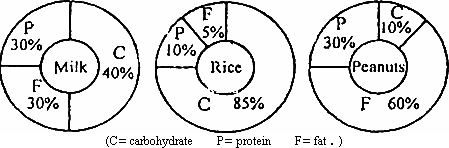
The energy in food is mainly in the form of three kinds of chemical materials-carbohydrate,protein and fat.Carbohydrate provides 3.8 Cal/gm(calories per gram)of energy, protein 4.0 Cal/gm,and fat 8.8 Cal/gm.Each food contains different amounts of these materials, as the second chart shows.
(1)
________ calories arc required to raise the temperature of 5kg of water form 35℃ to 90℃?
[ ]
A.
55.
B.
175.
C.
325.
D.
275.
(2)
If you lack for calories to support your running activities you'd better take more ________.
[ ]
A.
milk
B.
peanuts
C.
rice
D.
milk and rice
(3)
We may learn fm~ the charts that ________.
[ ]
A.
a child aged 8 requires more than 3 times the amount of calories that a baby does
B.
a boy aged 16 requires nearly twice the amount of calories that a boy aged 8 does
C.
a mother with a baby to feed uses up more calories them a hard-working farmer each day
D.
an old man needs less calories than an 8-year-old boy on account of his less movement
(4)
Which statement agrees with the passage and the charts above?
[ ]
A.
You need more calories for swimming than for mountain climbing.
B.
Food contains energy in the form of carbohydrates, proteins and fuel.
C.
Different people need different amounts of energy depending on their age, sex, and the activities they are in.
D.
3 grams of milk provides 16.6 calories because carbohydrate provides 3.8 Cal/gm, protein 4.0 Cal/gm, and fat 8.8 Cal/gm.
阅读理解
The human body is a living machine, and, like all machines, it needs “fuel” to supply it with energy.This is provided by the food we eat.But how much do we need to stay healthy?
The energy value of food is usually measured in calories.A calorie is the amount of heat required to raise the temperature of 1kg of water by 1℃.The number of calories people need per day is different.Also, the number of calories you use at any one moment normally depends on the activity you are in.For example, you need more calories for standing than for sitting, more for running than for walking, and so on.
The energy in food is in the form of three kinds of chemical materials-carbohydrate, protein and fat.Carbohydrate provides 3.8 Cal/gm, protein 4.0 Cal/gm, and fat 8.8 Cal/gm.Each food contains different amount of these materials, as the round pictures show.
(1)
The amount of calories supplied by equal amounts of milk, rice, and peanuts is the largest in the case of ________.
[ ]
A.
milk
B.
rice
C.
peanuts
D.
rice or peanuts
(2)
Which of the following is true?
[ ]
A.
You need more calories for swimming than for mountain climbing.
B.
Food contains energy in the form of carbohydres, proteins and fuel.
C.
Different people need different amounts of energy depending on their age, sex and the activities they are in.
D.
3 grams of milk provides 16.6 calories because carbohydrate provides 3.8 Cal/gm, protein 4.0 Cal/gm and fat 8.8 Cal/gm.