题目内容

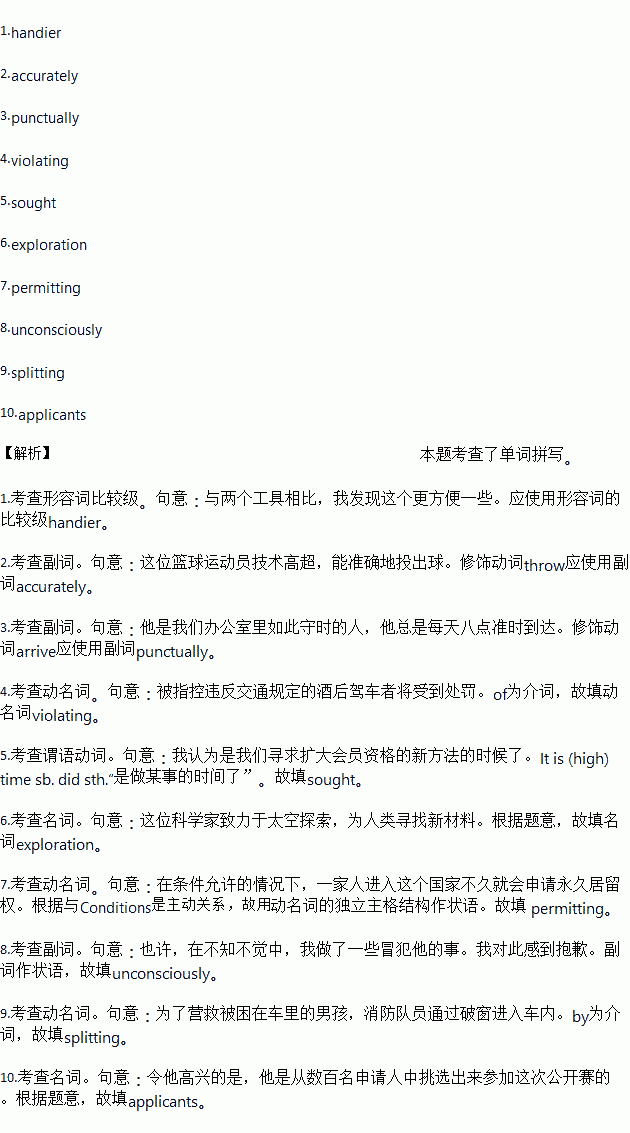
1.Comparing with the two tools, we find this is the h_________(方便的) of them.

2.The basketball player is so skillful that he throws the ball _________(准确地).

3.He is such a punctual person in our office that he always arrives p_________ at eight o’clock every day.

4.The drunk driving driver accused of v________(违反) traffic regulations will be punished.

5.I think it’s high time we s________(寻找) new ways of expanding our membership.

6.The scientist is dedicated to the _______ (探测) of space to find the new material for the mankind

7.Conditions p________(允许), the family will apply for permanent residence shortly after they enter the country.

8.Perhaps, __________(无意识地), I’ve done something to offend him. I feel sorry about it.

9.To rescue the trapped boy in the car, the firefighters broken into the car by s_______(分离) the car’s windows.

10.To his delight, he was chosen from hundreds of ________ (apply) to attend the opening ceremony.
练习册系列答案
相关题目

Whenever we see a button, we are eager to press it because we know something will happen. This is true in most cases, for example on a doorbell and on the “on/off” button on the TV. But some buttons are actually fake, like the “close” button on a lift.

Many people are in the habit of pressing the “close” button because they don’t have the patience to wait for the lift doors to shut. But lifts’ “close” buttons are a complete scam(骗局), at least in the US-the doors will not close any faster no matter how hard you press.

It started in the 1990s when the Americans with Disabilities Act was passed in the US, making sure that all lifts stayed open long enough so that people with disabilities could enter. Only US firefighters and repairmen can use the buttons to speed up the door-closing process if they have a code or special keys.

But to normal lift riders, the buttons aren’t completely useless. According to psychologists, fake buttons can actually make you feel better by offering you a sense of control.

“Perceived (能够感知的)control is very important. It reduces stress and increases well-being,” Ellen J. Langer, a psychology professor, said, “having a lack of control is associated with depression.”

Experts have revealed that a lot of buttons that don’t do anything exist in our lives for this same purpose. For example, many offices in the US have fake thermostats(温度调节器) because people tend to feel better when they think they can control the temperature in their workspace.

But psychologists found it interesting that even when people are aware of these little “white lies”, they still continue to push fake buttons because as long as the doors eventually close, it is considered to be worth the effort.

“That habit is here to stay,” John Kounios, a psychology professor, said. “Even though I have real doubts about the traffic light buttons, I always press them. After all, I’ve got nothing else to do while waiting. So why not press the button in the hope that this one will work?”

1.What was the author’s main purpose in writing the article?

A. To analyze the functions of fake buttons

B. To describe some different kinds of fake buttons

C. To explain the advantages and disadvantages of fake buttons

D. To explore people’s different habits when it comes to pushing buttons

2.In America, the “close” buttons on lifts .

A. are fake for the convenience of disabled people

B. work only when people press them hard for a while

C. were specially designed to give people a sense of control

D. cannot speed up the process of closing the door in any case

3.The underlined part “for this same purpose” in Paragraph 6 refers to .

A. making people more patient

B. giving people perceived control

C. helping people to build up confidence

D. making people with depression feel better

4.According to John Kounios, people who press fake buttons .

A. should give up this habit

B. probably do so to kill time

C. consider what they do to be meaningless

D. don’t know that what they press is fake

CONGRATULATIONS

We’ve organized the following information to help you prepare for your arrival at Boston College. Please feel free to contact our Admissions Office at any time over the coming months with any questions.

Your First Steps…

Please return the Acknowledgment Form sent with your acceptance letter to Dean Robert Howe, Graduate School of Arts & Sciences, McGuinn Hall 221,140 Commonwealth Avenue, Chestnut Hill, MA 02467.

■For Ph. D. Acceptances and Master’s Acceptances with funding, we ask you to reply by April 25, 2008.

■For Master’s Acceptances without funding and Non-degree Acceptances, we ask you to reply by May 31, 2008.

■You should also contact your department to receive any department information.

Over the Coming Months…

Get informed about services around campus. We have provided links for you to the following offices.

■Student Services

After you return your Acknowledgment Form, you should receive a letter containing your BC Username and Eagle ID number. With this information you can reach email and Agora. In Agora, BC’s online community, you can update your student information, check your student account, and register for classes.

The Office of Student Services issues (发行) your BC Eagle One Card. This ID card acts as your campus library card and meal card.

Student Services’ website offers a complete listing of courses for the school year, as well as student forms and other important student information. The Office of Student Services also handles billing.

■Housing …

CLICK HERE for more information.

If we can be of any more help to you, just contact us. Congratulations again! We look forward to you joining our University!

1.The above page can most probably be read _________.

A. on the Boston College website B. in the Boston College newspaper

C. on BC Eagle One Card D. at Student Services

2.The information above is particularly useful for those ________.

A. who want to apply for Boston College

B. who want to know about Boston College

C. who’ve been admitted to Boston College

D. who’ve decided to pay a visit to Boston College

3.If you want to study for your master’s degree with funding, you will have to _______.

A. return your Acknowledgment Form by May 31, 2008

B. send back your Acknowledgment Form by April 25, 2008

C. email your Acknowledgment Form to Admissions Office by May 31, 2008

D. return your Acknowledgment Form to Student Services by April 25, 2008

Many children first learn the value of money by receiving an allowance (pocket money). The purpose is to let the children learn from experiences at an early age when financial mistakes are not very costly.

The amount of money that parents give to their children to spend as they wish differs from family to family. Timing is another consideration. Some children get a weekly allowance. Others get a monthly allowance.

In any case, parents should make clear what, if anything, the child is expected to pay for with the money. At first, young children may spend all of their allowance soon after they receive it. If they do this, they will learn the hard way that spending must be done within a budget. Parents are usually advised not to offer more money until the next allowance.

The object is to show young people that a budget demands a choice between spending and saving.Older children may be responsible enough to save money for larger costs like clothing or electronics. Many people who have written on the subject of allowances say it is not a good idea to pay your child for work around the home. These jobs are a normal part of family life.

Paying children to do extra work around the house, however, can be useful. It can even provide an understanding of how a business works.

Allowances give children a chance to experience the three things they can do with money. They can share it in the form of gifts or giving to a good cause. They can spend it by buying things they want. Or they can save it.

Saving helps children understand that costly goals require sacrifice. You have to cut costs and plan for the future. Requiring children to save part of their allowances can also open the door to future saving and investing. Many banks offer services to help children and teenagers learn about personal finance.

A savings account is an excellent way to learn about the power of compound interest.

Compounding works by paying interest on interest. So, for example, one dollar invested at two percent interest for two years will earn two cents in the first year. The second year, the money will earn two percent of one dollar and two cents, and so on. That may not seem like a lot. But over time it adds up.

1.Giving an allowance, parents should consider all the following EXCEPT_______.

A. how much the child should get each time

B. whether the child has made a budget

C. where the money really goes

D. how often a child can get it

2.The author of the passage holds the opinion that________.

A. what children learn by handling allowances may be beneficial in the future

B. children can learn to set up their own business with their allowances

C. keeping allowances in the bank is the best choice for children

D. it is not a good idea to pay children for housework at home

3.The underlined words “compound interest” in the passage probably means ________.

A. increasing curiosity to learn how to make more money

B. stronger power to hold one’s attention to saving money

C. money paid by the bank on your original money and the gain from it

D. the sum of money that you earn from keeping your money in the bank

4.What is the best title for the passage?

A. Be Generous to Pay Your Children.

B. Be Wise to Avoid Financial Mistakes.

C. Saving Allowances Does Good to Children.

D. Allowances Help Children Learn about Money.

违法和不良信息举报电话:027-86699610 举报邮箱:58377363@163.com

精英家教网