题目内容

七选五

根据短文内容,从短文后的七个选项中选出能填入空白处的最佳选项。选项中有两项为多余选项。

Are you afraid of making mistakes?

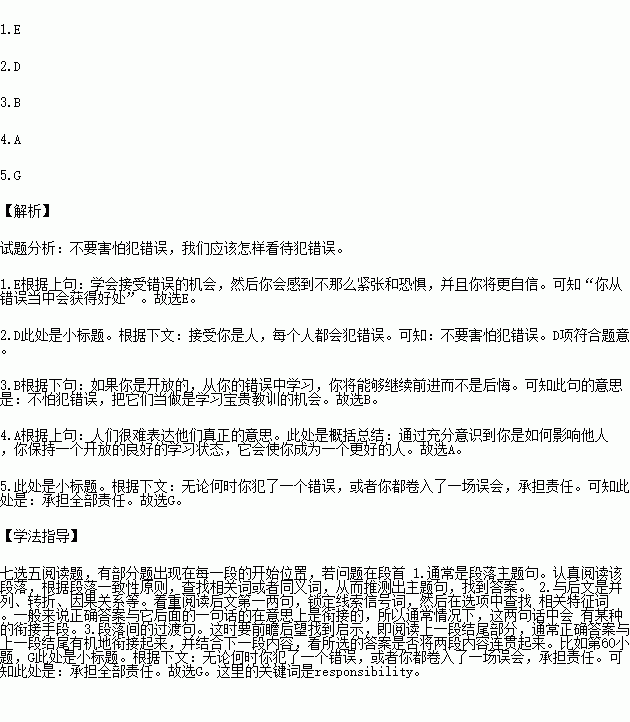
Learn to accept mistakes as opportunities, then you’ll feel less stressed and fearful and you’ll be more confident. __1._______ So what should you do?

2._________

Accept that you’re human and that each of us will make mistakes. 3._________ If you are open to learning from your mistake, you will be able to move on rather than wallowing in (沉湎于) regret.

Be aware

In other words, look for areas of improvement. Be aware of what you are doing, why you are doing it, how you feel, and how you make others feel. Sometimes, your words just don’t land right or you say something but it is not what you mean to say. People have difficulty expressing what they really mean. 4. _________

5._________

Whenever you make a mistake or you are involved in a misunderstanding, take responsibility. There is always something to be learned or improved even if the other person is wrong, too.

A. By being fully aware of how you impact others, you keep an open state of learning which allows you to practice being a better person.

B. Be open to making mistakes and consider them as opportunities to learn valuable life lessons.

C. Here are some ideas that can prevent you from making mistakes.

D. Be open to making mistakes.

E. In short, you will benefit from the mistakes.

F. Say your words again so that others can understand you.

G. Accept full responsibility.
练习册系列答案
相关题目

There are many idioms in English. An idiom is a phrase that we can't understand from the meaning of each word. The following are some of them.

As the crow flies

When a bird flies from place to place, it takes the most direct route. But when people drive, they have to follow roads and often go farther. When people give a distance "as the crow flies", they mean the shortest distance between the two points, not the distance you would have to travel by following roads.

As Dan and his mum drove along the river, they could see the beach on the opposite side. Dan asked "How far is it to the beach?"

"It's only about a quarter of a mile as the crow flies" his mother said.

Blow hot and cold

In one of Aesop's Fables, a man blows on his fingers to warm them up and then blows on his soup to cool it down. In both cases, the man is opening his mouth, but what comes out is different. If a person says one thing and later says the opposite, we say that the person is blowing hot and cold.

"Is Felicia going to try out for the soccer team this year?" Stacy asked.

"I don't know," Tricia replied." Last week she was saying yes, but this week she's saying no. She's really blowing hot and cold."

Break the ice

Nowadays people use the phrase to refer to ending an awkward silence by beginning a conversation.

It was the first day of summer camp. The four girls began to make their beds in silence. None of the girls knew each other, and no one knew what to say. Finally, one of them broke the ice by saying" Hey, where's everybody from?"

Bury the hatchet

In native American culture, when two nations agreed to end their war, they buried the hatchet. So to bury the hatchet is to make peace with someone else.

Colin could not excuse his sister for breaking his tennis racket. Finally, his sister said, "Colin, can't we bury the hatchet?"

1.What does "as the crow flies" mean?

A. In the smoothest way. B. In a straight line.

C. By plane. D. At top speed.

2."Blow hot and cold " can be used to talk about someone's ______.

A. dishonesty B. changing attitudes

C. communication skills D. bad manner

3.It can be inferred that Colin's sister hoped that Colin would ______.

A. buy a new tennis racket

B. stay away from her

C. forgive her mistake

D. make an apology to her

4.Which of the following is TRUE according to the text?

A. What Felicia thought was different from what he said.

B. Dan and his mother need drive a quarter of a mile to the beach.

C. “Bury the hatchet” is an idiom from Aesop’s Fables.

D. It’s difficult to understand the meaning of an idiom by each word.

阅读下面短文,从短文后各题所给四个选项(A、B、C和D)中,选出可以填入空白处的最佳选项,并在答题卡上将该项涂黑。

I went to a dinner party at a friend’s home last weekend and met her five-year-old daughter for the first time. Little Maya was all curly brown hair, dark eyes, and lovely _________ her shiny pink nightgown ( 睡裙) .I wanted to say, “Maya, you’re so _________!

Turn around and model that pretty gown for me. You’re beautiful!” But I didn’t.

“Maya,” I said, _________ into her eyes, “it’s very nice to meet you.”

“ Nice to meet you, too.” She said, in that _________ , talking-to-adults, good girl voice.

“Hey, what are you reading?” I asked. Her eyes got bigger, and the practiced, polite facial _________ gave way to real excitement over this _________ . But she seemed too _________ to answer me.

“I love books,” I said. “Do you?”

Most _________ do.

“Yes,” she said. “And I can _________ them all by myself now!”

“Wow, _________ !” I said. And it is, for a five-year-old.

“What’s your favourite book?” I asked.

“I’ll go and get it! Can I read it to you?”

Purplicious was Maya’s _________ , and a new one to me, as she sat next to me and _________ read aloud every word. Then I told her that I’d just _________ a book, and that I hoped she’d write one, too, one day. She was crazy _________ that idea. We were both sad when Maya had to go to bed, _________ I told her next time to choose another book and we’d read it.

Try this the next time you meet a little girl. She may be _________ and unsure at first, because few people ask her about her _________ , but be patient and stick with it. Ask her what she’s reading. What does she like and dislike, and why? You’re just _________ an intelligent (明智的) conversation that respects her brain. Tell her about your _________ and accomplishments, and your favourite books. Set a good example for her of what a _________ woman says and does.

1.A. on B. in C. at D. with

2.A. clever B. honest C. cute D. brave

3.A. turning B. getting C. looking D. putting

4.A. strange B. polite C. different D. frequent

5.A. expression B. attention C. devotion D. decision

6.A. outline B. title C. topic D. headline

7.A. shy B. difficult C. confident D. easy-going

8.A. books B. adults C. women D. children

9.A. recognize B. study C. read D. understand

10.A. amazing B. amusing C. frightening D. pleasing

11.A. friend B. dislike C. pick D. question

12.A. surprisingly B. sadly C. entirely D. proudly

13.A. bought B. written C. sold D. started

14.A. over B. for C. about D. to

15.A. but B. though C. since D. because

16.A. worried B. surprised C. exhausted D. uninterested

17.A. mood B. face C. mind D. head

18.A. producing B. accepting C. educating D. escaping

19.A. events B. disadvantages C. ideas D. sufferings

20.A. speaking B. thinking C. confusing D. living

从短文后各题所给的四个选项(A、B、C和D)中,选出可以填入空白处的最佳选项。

Patricia Blues, 29, has a new aim in life: to keep drivers’ hands on their steering wheels and off their cell phones. On November 2, 2007, Blues lived through a horrible experience. A motorist dialing a cell phone drove through a stop sign at 45 miles per hour and ran into the side of Blues’ car. Blues’ 2-year-old daughter was killed immediately in the crash.

Blues has since devoted her time top pushing for laws that would prevent this type of tragedy from happening again.

Cell phones are not the only distractions(分神) that cause accidents. Eating, changing CDs, reading maps, talking to passengers, and just reaching for an object on the floor can be dangerous. Therefore, the emphasis should be on educating drivers to avoid all distractions. However, talking on cell phones might be easier to regulate than eating or changing music. At least 34 states have already passed laws to restrict cell phone use in moving cars. No state has banned it yet, but several US. cities. Worldwide, 13 nations, including Australia, England, Germany, Japan and China have banned drivers’ use of cell phones in moving cars.

To date, no scientific evidence has been published showing that talking on the phone affects driving safety. But according to a test by some high school students, “driving while on the phone does affect safety and probably shouldn’t be done”.

1.What happened to Patricia Blues on November 2, 2007?

A. She was seriously injured in a car crash.

B. She lost her daughter in a road accident.

C. She broke the traffic rules at a bus stop

D. Her vehicle was destroyed by a motorbike.

2.The tragedy was caused by ________.

A. Blues’ lack of driving experience

B. the motorist’s failure of seeing the stop sign

C. Blues’ poor car conditions

D. the motorist’s absence of mind while driving

3.Patricia Blues’ new goal of life is to persuade the government ________.

A. to forbid the carrying of cell phones in cars

B. to educate drivers to avoid all distractions

C. to ban talking on cell phones while driving

D. to study harmful results of using cell phones

4.Which of the following is TRUE according to the text?

A. Using cell phones while driving is easier to be controlled by law than other distractions

B. It is more important to make laws than educate drivers to be aware of driving safety.

C. Driving while on the cell phone is firmly against only by some students from high schools.

D. It is extremely urgent for the cities with a large population to restrict using cell phones

违法和不良信息举报电话:027-86699610 举报邮箱:58377363@163.com

精英家教网
