题目内容
注意:每空不超过3个单词。
two aspects of fashion-'ecological' and 'ethical' (伦理的). Ecological fashion usually refers to textile (织
物) and clothing production processes and the environmental issues (议题) surrounding them; ethical
fashion generally relates to the working conditions involved in the producing processes.
What are the problems with fashion? Firstly, the production of textiles pollutes the environment heavily.
Cotton-planting uses pesticides; sheep-farming and wool-cleaning contribute to global warming; synthetics-
making (人造纤维生产) brings about harmful waste. Secondly, every stage of clothing production has a
significant effect on the environment. They all use a great deal of energy, and some also involve harmful
chemicals. In addition to this, there is a lot of waste produced in the process, especially in the form of
polluted water. Thirdly, growing consumption levels and our shopping habits further worsen the bad effects.
We are now buying clothes in increasing quantities without realizing the scale on which it affects natural
environment, and we are also quick to throw away clothes that have been worn only a couple of times.
Then, how to solve the problems? To a large degree, it is the fashion producers that really have the power
and the responsibility to shape our future. There are numerous ways in which these producers can reduce
their ecological footprint, from switching to green energy and reducing energy use, through selecting
sustainable (可持续使用的) materials and choosing local suppliers, to recycle and minimize waste. On the
other hand, as consumers we can all make contributions by selecting environmentally friendly clothing and
reducing clothing consumption.
Now many people are beginning to shop for organic food products because the benefits of eating food
free of chemicals are straightforward and immediate. They relate directly to our personal health. In fact,
choosing eco-fashion can also contribute to our personal health, though it is mostly done by way of keeping
the health of the planet.
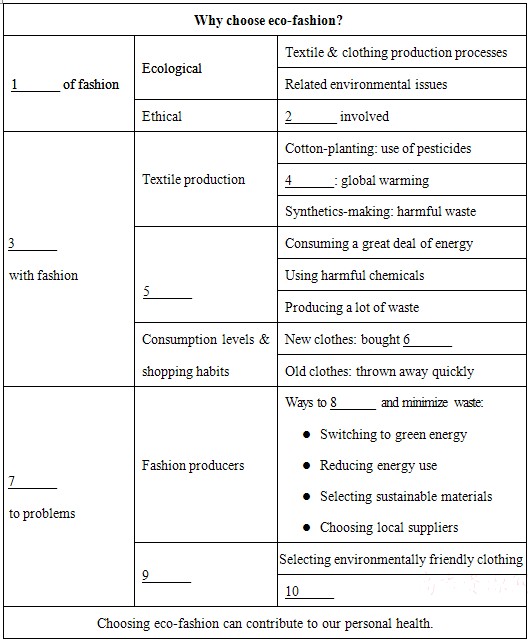
5. Clothing production 6. in increasing quantities 7. Solutions 8. recycle 9. Consumers
10. Reducing clothing consumption

 名校课堂系列答案
完形填空,阅读下面短文,从各题所给的四个选项中,选出能填入空白处的最佳选项。
When a person is curious about something, it means he is 1 in it and wishes to know more about it. There is 2 wrong with curiosity in itself. Whether it is good or bad depends on what people are curious about.
Curiosity is 3 silly or wrong. Some persons with nothing to do are full of curiosity about what their 4 are doing. They are 5 to know what they are eating or drinking, what they are 6 home or taking outside, or 7 they have come so early or late. To be interested in these things is 8 because they are 9 at all. It is none of their 10 to know what their neighbors do or are doing. Such curiosity is 11 not only 12 but also harmful. For most probably, it 13 to small talk which often brings harm, shame of disrespect to others, and thus 14 their feelings.
On the other hand, there is a 15 curiosity--the curiosity of wise men, who wonder at all the great things and try to 16 all they can about them. Columbus could never have found America if he had not been 17 . James Watt would not have made the steam engine 18 his curiosity about the raising of the kettle lid. All the discoveries in human history have been made 19 a result of curiosity, 20 , the curiosity is never about unimportant things which have few or nothing to do with the happiness of the public.
|
(1)A.interesting |
B.engaged |
C.excited |
D.interested |
|
(2)A.something |
B.nothing |
C.much |
D.much |
|
(3)A.often |
B.sometimes |
C.seldom |
D.always |
|
(4)A.neighbors |
B.companies |
C.workshops |
D.families |
|
(5)A.worried |
B.satisfied |
C.anxious |
D.nervous |
|
(6)A.taking |
B.going |
C.coming |
D.bringing |
|
(7)A.when |
B.why |
C.whether |
D.however |
|
(8)A.silly |
B.necessary |
C.impossible |
D.possible |
|
(9)A.not right |
B.good |
C.unimportant |
D.important |
|
(10)A.business |
B.duty |
C.work |
D.idea |
|
(11)A.all |
B.something |
C.everything |
D.the matter |
|
(12)A.funny |
B.wise |
C.interesting |
D.foolish |
|
(13)A.leads |
B.causes |
C.refers |
D.stick |
|
(14)A.effects |
B.hurts |
C.expresses |
D.destroys |
|
(15)A.strange |
B.terrible |
C.noble |
D.stupid |
|
(16)A.find out |
B.find |
C.decide |
D.work out |
|
(17)A.brave |
B.careful |
C.curious |
D.famous |
|
(18)A.with |
B.without |
C.for |
D.from |
|
(19)A.as |
B.with |
C.because |
D.after |
|
(20)A.and |
B.so |
C.but |
D.however |