题目内容
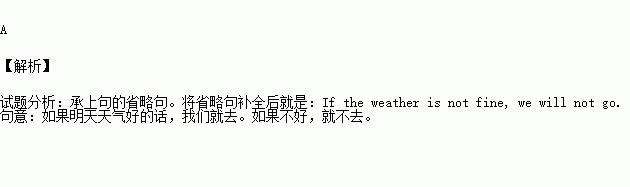
If the weather is fine, we’ll go. If ______, ______.
A. not; not B. no; no
C. not; no D. no; not
You’ve made such great efforts that you are ________to pass the exam.
A. easily B.bound C.possible D.unlikely
书面表达
假定你是李华,你的英国朋友Peter来信向你咨询如何才能学好中文。请你根据下列要点写封回信。
1.参加中文学习班;2.看中文书刊、电视;3.学唱中文歌曲;4.交中国朋友。
注意:1.词数不少于100;2.可适当增加细节;3.开头语已为你写好,不计入总词数
June 8, 2011
Dear Peter,
I'm glad to receive your letter asking for my advice on how to learn Chinese well.
________________________________________________________________________
______________________________________________________________________
Best wishes.
Li Hua
They set up a company, but he broke up with his (搭档) two years later.
Miss Green often said “God helps those who help themselves”, intending to _______ on us the significance of being independent.
A. base B. impress
C. focus D. rely
Niki is always full of ideas, but is useful to my knowledge.
A. nothing B. no one
C. neither D. none
Excited by the news, he couldn’t find words to c__________ his feeling at that time.
阅读理解。
Encouragement and praise can come in many forms,and some ways are better for children’s development than others.Researchers at the University of Chicago who studied mother-child interactions over the course found that the type of praise children receive affects their attitudes toward challenges later in life.Specifically,praise coming with feedback about their behavior that kids made helped them to deal better with difficult experiences five years later,compared with compliments that focused more on the child himself,like “You’re a good boy.”
“This is something we suspected would be the case based on a lot of experimental research,and it’s exciting to see it plays out in the real world,” says Elizabeth,a professor of psychology at Temple University,who led the study.“Praising the efforts,actions and work of the kid is going to be more beneficial in their long-term persistence and work hard in the future.”
Such “process praise” includes comments such as “You worked really hard” or “You’re doing a great job,” which emphasize the child’s actions.“Person praise” includes comments like “You’re so smart” or “You’re so good,” which focus on a child’s inherent qualities.These distinctions aren’t new in the field of psychology,but exactly how they affect children’s development over the years hasn’t been clear.
As part of the study,researchers visited the homes of more than 50 toddlers between the age of 1 and 3 years old,and filmed their daily interactions with their parents during multiple 90-minute sessions.Five years later,the researchers followed up with the families,using questionnaires to measure the children’s attitudes toward challenges and problem solving.The children who grew up with more process praise were more open to challenge,and could identify more ways of overcoming difficult problems.While person praise didn’t seem to have any negative effect on the children,process praise teaches children that their talents and abilities can be developed and improved,while person praise sends the message that their abilities are fixed and therefore not easily changed.
1.Which of the following statements is NOT true?
A.Praising inspires kids to form good personal quality.
B.Praising kids is tested to be effective in the long run.
C.The process of praising kids experiment is suspected.
D.The praising experiment is carried out in real situation.
2.The underlined word “distinctions” in Paragraph 3 is closest in meaning to .
A.condition B.differences
C.exception D.appearance
3.From the last paragraph we can learn that .
A.kids should not be praised too frequently
B.different kids should be praised differently
C.process praise is less effective as we expected
D.kids with process praise tend to be more creative
4.What is the main purpose of the passage?
A.To introduce a better way to praise kids.
B.To compare two different praising ways.
C.To predict the result of process praising.
D.To report the way of praising experiment.
If something such as a product, an activity, or someone's career _______, it suddenly becomes very successful.
A. takes up B. takes in
C. takes off D. takes away