题目内容

假如你是中学生李华,你校外教Mary女士近期准备回英国度假,为此,你班同学准备开一个晚会为她送行。请你根据以下提示,用英语写一封e-mail,通知她相关情况。

1. 对她的辛勤教学工作表示感谢。

2. 晚会本周日晚上7:30开始,预计持续1个小时。

3. 地点:高三10班教室

4. 活动:同学们一起唱英文歌,班长代表全班赠送她鲜花和亲手制作的礼物。

注意:

1.词数100左右。

2.开头和结尾已经给出,不计入总词数。

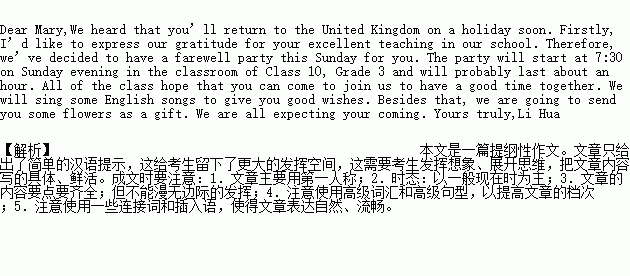
Dear Mary,

We hear that you’ll return to the United Kingdom on a holiday soon.All the class will miss you very much during your absence!

.

.

.

Yours truly,

Li Hua
练习册系列答案
相关题目

完形填空

My heart beat with that feeling, like blood to my body as my fingers flew across the piano keys.As the piece neared the end, I up to take my final bow.For a second, the room was .Yet, even in that one second, I had enough time to whether I had done perfectly.Then, , the applause (掌声) came.

“Thank you… so much,” I said, to the person standing on my other side.Olga, my piano teacher for six years, smiled back at me.“You’ve been an . student all these years,” she said, “I hope that whatever you do, you never stop .”

I leaned forward, I would keep playing because I loved piano, and hugged her.

As it , the promises weren’t as meaningful as I’d hoped. Right after the , I kept up my strict practicing schedule every day. , it began slipping away from me.The reason I had stopped taking was because of my busy schedule with homework.Not long after, I stopped practicing altogether.It was not to have to stress about piano anymore.But something was inside of me.I was empty inside.

One day I met Michelle, who had also taken piano lessons from Olga.

“Are you taking lessons from Olga?” she asked.

“Actually I just quit a while ago,” I replied.

“That’s a ,” she responded, “I remember your performance a year ago; it was .”

Two days after talking to Michelle, I was at a what to do.I moved slowly into the living room unconsciously, but in fact I knew what I was doing.

As the music , a familiar feeling rose inside me.

1.A. showed B. sat C. stood D. looked

2.A. light B. quiet C. colorful D. nervous

3.A. expect B. remind C. know D. doubt

4.A. immediately B. successfully C. hopefully D. suddenly

5.A. turning B. waving C. running D. pointing

6.A. easy-going B. imaginative C. amazing D. honest

7.A. practising B. learning C. competing D. gaining

8.A. telling B. promising C. admitting D. speaking

9.A. carried on B. brought up C. turned out D. taken in

10.A. performance B. final C. presentation D. play

11.A. Soon B. Besides C. Thus D. Instead

12.A. lectures B. parts C. lessons D. pieces

13.A. disappointing B. pleasing C. inspiring D. puzzling

14.A. beating B. rising C. changing D. shining

15.A. still B. even C. much D. yet

16.A. shame B. relief C. pleasure D. deal

17.A. challenging B. breathtaking C. demanding D. embarrassing

18.A. time B. heart C. dream D. loss

19.A. normally B. exactly C. unclearly D. badly

20.A. ended B. hit C. covered D. spread

Many Americans are turning to Japan, they think, a country of high academic(学术的) achievement and economic success, for possible answers.However, the answers provided by Japanese preschools are not the ones Americans expected to find. In most Japanese preschools, surprisingly little emphasis is put on academic instruction.In one survey, 300 Japanese and 210 American preschool teachers, child development specialists, and parents were asked about various aspects of early childhood education.Only 2 percent of the Japanese respondents(答问卷者)listed “to give children a good start academically” as one of their top three reasons for a society to have preschools.In contrast, over half the American respondents chose this as one of their top three choices.To prepare children for successful careers in first grade and beyond, Japanese schools do not teach reading, writing, and mathematics, but rather skills such as determination, concentration, and the ability to work as a member of a group.The huge majority of young Japanese children are taught to read at home by their parents.

Like in America, there is diversity(多样性) in Japanese early childhood education.Some Japanese kindergartens have specific aims, such as early musical training or potential(潜力的) development.In large cities, some kindergartens are attached to universities that have elementary and secondary schools.Some Japanese parents believe that if their young children attend a university-based program, it will increase the children’s chances of eventually being admitted to top-rated schools and universities.Several more progressive programs have introduced free play as a way out for the heavy intellectualizing in some Japanese kindergartens.

1.We learn from the first paragraph that many Americans believe ________.

A. Japanese preschool education emphasizes academic instruction

B. Japanese parents are more involved in preschool education than American parents

C. Japan’s economic success is a result of its scientific achievements

D. Japan’s higher education is superior to theirs

2.In Japan’s preschool education, the focus is on ________.

A. preparing children academically

B. shaping children’s character

C. teaching children mathematics

D. developing children’s artistic interests

3.Why do some Japanese parents send their children to university-based kindergartens?

A. They can do better in their future studies.

B. They can make more group experience grow there.

C. They can be individually oriented when they grow up.

D. They can have better chances of getting a first-rate education.

4.Free play has been introduced in some Japanese kindergartens in order to ________.

A. broaden children’s knowledge

B. train children’s creativity

C. lighten children’s study load

D. enrich children’s experience

Neither television nor radio nor magazines nor books nor any other medium can begin to match newspapers for depth and breadth of coverage (新闻报道). In fact, all these media themselves depend on newspapers to bring them information that they then process and distribute as their own brand of news.

Now many newspapers are locked in a struggle for survival. If they lose—which is by no means impossible—we all lose.

The great task for editors and publishers is to respond to the competitive challenge caused by online news, and at the same time use their own online news to increase their profits (利润). As yet,they haven't figured out a smooth and sure way to do that.

So they cut some more to get profit. The cuts in size that they are making are in some cases risky and in others without considering the results. With every cut, publishers tirelessly argue that readers won't even know the difference. The trouble is that by the time customers do notice that they are getting less for their money,it will be too late—too late to notice the reduction in the number of readers.

The other big cuts, of course, are in staff (员工). The victims would be the oldest and most experienced workers because they are the highest paid.While there is plenty of tired deadwood among them,there is also a lot of talent.

When experienced staff leave in large numbers—as they often do now—the newspaper loses great professional memory. But the real loser is the readers, who are suddenly robbed of the insights (见识) that only the experienced reporters can bring.

As for the future, there is at least one big, bright sign:intelligent young people will continue to flood into journalism in urgent search of jobs, despite its high demands and modest (不太高的) pay.

1.The underlined word “deadwood” in Paragraph 5 may refer to “ ”.

A. the staff who are going to retire

B. people who are no longer useful or needed

C. workers who are experienced

D. reporters who are tired of covering events

2.According to the passage,which of the following can best describe the author's attitude towards the ways the editors and publishers have adopted to get profit?

A. The author has no objection.

B. The author is against them.

C. The author has not shown it clearly.

D. The author regards them reasonable.

3.The author seems to agree with the view that .

A. experienced workers are the last to be laid off

B. journalism is a job offering highest pay for high demands

C. the challenge of newspapers is that there are not enough intelligent young people

D. it is possible that newspapers may not survive in the end

4.It is stressed by the passage that the most important quality for a journalist is .

A. patience B. selfishness C. insights D. sensitivity

违法和不良信息举报电话:027-86699610 举报邮箱:58377363@163.com

精英家教网