题目内容

The defeat of Lee Sedol, the world’s strongest Go (围棋) player, by a Google artificial intelligence (AI) program, looks like another milestone towards a world where computers can do almost anything a human can. It is not. There are uncountable things that only a human can do, and that no computer seems close to. The problem is that the purely human things are not economically useful to anyone. The things that computers can be taught to do are by contrast economically fantastic. But even the most powerful programs are not human, just as a shovel (铲车). They have no feelings. What they have is power, but this power is growing at a rate that should frighten us all.

It might be less frightening if computers were truly intelligent, but even the most powerful networks are less human than monstrous Martians (火星人). Their power will be used to make money for the firms that finance their development, and then for others quick and clever enough to take advantage of the new world. It is far more likely that they will increase inequality and still further remove the middle classes as we move towards an hourglass (以金钱来衡量的) society in which everyone is either very rich or very poor and likely indebted.

One of the ill effects of the spread of more intelligent computer networks is, at the same time, the spread of what might be called artificial stupidity. If AI is employed largely to replace unskilled labour, it is most productive when labour is kept unskilled or redefined that way. So much of the work in service industries is now simplified until it might be automated (自动化). And robots will never need pensions(养老金). AI is slowly reducing skilled work, like some forms of medical diagnosis (诊断), at the same time, as older doctors complain that the traditional human skills of diagnosis are falling out of medical training. The belief that everything worthwhile can be measured and then managed is far more damaging to humanity than the threat of artificial intelligence on its own.

But no victory in complicated Go games can bring us closer to truly human-like computers.

1.By mentioning the defeat of Lee Sedol, the author intends to tell us that ______.

A. computers can completely replace humans in everything

B. humans are of no practical economic values to the society

C. the power of computers is growing at a frightening rate

D. AI programs can not compare with humans economically

2.We can learn from Paragraph 2 that the power of computers will ______.

A. improve the quality of human life

B. widen the gap between the rich and the poor

C. make contributions to human development

D. promote equality at work places

3.What is the author’s attitude towards the future of artificial intelligence?

A. Optimistic. B. Supportive.

C. Cautious. D. doubtful.

练习册系列答案
相关题目

Dar and I loved to dance. It was probably the first thing we did together, long before we would share our lives.

We grew up in a small Oregon mountain community where dances were held almost every Saturday night. Dar was seventeen and l was thirteen when we first danced. He was one of the best dancers on the floor, and so was I. We always jitterbugged. No slow dancing for us; nothing remotely romantic.

Our fathers would stand along the wall and watch. Every once in a while, Dar’s dad would smile a little and say, to no one in particular, but my dad could hear, “Boy, my kid can sure dance.” My dad never blinked an eye; he acted like he’d never heard. But a while later he would say, to no one in particular, “That girl of mine can sure dance.”

Our dancing together stopped for five years while Dar was in the South Pacific in World War II. When we met again, Dar was twenty-two, and l was eighteen. We began to date and dance again. We were as good together as we remembered, and this time we added slow dancing.

For us, life is a dance, a movement of rhythms, directions, stumbles, missteps, at times slow and precise, or fast and wild and joyous. We did all the steps.

Two nights before Dar died, the family were with us. We all ate dinner together, and Dar sat with us. He hadn’t been able to eat for several days. After dinner, I put on a Nat King Cole tape. Dar took me in his arms, weak as he was, and we danced and smiled. No tears for us. We were doing what we had loved to do for more than fifty years. It was our last dance---forever unforgettable. I wouldn’t have missed it for the world.

1.The author first danced with Dar when____.

A. they were still in their teens

B. they began to date each other

C. they began to share their lives

D. Dar returned from the South Pacific

2.What does the author mean by the underlined sentence in paragraph 3?

A. Her dad didn’t like Dar's father.

B. Her dad was not interested in the dance.

C. Her dad was too focused on his daughter.

D. Her dad thought his daughter danced better.

3.How did the author feel when she danced with Dar for the last time?

A. Regretful. B. Content.

C. Heart-broken. D. Concerned.

4.Which of the following can be the best title for the text?

A. My Unforgettable Dancing Partner

B. Dance Together to the Last

C. My Last Dance with Dar

D. The Best Dancers

We have a strange and strong belief in the idea of perfection. Driven by our culture, we struggle for an unattainable ideal: If I have the perfect parents, perfect grades, perfect…, then I would be happy. We seek what we can’t have without remembering that we don’t actually need to be perfect. Imperfection allows us to be human.

Parents, teachers and other high-achieving peers will have us believe that we must be perfect if we wish to remain competitive. However, what job or school requires you to develop a cure for some form of cancer by the age of 18? Although these grades would be admirable achievements, are they worth losing sleep over? We feel like we need the perfect grades to get into the perfect college that will provide us with the perfect education necessary to obtain the perfect job. Making use of our thirst for perfection, the whole college and career industries have emerged claiming to help us reach our goals.

Truth is, you only need to be good enough to get into the conversation. It is what you do afterwards that sets you apart. Focus more on your passions. Don’t worry about anything secondary to your passions. You don’t become an expert at anything if you spent your time trying to succeed in everything you do. You only become an expert when you devote your time to that one project that truly brings you joy.

As members of this society, we have a responsibility to be excellent in what we do, not perfect. Although perfection can be a goal, it should not be the only goal. We only have 24 hours in a day and seven days in a week. Thus, we need to plan what we want to do and cut out the activities we cannot do.

With everything, though, make sure you’re doing enough. Pursuing your passions is not enough of a reason to completely give up on everything else. Try as hard as you can and let your future worry about itself. Worry about your task at hand and you will be successful in achieving your dreams. Most of all, remember that you’re going to be okay.

1.It is implied in Paragraph 1 that there is a culture where ________.

A. Students are driven to learn concepts

B. great importance is attached to perfection

C. imperfect people aren’t happy at all

D. perfect grades result from remembering facts

2.We can infer from the second paragraph that ________.

A. a perfect grade is worth losing sleep over

B. the whole college and career industries are perfect

C. some schools ask students to invent some medicine

D. someone is profiting from our search for perfection

3.According to the author, we should ________.

A. see becoming perfect as our responsibility

B. deal with what we hope to do first

C. set a goal of perfection in our life

D. worry about our future dreams

4.What might be the most suitable title for the passage?

A. How to be perfect

B. Being enough is enough

C. Finding your own passions

D. Giving up your secondary goals

D

Attention to detail is something everyone can and should do — especially in tight job market.

Bob Crossley, a human-resources expert notices this in the job applications that come across his desk every day. “It’s amazing how many candidates eliminate (淘汰) themselves,” he says. “Resumes (简历) arrive with faults. Some candidates don’t bother to spell the company’s name correctly. Once I see a mistake, I refuse the candidates,” Crossley concludes,” If they cannot take care of these details, why should we trust them with a job?”

Can we pay too much attention to details? Absolutely not.

Perfectionists(完美主义者) struggle over little things instead of something larger they work toward. “To keep from losing the forest for the trees,” says Charles Garfield, the professor at the University of California, San Francisco, “We must constantly ask ourselves how the details we’re working will influence the larger picture. If they don’t, we should drop them and move to something else.”

Garfield compares this process to his work as a computer scientist at NASA. “The Apollo II moon launch was slightly off-course 90 percent of the time,” says Garfield. “But a successful landing was still likely because we knew the exact position of our goal. This allowed us to make adjustments as necessary.” Knowing where to go helps us judge the importance of every task we undertake.

Again and again, we see that by doing little things within our grasp well, large rewards follow.

1.According to the passage, some job applicants were refused because they are ________.

A. too limitedly educated to write a perfect resume

B. so careless that they make some spelling mistakes in their resume

C. so careless that they forget the company’s name

D. too foolish to spell the company’s name correctly

2.From the passage, we can infer that a perfectionist will _________.

A. change their goals as the situations change

B. lose their jobs by paying too much attention to details

C. pay attention to details as much as to their major goals

D. pay attention to details more than their major goals

3.Garfield makes his opinion believable by _________.

A. giving ideas of experts

B. offering examples of resumes

C. providing an example of his work.

D. showing the results of experiments

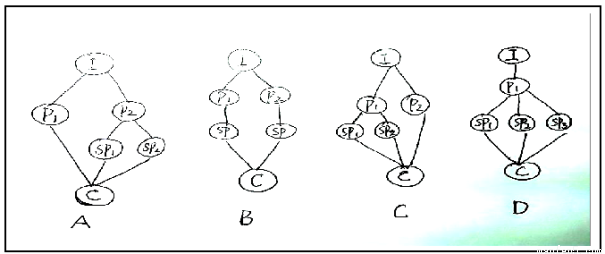
4.Which of the following best shows the structure of the passage?

I: Introduction P:Point Sp: Sub-point (次要点)C: Conclusion

违法和不良信息举报电话:027-86699610 举报邮箱:58377363@163.com

精英家教网