题目内容

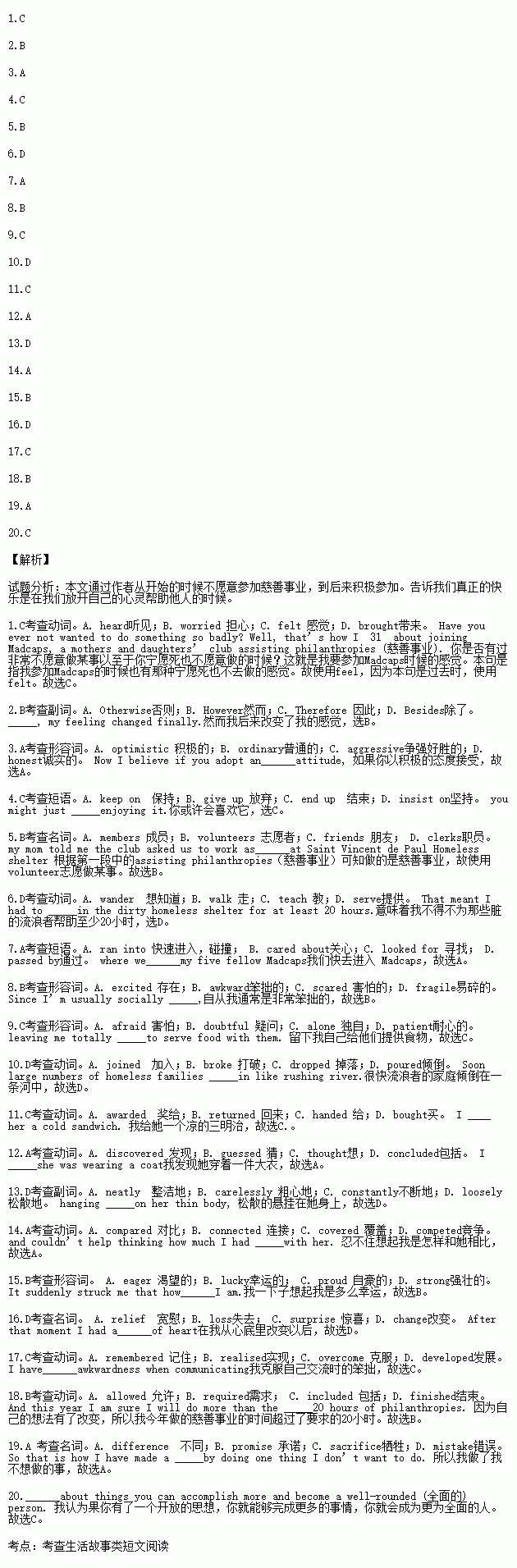
Have you ever not wanted to do something so badly? Well, that’s how I about joining Madcaps, a mothers and daughters’ club assisting philanthropies (慈善事业). , my feeling changed finally. Now I believe if you adopt an attitude, you might just enjoying it.

Six months ago, my mom told me the club asked us to work as at Saint Vincent de Paul Homeless shelter. That meant I had to in the dirty homeless shelter for at least 20 hours.

The first time we went there, a lady led us to the kitchen where we my five fellow Madcaps classmates they also wore the same expression. Since I’m usually socially , I had never talked with any of them earlier. Worse still, my mom was asked to help outside the kitchen, leaving me totally to serve food with them. Soon large numbers of homeless families in like rushing river. A little girl, around 5 years old, walked up to me. I her a cold sandwich. She took it and joined her family quickly. As she walked away, I she was wearing a coat, clearly too big for her, hanging on her thin body, and couldn’t help thinking how much I had with her. It suddenly struck me that how I am.

After that moment I had a of heart. Now I love Madcaps and don’t miss one meeting. I have awkwardness when communicating and have many friends. And this year I am sure I will do more than the 20 hours of philanthropies.

So that is how I have made a by doing one thing I don’t want to do. If you have an open

about things you can accomplish more and become a well-rounded (全面的) person.

1.A. heard B. worried C. felt D. brought

2.A. Otherwise B. However C. Therefore D. Besides

3.A. optimistic B. ordinary C. aggressive D. honest

4.A. keep on B. give up C. end up D. insist on

5.A. members B. volunteers C. friends D. clerks

6.A. wander B. walk C. teach D. serve

7.A. ran into B. cared about C. looked for D. passed by

8.A. excited B. awkward C. scared D. fragile

9.A. afraid B. doubtful C. alone D. patient

10.A. joined B. broke C. dropped D. poured

11.A. awarded B. returned C. handed D. bought

12.A. discovered B. guessed C. thought D. concluded

13.A. neatly B. carelessly C. constantly D. loosely

14.A. compared B. connected C. covered D. competed

15.A. eager B. lucky C. proud D. strong

16.A. relief B. loss C. surprise D. change

17.A. remembered B. realised C. overcome D. developed

18.A. allowed B. required C. included D. finished

19.A. difference B. promise C. sacrifice D. mistake

20.A. study B. plan C. mind D. question
练习册系列答案
相关题目

下面文章中有5处需要添加小标题,请从以下选项中选出符合各段意思的小标题,并在答题卡上将该项涂黑,选项中一项为多余选项。

A. Draw on the positives.

B. Deal with the pain.

C. Find support from others.

D. Use rejection to your advantage.

E. Don’t let negative feelings hold you down.

F. Keep track of your thoughts.

Harry Potter was rejected. So were Bella and Edward. If authors J.K. Rowling and Stephenie Meyer hadn’t kept trying with publisher after publisher, we’d all have missed out on some great adventures. Life is about going for things. And when we do, rejection is always a possibility. The better we get at dealing with rejection, the less it affects us. So how can you build that ability to cope? Here are some ideas:

1.

Coping well with rejection involves working with two things: how you feel and what you think. Let’s start with feelings: If you get rejected, acknowledge it to yourself. Don’t try to brush off the hurt or pretend it’s not painful. Instead of thinking “I shouldn’t feel this way,” think about how normal it is to feel like you do, given your situation.

Notice how intense your feelings are. Did this rejection upset you a lot? Or just a little? Cry if you want to or tell someone else what happened and how you feel about it.

2.

When you’re dealing with a painful emotion like rejection, it’s easy to get stuck in the bad feeling. But dwelling on the negative stuff can feel like living the experience over and over again. Not only does it keep hurting, it becomes harder to get past the rejection.

So admit how you feel but don’t dwell on it. Avoid talking or thinking about it nonstop. Why? Negative thinking influences our expectations and how we act. Getting stuck in a negative outlook might even bring about more rejection. It certainly doesn’t inspire a person to try again.

3.

Now on to what you think: Consider how you’re explaining the rejection to yourself. Are you being too hard on yourself? It’s natural to wonder, “Why did this happen?” When you give yourself an explanation, be careful to stick to the facts.

Tell yourself: “I got turned down for prom because the person didn’t want to go with me.” Don’t tell yourself: “I got turned down because I’m not attractive” or “I’m such a loser.” These aren’t facts. They’re imagining a reason, reading too much into a situation. If thoughts like these start creeping into your mind, shut them down.

4.

Tell yourself: “OK, so I got rejected this time. Maybe next time, I’ll get a ‘yes’ ” or “Oh, well. This is what happened. I don’t like it. But everyone gets rejected – and I can try again.”

Think about what you’re good at and what’s good about you. Remember times when you’ve been accepted, when you made the cut, when someone told you “yes.” Think of all the people who like you and support you. Remind yourself that you can handle the rejection. Even though you were turned down now, there will be another opportunity, another time.

5.

A rejection is a chance to consider if there are things we can work on. It’s OK to think about whether there’s room for improvement or if your goals were higher than your skills.

If your skills weren’t strong enough this time, maybe you need to work on your game, your studies, or whatever it takes to improve your chances of getting accepted next time. Use the rejection as an opportunity for self-improvement.

The disease Ebola is spreading in West Africa. The situation frightens both local citizens and travelers.

There is no vaccine or special treatment. It is difficult to stop Ebola from spreading. It moves easily from person to person. The disease strikes its victims through direct contact with the blood or other fluids from the body of an infected person.

The bodies of victims still contain the virus days after they die. Local traditions and burial and funeral customs also make the sickness hard to control. Doctors say it is important to identify an Ebola case early to prevent others from becoming infected. Patients suffer from high body temperature, bleeding and diarrhea(腹泻).

Only a few prevention measures exist. The Centers for Disease Control and Prevention in the U.S. suggest staying away from countries with confirmed Ebola cases. People at increased threat include those working in animal research, health care workers and others caring for patients in the community.

In the past, cases of Ebola have been confirmed in the Republic of the Congo, Cte d'Ivoire, Democratic Republic of the Congo, Gabon, Sudan, and Uganda.

Doctors advise careful protective measures if you must go to an area where Ebola exists.

If Ebola has been identified directly around you, the C.D.C. and W.H.O. strongly suggest wearing protective clothing. Cover your face and hands. Goggles can protect the eyes. Try to remove Ebola germs with cleaners that fight infection.

1.How does the disease Ebola spread? (No more than 16 words)

2.What makes the sickness hard to control? (No more than 10 words)

3.What symptoms do the Ebola patients have? (No more than 7 words)

4.Who are at increased threat according to the passage? (No more than 17 words)

Big trees are incredibly important ecologically. For a start, they provide food for countless other species and shelter for many animals. With their tall branches in the sun, they capture vast amounts of energy. This allows them to produce massive crops of fruit and flowers that sustain much of the animal life in the forest.

Only a small number of tree species have the genetic ability to grow really big. The biggest are native to North America, but big trees grow all over the globe, from the tropics to the forests of the high latitudes (纬度). To achieve giant size, a tree needs three things: the right place to establish its seedling, good growing conditions and lots of time with low adult death rate. Lose any of these, and you will lose your biggest trees.

In some parts of the world, populations of big trees are dwindling(逐渐变少) because their seedlings cannot survive. In southern India, for instance, an aggressive non-native bush, Lantana camara, is invading the floor of many forests. Lantana grows so thickly that young trees often fail to take root. With no young trees to replace them, it is only a matter of time before most of the big trees disappear.

Without the right growing conditions, trees cannot get really big and there is some evidence to suggest tree growth could slow in a warmer world, particularly in environments that are already warm. Having worked for decades at La Selva Biological Station in Puerto Viejo de Sarapiqui, Costa Rica, David and Deborah Clark and colleagues have shown that tree growth there declines markedly in warmer years. “During the day, their growth shuts down when it gets too warm, and at night they consume more energy because their metabolic (新陈代谢) rate increases,” explains David Clark. With less energy produced in warmer years and more being consumed just to survive, there is even less energy available for growth.

The darks’ theory, if correct, means tropical forests would shrink over time. The largest, oldest trees would progressively die off and tend not to be replaced. According to the Clarks, this might cause a destabilization(不稳定) of the climate; as older trees die, forests would release some of their stored carbon into the atmosphere, causing a cycle of further warming, forest shrinkage and carbon emissions.

Besides, big trees face threats from elsewhere.

1.According to the passage, big trees make great contributions to the ecosystem because .

A. they can capture large amounts of energy.

B. they determine the change of global climate.

C. they provide the essentials for many creatures.

D. they can avoid a new cycle of further warming.

2.All the following factors are a must for making big trees EXCEPT .

A. no deadly damage

B. genetic contribution

C. ideal environment for growth

D. high-latitude location

3. What is the best title of the passage?

A. Big trees in trouble.

B. Advantages of big trees.

C. Results of big trees’ disappearing.

D. Importance of big trees to humans.

4.What will the author most probably discuss after the last paragraph?

A. More threats to the existence of big trees.

B. The effect of human activities on big trees.

C. Benefits of big trees to the whole atmosphere.

D. Comparison between common trees and big ones.

违法和不良信息举报电话:027-86699610 举报邮箱:58377363@163.com

精英家教网