题目内容

Tone of voice is very important in human conversation. A person might use words that communicate one message and a tone that shows something very different. This possibility for confusion is one reason that businessmen encourage discussing things in person, rather than through email, as tone cannot be determined in the written form.

The same rule is true with children. Children as young as a few months respond to a change in voice. It has been recorded that babies prefer to hear a story read by their own mother rather than another woman whom they do not know.

Have you ever talked to someone who had little or no changes in their voice no matter what you were discussing? Think of the teacher or professor you had in the past that spoke in a monotone manner for the entirelecture. It is very boring and difficult to become interested in the topic.

Parents should make an active effort to communicate with your child. If your child figures out how to open a box he or she has been struggling with and says “YES!” with pride in his or her voice, your response should be happy and excited (something encouraging, like “You did it!”). If you plainly said the same thing, you would not be matching the tone of your child.

This applies to feelings that the child may express in everyday situations as well. If a child argues with a friend, your response should not be said in a high voice or with a smile. Seriously and sincerely you should say “You look sad” or “That must have been hard for you”.

The tone of your voice expresses understanding, acknowledgement, connection and several other healthy things to your child. Although your words are very important, equally important is the tone with which you say those words.

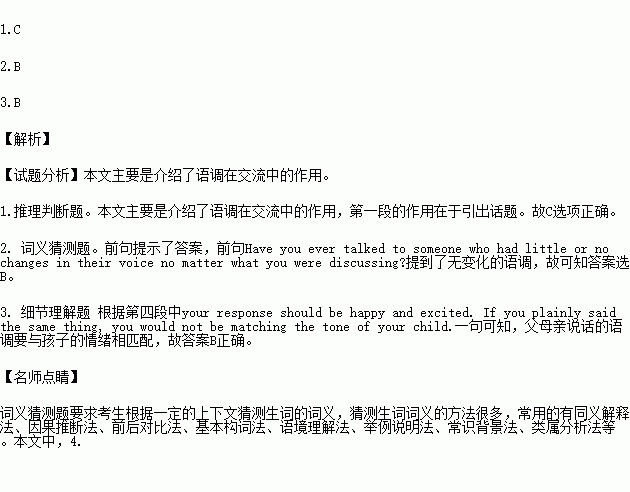
1.What’s the purpose of the first paragraph?

A. To tell us that our tone of voice is as important as the words we say.

B. To tell us that businessmen prefer to talk in person.

C. To lead to the topic of the passage.

D. To advise us to use different tones of voice correctly.

2.The underlined word “monotone” in the 3rd paragraph probably means a(n) ________ tone.

A. slowB. unchangingC. coldD. high

3.When communicating with their children, what are parents advised to do?

A. To hide their feelings with different tones of voice.

B. To use a tone of voice that can match their children’s feelings.

C. Not to speak to their children in a low voice.

D. To train their children to express their feelings by tone of voice.
练习册系列答案
相关题目

根据短文内容,从短文后的选项中选出能填入空白处的最佳选项。选项中有两项为多余选项。

One of the common complaints we hear from the people around us are problems they are facing. Every day and everywhere there are problems. Many times we find it hard to stay happy. When one problem is solved, another one comes up. How to solve them? The answer is that we must equip ourselves to deal with different kinds of worries by learning the three basic steps of problem analysis. The three steps are:

Get the facts

Why is it so important to get the facts? Unless you have the facts, you can’t possibly attempt to solve your problem intelligently. Without the facts, all you can do is wondering around in confusion. It is not an easy job to get facts. When you are worried, your emotions are riding high. 1.

When trying to get the facts, you can pretend that you are collecting this information not for yourself but for some other person. 2. You can also pretend that you are a lawyer preparing to agree. Try to get all the facts both on your side and the other side of the case. You will generally find the truth lies somewhere in between.

3.

Whenever you are worried, write down the questions that make you worry. And write out all the various steps you could take and then the probable consequences of each step. For example, what am I worrying about? What can I do about it? Here is what I’m going to do about it. After carefully weighing all the facts, you can calmly come to a decision.

Act on that decision.

4. How can you break the worry habit before it breaks you? Crowd worry out of your mind by keeping busy. Plenty of action is one of the best ways to cure worry.

5. If you know a situation is beyond your power, say to yourself: “It is so; it can’t be otherwise.” Don’t permit little things to ruin your happiness. Try to cultivate a mental attitude that will bring you peace and happiness.

A. Analyze the facts.

B. Accept what can’t be avoided.

C. Decide how much anxiety a thing may be worth.

D. This will help you to take a cold and fair view of the evidence.

E. There comes a time when you must decide and never look back.

F. But here are two ideas that can help you see the facts in a clear and objective way.

G. Unless you take your action, all your fact-finding and analysis is a sheer waste of energy.

阅读下面短文,掌握其大意,从短文后所给的四个选项(A、B、C和D)中,选出可以填入空白处的最佳选项,并在答题卡上将该项涂黑。

Years ago a professor gave a group of graduate students this assignment:Go to the slums(贫民窟).Take 200 boys between the ages of 12 and 16, investigate their ________ and environment and then ________ their chances for the future. The students,after ________ social statistics,talking to the boys and compiling(汇编) much data, ________ that 90 percent of the boys would spend some time in ________.

Twenty?five years later another group of graduate students were given the job of ________ the previous prediction. They went back to the ________ area. Some of the boys—now ________ —were still there,a few had died and some has moved away. But they managed to ________ 180 of the original 200. They found that only four of the boys had ever been sent to prison.

Why was it that these men,who had lived in a breeding place of ________,had such surprisingly ________ record?The researchers were ________ told. “Well,there was a ________.”

They investigated ________ and found that in 78 percent of the ________ it was the same woman. The researchers went to the teacher,now living in a home for ________ teacher. How had she had this remarkable ________ on that group of children?Could she give them any reason why these boys ________ her?“No,”she said,“I really couldn't.” And then,________ over the years,she said musingly(沉思地),more to herself than to her questioners,“I ________ these boys.” The researchers finally realized that it was the teacher's care that made a difference.

1.A. safetyB.nationalitiesC.healthD. backgrounds

2.A. adviseB.increaseC.predictD.check

3.A. consultingB.preparingC.offeringD.showing

4.A. discussedB.concludedC.introducedD.expected

5.A. businessB.schoolC.hospitalD.prison

6.A. testingB.explainingC.findingD.making

7.A. specialB.sameC.onlyD.lonely

8.A. workersB.teenagersC.menD.students

9.A. recordB.findC.knowD.trace

10.A. diseaseB.magicC.disasterD.crime

11.A. reliableB.goodC.detailedD.bad

12.A. normallyB.graduallyC.continuallyD.nearly

13.A. teacherB.doctorC.directorD.friend

14.A. tooB.insteadC.alreadyD.further

15.A. casesB.mannersC.statesD.ways

16.A. determinedB.well-knownC.retiredD.skilled

17.A. techniqueB.influenceC.courageD.advantage

18.A. rememberedB.rewardedC.treatedD.frightened

19.A. looking aroundB.going on

C.working outD.thinking back

20.A. persuadedB.remindedC.lovedD.taught

It was one of the hottest days of the dry season. We had not seen rain in almost a month. The crops were dying. Cows had stopped giving milk. The streams were long gone back into the earth. If we didn't see some rain soon we would lose everything.

I was in the kitchen making lunch for my husband and his brothers when I saw my six-year old son, Billy, walking toward the woods. He was obviously walking with a great effort... trying to be as still as possible. Minutes after he disappeared into the woods, he came running out again, toward the house.

Moments later, however, he was once again walking in that slow purposeful long step toward the woods. This activity went on for over an hour: walking cautiously to the woods, then running back to the house. Finally, my curiosity got the best of me. I crept out of the house and followed him on his journey.

He was cupping both hands in front of him as he walked; being very careful not to spill the water he held in them. Branches and thorns slapped his little face but he did not try to avoid them. He had a much greater purpose. As I leaned in to spy on him, I saw the most amazing site.

Several large deer appeared threatening in front of him. But Billy walked right up to them. I almost screamed for him to get away. And I saw a baby deer lying on the ground, obviously suffering from heavy loss of water and heat exhaustion, lift its head with great effort to lap up the water cupped in my beautiful boy's hand.

I stood on the edge of the woods watching the most beautiful heart I have ever known working so hard to save a life. As the tears that rolled down my face began to hit the ground, they were suddenly joined by other drops... and more drops... and more. I looked up at the sky. It was as if God, Himself, was weeping with pride.

1.Why did the author follow her son?

A. Because there might be danger.

B. Because her son was doing a good deed.

C. Because she intended to help.

D. Because she was curious.

2.Which of the following statements is Not True according to the passage?

A. Rain was in great need.

B. Billy carried water with his small hands.

C. There were few trees in the woods.

D. Billy walked into the woods and then returned over and over again.

3.Which is the correct order of the development of the story?

① The author was moved to tears.

② Billy fed the water to the baby deer.

③ Billy walked towards the large deer.

④ It began to rain.

⑤ The author followed Billy into the woods.

A. ③②⑤①④B. ⑤③②①④

C. ④①③②⑤D. ⑤②①③④

4.At the end of the story, the author might experience different feelings Except that ________.

A. Billy was a pride

B. God was touched by Billy's activity

C. the rain should have dropped earlier

D. it was worthwhile to have given birth to Billy

违法和不良信息举报电话:027-86699610 举报邮箱:58377363@163.com

精英家教网