题目内容

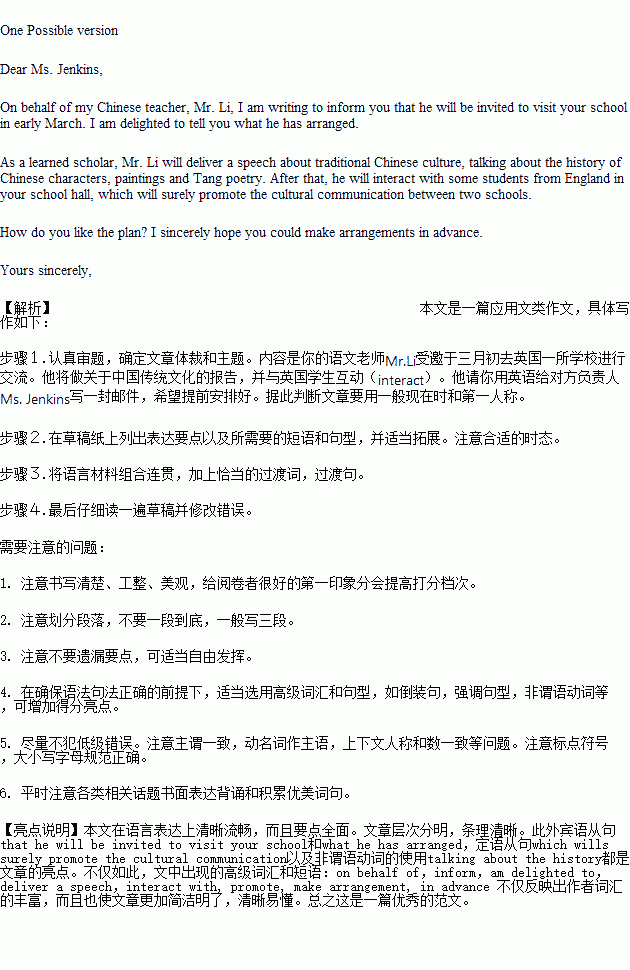
假定你是李华,你的语文老师Mr.Li受邀于三月初去英国一所学校进行交流。他将做关于中国传统文化的报告,并与英国学生互动(interact)。他请你用英语给对方负责人Ms. Jenkins写一封邮件,希望提前安排好。

注意:1.词数100左右;

2.可以适当增加细节,以使行文连贯。

Dear Ms. Jenkins.

___________________________________________________________________________________________________________________________________________________________________________________________________________________________________________________________________________________________________________________________________________________________________________________________________________________________________________________________________________________________________________________________________________________________________________________________________________________________________________________________________________Yours faithfully,

Li Hua
练习册系列答案
相关题目

Anvitha Vijay has built two educational apps and is at work on a third. She aims to use her skills to help others.

Need an app for that? Anvitha Vijay, 9, can build it. With the help of YouTube videos, the young techie from Melbourne, Australia, learned to code at age 7. Soon, she was trying her hand at making apps.

“When I first got my iPad, I was fascinated by all the apps on it,” she told TFK. “It wasn’t long before I wanted to create my own.”

She built her first two apps with her younger sister in mind. Smartkins Animals helps children identify more than 100 animals and their sounds. Smartkins Rainbow Colors teaches kids colors. Each app has been downloaded thousands of times.

Anvitha’s skills won her a scholarship to attend a big tech conference hosted by Apple in San Francisco, California. There, she got applicable tips from the pros. She went to workshops where she learned about the latest software for app building. All that training led to an idea for a third app. This one, called GoalsHi, inspires kids to practice good habits. Users are rewarded for achieving goals, such as eating their vegetables or practicing piano. Anvitha says the rewards are like getting a sticker for a job well done. “Kids can set goals with this app and get stars when they achieve them,” she says. “The idea is to empower and motivate kids to achieve one little step a day.”

Anvitha’s goal is to continue creating technology that helps kids learn while having fun. But even more important to her is that the world sees the power of technology in kids’ hands. “The more training we get in tech at an early age,” she says, “the better chance we have of becoming innovation champions who will one day change the world.”

1.What can we know about Anvitha?

A. She made her first app at 7.

B. She first learned about apps through her iPad.

C. She made a speech at the conference in California.

D. She used her scholarship to try making her third app.

2.What’s the function of GoalsHi?

A. To help kids identify colors.

B. To help kids recognize animals.

C. To inspire kids to achieve all goals.

D. To motivate kids to form good habits.

3.Why does Anvitha try to make apps?

A. To win a scholarship.

B. To help children have fun.

C. To help kids and in turn change the world.

D. To show her talent and skills of technology.

I had five hours in the company of First Great Western(FGW) last weekend, on a train full of passengers, all the way from Cornwall to London. I got to know some of my fellow passengers rather well. Not through talking to them, you understand.

There was the youth who was explaining to his friend exactly how he enjoyed a party with his friends last night. Opposite him was a young woman who was very excited to be going to Lanzarote for her summer holiday. And then there was the man who I took to be a car mechanic(汽车修理工); so detailed and technical was his conversation about a second-hand Audi. Everyone had a different, noisy ringtone, and none of the mobile phone conversations I was forced to hear was interesting.

By the end of the journey, I was silently complaining about the modern world, and feeling mad with FGW who, at the very moment when our carriage fell silent, would make an announcement about the buffet car (a carriage where food and drinks are sold) either opening or closing.

FGW seems to be campaigning against peace and quietness, having removed quiet carriage spaces where passengers were requested not to use mobiles so that their trains could carry more passengers. How so? I cannot understand why FGW takes no notice of passengers like me, who have suffered a lot from hearing endless telephone conversations. I have no interest in the smallest details of others’ lives. Making people listen to boring mobile phone conversations should be regarded as a rude act.”

Every train carriage should, in theory, be quiet. Why can’t that be the standard? It is possible to change public custom and practice. It was not so long ago that sidewalks were littered with dog waste:now it’s a general rule that dog owners clean it up after their pets. And once we restore peace and quietness to trains, we can then move on and stop people bringing fast food onto them, too.

1.How did the author get to know the three passengers?

A.From their phone conversations.

B.Through introductions.

C.In informal conversations.

D.By using a mobile phone.

2.At the end of the journey, the author ______.

A.became satisfied with FGW’s service

B.felt uneasy about the silence

C.was filled with anger

D.went to the buffet car

3.What can we learn about the author from Paragraph 4?

A.He is in support of the decision of FGW.

B.He believes FGW will have more passengers.

C.He dislikes hearing others’ phone conversations.

D.He thinks it’s rude to listen to others’ conversations.

4.The author mentioned the rule of cleaning up dog mess to show ____.

A.dog mess has become a serious problem

B.quiet carriages can become the standard

C.noise in carriages is as troubling as dog mess

D.changing public custom and practice is difficult

When Columbus ‘sailed the ocean blue in 1492’ wasn’t looking for America, he was searching for a route from Spain to China; America just got in the way.

The Spanish were after the riches of Asia: silk, dates, spices. Until later adventures discovered how to sail to the Far East, trade with China depended on the Silk Road. The trade between China and Europe brought huge wealth, so the Spanish had a strong desire to find a new way to the East. Eventually a way appeared; as sea traffic developed from the 17th Century onwards, the overland route diminished.

Now China is seeking to revive(复兴) the Silk Road and is preparing to invest 4 trillion pounds in new road, rail links, oil pipelines and other basic facilities. It is hoped that goods can be shipped westwards by land far more quickly and economically than by sea.

But the plan is also to attract more tourists. Actually, China does pretty well for tourists already; it’s the world’s fourth most visited country. Two cities — Beijing and Shanghai — possess the tourism business, with significant interest in destinations such as Xi’an and Chengdu. While Beijing is modern, cities such as Lanzhou and Dunhuang have one foot planted firmly in old China.

Other places featured include Xi’an, the former capital of China, where you can come face to face with the Terracotta Army built to protect China’s first emperor in the afterlife. From Lanzhou tour members take the train to Jiayuguan, China’s western gateway and a key location on the Silk Road.

There is also a four-day coach journey along the original Silk Route through the Xinjiang region to Kashgar. Along the way, at Kurla, you can visit the ruins of the Iron Fortress.

1.What does the underlined word “diminished” in Paragraph 2 mean?

A. Discovered. B. Disappeared. C. Disturbed. D. Displayed.

2.What is the purpose of reviving the Silk Road?

A. To rebuild the ruins of the Iron Fortress.

B. To construct new roads and other basic structures.

C. To make transportation westwards faster and cheaper.

D. To draw more inland tourists’ attention to the western gateway.

3.What can we learn about the Silk Road?

A. It is nothing but a trade route.

B. It may destroy some cities’ ancient style.

C. It attracts foreign investment of ? 4 trillion.

D. It promotes the tourism industry of China.

4.What is the best title for the text?

A. The Charming of the Silk Road B. The function of the Silk Road

C. The origin of the Silk Road D. The future of the Silk Road

My name is Peter, and I use a wheelchair to get around. This year I ____ to be in the School Walkathon.

At the Walkathon last year, I helped hand out drinks to the walkers. The teachers and parents said they couldn’t have ____ without me.

“Are you going to give out drinks ____ this year?” my friend Michael asked.

“I ____ so,” I said. “But I ____ wish I could do laps (跑道的圈) with you.”

Michael told Mrs Hunt that I wanted to ____ the Walkathon. Mrs Hunt looked at me. “It’s not a good course for a wheelchair,” she said. “The hilly part would be too ____.”

“But I could push Peter over the hard bits,” said Michael.

“I’ll ____ it,” said Mrs Hunt.

That afternoon, Mrs Hunt called a class meeting. Michale told everyone about his ____.

“We could all take turns. That way no one would get too ____,” said Olivia. Then everyone said they would take a turn.

When the Walkathon began, I turned my wheels round and round as ____ as I could. When we came to the hilly bit, Michael ____ to push me up it. Olivia was waiting halfway up. “My ____ now,” she said. With all the help my ____ were giving me, I ____ the first lap and did a second lap — and another. I was tired in the ____.

“It’s time to announce the winner of the mystery prize. It goes to ... Peter!” Mrs Hunt said.

I looked at all the things I had ____, and felt extremely ____. But then I remembered that the whole ____ had helped me.

“I want everyone to ____ the prize,” I said. “Let’s keep all the things in our classroom. Then we can all have some fun!”

And that’s what we did.

1.A. need B. agree C. want D. offer

2.A. remembered B. waited C. helped D. managed

3.A. soon B. again C. once D. first

4.A. suppose B. hope C. do D. say

5.A. never B. really C. partly D. still

6.A. lead B. organize C. give up D. join in

7.A. difficult B. serious C. important D. different

8.A. take control of B. have pity on C. think about D. look after

9.A. fear B. idea C. success D. story

10.A. sad B. dirty C. slow D. tired

11.A. fast B. long C. far D. often

12.A. forgot B. avoided C. started D. hated

13.A. break B. decision C. turn D. plan

14.A. teachers B. friends C. parents D. neighbors

15.A. finished B. caught C. prevented D. wasted

16.A. day B. way C. past D. end

17.A. owned B. expected C. won D. discovered

18.A. nervous B. happy C. bored D. young

19.A. class B. family C. school D. world

20.A. share B. receive C. value D. show

违法和不良信息举报电话:027-86699610 举报邮箱:58377363@163.com

精英家教网