题目内容

阅读下面短文,从短文后各题所给的四个选项(A、B、C和D)中,选出可以填入空白处的最佳选项,并在答题卡上将该项涂黑。

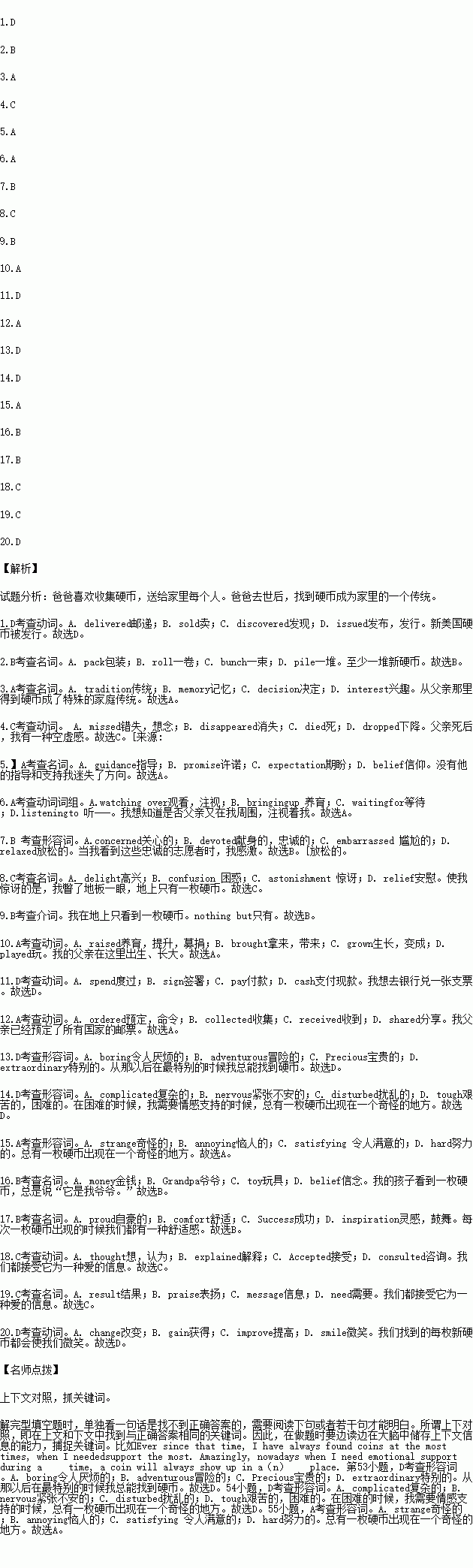
My dad always collected coins. He was delighted when the new U.S. state coins were _________ .He would walk to his long-time bankers and make sure they put at least a _________ of new coins aside for him. He gave them to every family member. It gradually became a special family __________ to get coins from Dad.

When my dad _________, I felt such a sense of emptiness. My father and I had been so close. Iwas lost without his _________ and support. I wondered if I would ever feel my dad around me again, __________ me. It was right after Hurricane Katrina and I was doing a motivational meeting for aboutthree hundred volunteers. At the end of the event, I felt so grateful as I looked at these __________individuals. To my _________ , when I glanced at the floor, I saw nothing _________ a coin, from NorthCarolina, the state in which my dad was born and _________ .

Then two months later, I went back to visit my mom. While I was there, I went to the bankto ___________ a check. The bank manager, who had known me, called me into her office, showing methe coins for all the states my dad had _________ .

Ever since that time, I have always found coins at the most _________ times, when I neededsupport the most. Amazingly, nowadays when I need emotional support during a _________ time, a coin will always show up in a(n) _________ place.

It has now become a tradition in my family. Every time a coin appears in our house, oneof my kids says, “Oh, it’s _________! ”We all feel a sense of _________ every time a single coin turnsup in an unexpected place. We have all _________ it as a _________ of love, guidance and support fromDad — and every new coin we find makes us _________ .

1.A. delivered B. sold C. discovered D. issued

2.A. pack B. roll C. bunch D. pile

3.A. tradition B. memory C. decision D. interest

4.A. missed B. disappeared C. died D. dropped

5.A. guidance B. promise C. expectation D. belief

6.A.watchingover B. bringingup C. waitingfor D. listeningto

7.A.concerned B. devoted C. embarrassed D. relaxed[

8.A. delight B. confusion C. astonishment D. relief

9.A. from B. but C. with D. for

10.A. raised B. brought C. grown D. played

11.A. spend B. sign C. pay D. cash

12.A. ordered B. collected C. received D. shared

13.A. boring B. adventurous C. Precious D. extraordinary

14.A. complicated B. nervous C. disturbed D. tough

15.A. strange B. annoying C. satisfying D. hard

16.A. money B. Grandpa C. toy D. belief

17.A. proud B. comfort C. Success D. inspiration

18.A. thought B. explained C. Accepted D. consulted

19.A. result B. praise C. message D. need

20.A. change B. gain C. improve D. smile
练习册系列答案
相关题目

The role of a newspaper is to present and comment on the news. It is vital for keeping people well-informed on current affairs. In most Western countries, journalists try to shape the ideas and opinions of their readers, since in Western countries all newspapers are independent of the government. Some newspaper owners support liberal ideas including economic policies that help poor people. Other owners want policies such as lower taxes for rich people and less money to be given to poor people. You can almost judge the political ideas of a person in the West by looking at the newspaper he reads.

All newspapers report national and international news. They give the facts but also provide opinions on controversial issues in the editorials and columns of opinion. The readers of the newspaper can also comment on these editorials or articles. There are many informative articles too as well as reviews of new films and books, etc. These are very important, for if a film or book gets good reviews it will often become more successful.

All these articles require many journalists who are experts in different areas of life. All these articles come together and are checked by the chief editor of the newspaper. When he or she has made a decision on the articles, the newspaper is prepared for printing. All this work means that the journalists must work together as a team because there is a lot of pressure when you work in a newspaper office. There are constant deadlines and articles have to be fitted round advertisements, photographs and much, much more.

1.What does the underlined word “be fitted” mean?

A. be suitable B. be put

C. be read D. be measured

2.What articles comment on controversial issues?

A. Editorials and opinion columns.

B. News stories.

C. Some of the informative articles.

D. Jokes and humour.

3.Which is true about the journalists in Western countries?

A. There’s no time limit for their report articles.

B. They have no right to influence the readers’ opinions.

C. A newspaper can come out with just a journalist working individually.

D. Journalists must submit their articles before the due date.

4.Why are good reviews important to books?

A. Good reviews are excellent introduction to books.

B. Readers especially favour books with good reviews.

C. Good reviews can make readers feel relaxed and comfortable.

D. Good reviews can bring a large circulation(发行量) of the books reviewed.

An article published recently in the scientific journal Nature is shedding new light on an important, but so far little has been appreciated, aspect of human evolution. In this article, Professors Dennis Bramble, and Daniel Lieberman suggest that the ability to run was a decisive factor in the development of our species. According to the two scientists, humans possess a number of anatomical(人体结构的)features that make them surprisingly good runners. “We are very confident that strong selection for running,which came at the expense of the historical ability to live in trees-was helpful in the origin of the modern human body form,” says Bramble, a biology professor at the University of Utah.

Traditional thinking up to now has been that the upright body form of modern humans has come about as a result of the ability to walk, and that running is simply a by-product of walking. Furthermore, humans have usually been regarded as poor runners compared to such animals as dogs, horses or antelopes. However, this is only true if we consider fast running over short distances. Even Olympic athlete can hardly run as fast as a horse can gallop, and can only keep up a top speed for fifteen seconds or so. Horses and antelopes, on the other hand, can run at top speed for several minutes, clearly outperforming us in this respect. But when it comes to long-distance running, humans do astonishingly well. They can maintain a steady pace for miles, and their overall speed compares favorably with that of horses or dogs.

Bramble and Lieberman examined twenty-six anatomical features found in humans. One of the most interesting of these is the nuchal ligament(颈背的韧带). When we run, it is this ligament that prevents our head from pitching back and forth or from side to side. Therefore, we are able to run with steady heads held high. The nuchal ligament is not found in any other surviving primates(灵长类动物), although the fossil(化石)record shows that Homo erectus, an early human species that walked upright, much as we do, also had one. Then there are our Achilles tendons(跟腱)at the backs of our legs, which have nothing to do with walking. When we run, these tendons behave like springs, helping to push us forward. Furthermore, we have low, wide shoulders, virtually disconnected from our skulls (the bony part of the head), another anatomical adaptation which allows us to run more efficiently.

But what evolutionary advantage is gained from being good long-distance runners? One assumption is that this ability may have permitted early humans to obtain food more effectively. “What these features and fossil facts appear to be telling us is that running evolved in order for our direct ancestors to compete with other carnivores (animals that eat meat) for access to the protein needed to grow the big brains that we enjoy today.” says Lieberman.

1.We can learn from the passage that the human ability to run _______.

A. was only recently described in a scientific journal

B. played an important part in human evolution

C. was considered more natural than the ability to live in trees

D. contributed to the form of human language

2.According to the second paragraph, humans _______

A. are better runners than most other animals

B. are not good at running short distances

C. compare unfavorably with horses and dogs

D. are poor long-distance runners

3.It appears that the nuchal ligament _______.

A. enables us to run with steady heads

B. is found in modern primates only

C. prevents the head from being held high

D. is a unique feature of carnivores

4.The passage does NOT tell us that _______

A. early humans had an advantage in obtaining food thanks to the running ability

B. fossils help us better understand human evolution.

C. our Achilles tendons are an adaptation for running efficiently

D. big brains may have been evolved for running long-distance

With only about 1,000 pandas left in the world, China is desperately trying to clone (克隆) the animal and save the endangered species(物种).That's a move similar to what a Texas A&M University researchers have been undertaking for the past five years in a project called “Noah's Ark”.

Noah's Ark is aimed at collecting eggs, embryos(胚胎),semen and DNA of endangered animals and storing them in liquid nitrogen(氮). If certain species should become extinct, Dr.Duane Kraemar, a professor in Texas A&M University Medicine, says there would be enough of the basic building blocks to reintroduce the species in the future.

It is estimated that as many as 2,000 species of mammals, birds reptiles will become extinct in over 100 years. The panda, native only to China, is in danger of becoming extinct in the next 25 years.

This week, Chinese scientists said they grew an embryo by introducing cells from a dead female panda into the egg cells of a Japanese white rabbit. They are now trying to implant the embryo into a host animal.

The entire procedure could take from three to five years to complete.

“The nuclear transfer(核子移植) of one species to another is not easy, and the lack of available(capable of being used) panda eggs could be a major problem,”Kraemer believes. “They will probably have to do several hundred transfers to result in one pregnancy (having a baby). It takes a long time and it’s difficult, but this could be groundbreaking science if it works. They are certainly not putting any live pandas at risk, so it is worth the effort,” adds Kraemer, who is one of the leaders of the Project at Texas A & M, the first–ever attempt at cloning a dog.

“They are trying to do something that’s never been done, and this is very similar to our work in Noah’s Ark. We’re both trying to save animals that face extinction. I certainly appreciate their effort and there’s a lot we can learn from what they are attempting to do. It’s a research that is very much needed.”

1.The aim of “Noah’s Ark” project is to________.

A. make efforts to clone the endangered pandas

B. save endangered animals from dying out

C. collect DNA of endangered animals to study

D. transfer the nuclear of one animal to another

2.The underlined word groundbreaking can be interpreted as __________.

A. especially new B. pioneering

C. damaging D. trouble- making

3.The best title for the passage may be ______.

A. China’s Success in Panda Cloning

B. The First Cloned Panda in the World

C. Exploring the Possibility to Clone Pandas

D. China---the Native Place of Pandas Forever

4.From the passage we know that _______.

A. Kraemer and his team have succeeded in cloning a dog

B. scientists try to implant a panda’s egg into a rabbit

C. Kraemer will work with Chinese scientists in clone researches

D. about two thousand species will probably die out in a century

完形填空

阅读下面短文,从短文后所给各题的四个选项(A、B、C、D)中选出可以填入空白处的最佳选项,并在答题卡上将该项涂黑。

The story of “Making Pancakes” reminds me of Mother’s Day in Georgia in 1970. That _________,my family and I were at the Church_________for the preacher (牧师)to begin when I looked around noticing our 12-year-old son was_________. My wife and I looked at each other with_________eyes, thinking he was _________outside playing with his friends.

Thirty minutes later the preacher was well into his sermon (讲道) and _________ no son.Since we only _________ about a block from the Church,all through the sermon I was _________he had gone home to watch television. _________the preacher finished hissermon,my wife and I rushed for the door. With_________building with every step I took toward the house,I _________ what I would say and what I would do as soon as we found him.

With all that tension and anxiety_________,can you imagine our surprise when we walked into the house and found him sitting on the sofa waiting for us with a(an) _________? I was just about to let it all _________ ,when without saying a word he stood, took his mother by the hand,and _________her into the kitchen.

There before us was a _________table of food spread our 12-year-old son had _________for my wife as his Mother’s Day gift with his smile.Later,we learned he left_________after Sunday School to rush home to have it ready for his mom.

In our life,we often look at our circumstances and think how _________things are. Then when we see the_________ of the cases,wecan only bow our humble (卑微的)heads in amazement at how things turned out for our good!

1.A. Monday B. Wednesday C. Sunday D. Tuesday

2.A. calling B. waiting C. looking D. searching

3.A. absent B. present C. naughty D. honest

4.A. tearful B. friendly C. frightening D. questioning

5.A. surely B. probably C. actually D. exactly

6.A. already B. ever C. still D. either

7.A. lived B.worked C. studied D. traveled

8.A. remembering B. forgetting C. proving D. thinking

9.A. Now that B. In order that C. As soon as D. Even though

10.A. joy B. anger C. sadness D. pride

11.A. explained B. confused C. ignored D. imagined

12.A. growing B. changing C. dropping D. stopping

13.A. apology B. excuse C. smile D. frown

14.A. up B. out C. down D. in

15.A. forced B. drove C. talked D. led

16.A. beautiful B. terrible C. magical D. dreamful

17.A. bought B. carried C. prepared D. borrowed

18.A. slowly B. immediately C. carefully D. secretly

19.A. bad B. lucky C. good D. strange

20.A. beginning B. ability C. power D. outcome

阅读下面短文,从短文后各题所给的四个选项(A、B、C和D)中,选出可以填入空白处的最佳选项。

John entered a college and often worked late until 12 at night. He fell into the _______ of smoking a year ago. He smoked so much that he _______ had a cigarette on his lips. He _______ while he read, while he watched television and _______ while he drank a cup of coffee or tea. He smoked nearly forty cigarettes a day, but he was _______.

John's friend, Frank, _______ many times to _______ him not to smoke. “Smoking is bad for your _______!” he said. “You'd better give it up.” But his advice didn't _______.

Before long, John found that he often got a hard and _______ cough, _______ he went to see a doctor. The doctor _______ him carefully and asked whether he often smoked. John told him the _______. Then the doctor told him that his cough was _______ by smoking and he wouldn't get any better unless he stopped smoking.

“If not,” said the doctor, “your cough will never be _______ and some other illnesses may also be caused.” John became _______ and made up his mind to give up smoking. At the beginning, it was very _______ for him. Every _______ when he wanted to smoke, he got something to eat. At last, he was not _______ smoking at all. And he no longer had _______.

1.A. hole B. habit C. interest D. love

2.A. still B. seldom C. never D. always

3.A. stopped B. smoked C. ate D. had

4.A. still B. just C. even D. only

5.A. happy B. tired C. proud D. calm

6.A. talked B. ordered C. worked D. tried

7.A. advise B. force C. order D. call

8.A. work B. study C. health D. life

9.A. continue B. work C. reply D. answer

10.A. wet B. loud C. dry D. rapid

11.A. but B. so C. for D. as

12.A. saw B. felt C. cured D. examined

13.A. truth B. reason C. matter D. thing

14.A. shown B. kept C. caused D. resulted

15.A. stopped B. cured C. helped D. passed

16.A. angry B. sad C. sorry D. worried

17.A. sick B. tired C. difficult D. ill

18.A. day B. time C. way D. place

19.A. surprised at B. excited about C. worried about D. interested in

20.A. worries B. problems C. coughs D. cigarettes

违法和不良信息举报电话:027-86699610 举报邮箱:58377363@163.com

精英家教网