题目内容

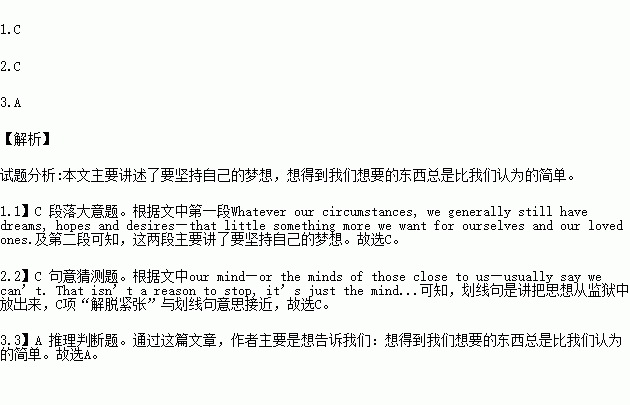
Life can be so wonderful, full of adventure and joy. It can also be full of challenges, setbacks(挫折)and heartbreaks. Whatever our circumstances, we generally still have dreams, hopes and desires—that little something more we want for ourselves and our loved ones. Yet knowing we can have more can also create a problem, because when we go to change the way we do things, up come the old patterns and pitfalls(陷阱)that stopped us from seeking what we wanted in the first place.

This tension between what we feel we can have and what we are seemingly able to have is niggling(烦人的) suffering, the anxiety we feel. This is where we usually think it is easier to just give up. But we are never meant to let go of the part of us that knows we can have more. The intelligence behind that knowing is us—the real us. It’s the part that believes in life and its possibilities. If you drop that, you begin to feel a little “dead” inside because you are dropping “you”.

So, if we have this capability but somehow life seems to keep us stuck, how do we break these patterns?

Decide on a new course and make one decision at a time. This is good advice for a new adventure or just getting through today’s challenges.

While, deep down, we know we can do it, our mind—or the minds of those close to us—usually say we can’t. That isn’t a reason to stop, it’s just the mind, that little man or woman on your shoulder, trying to talk you out of something again. It has done it many times before. It’s all about starting simple and doing it now.

Decide and act before overthinking. When you do this you may feel a little, or large, release from the jail of your mind and you will be on your way.

1.It can be inferred from the first two paragraphs that we should ________.

A. slow down and live a simple life

B. be careful when we choose to change

C. stick to our dreams under any circumstances

D. be content with what we already have

2.Which of the following best explains the underlined part in the last paragraph?

A. Escape from your punishment.

B. Realization of your dreams.

C. Freedom from your tension.

D. Reduction of your expectations.

3.What does the author intend to tell us?

A. It’s easier than we think to get what we want.

B. It’s important to learn to accept sufferings in life.

C. It’s impractical to change our way of thinking.

D. It’s harder than we expect to follow a new course.
练习册系列答案
相关题目

根据短文内容,从短文后的选项中选出能填入空白处的最佳选项。选项中有两项为多余选项。

How to Study for a Test

With exams approaching, how can you study for a test? The most important thing you can do is give yourself plenty of time to prepare. Then follow this simple plan:

Start early

Gather together all the material you’ve received during the term. You probably have handouts, notes, old assignments, and old tests. Don’t leave anything out.

Establish a study group or partner

__1.__. If you absolutely can’t get together, then exchange email addresses. Instant messages will work well, too.

Use old tests

Collect your old exams from the year or semester and make a photocopy of each one. White out (不透明) the test answers and copy each one again. __2.__. For best results, you should make several copies of each old exam and keep taking the tests until you score perfectly on each one.

___3._

Organize your notes by date. If you didn’t date your pages, make note of any missing dates/pages. Get together with a study partner or group to compare notes and fill in any missing material. After you organize your new set of notes, underline all key words, formulas, themes and concepts. Without referring to your notes, ask the members of your study group to test you. __4.___.

Old assignments

Gather any old assignments and re-do the exercises. __5.___. Review and do them again and again until you entirely master them.

A.Test yourself again

B.Use different textbooks

C.Build up your class notes

D.Then swap your roles with them

E.Every student should participate in class discussion

F.Many textbooks have exercises at the end of every chapter

G.Schedule at least one meeting time with a study partner or study group

Tom goes everywhere with Catherine Green, a 54-year-old secretary. He moves around her office at work and goes shopping with her. "Most people don't seem to mind Tom," says Catherine, who thinks he is wonderful. "He's my fourth child," she says. She may think of him and treat him that way as her son. He moves around buying his food, paying his health bills and his taxes, but in fact Tom is a dog.

Catherine and Tom live in Sweden, a country where everyone is expected to lead an orderly life according to rules laid down by the government, which also provides a high level of care for its people. This level of care costs money.

People in Sweden pay taxes on everything, so aren't surprised to find that owning a dog means more taxes. Some people are paying as much as 500 Swedish kronor in taxes a year for the right to keep their dog, which is spent by the government on dog hospitals and sometimes medical treatment for a dog that falls ill. However, most such treatment is expensive, so owners often decide to offer health and even life premium for their dog.

In Sweden dog owners must pay for any damage their dog does. A Swedish Kennel Club official explains what this means: if your dog runs out on the road and gets hit by a passing car, you, as the owner, have to pay for any damage done to the car, even if your dog has been killed in the accident.

1.Catherine pays taxes for Tom because ________.

A. Tom follows her everywhere

B. Tom is her child

C. Tom is her dog

D. Tom often falls ill

2.The money paid as dog taxes is used to ________.

A. keep a high level of care for the people

B. pay for damage done by dogs

C. provide medical care for dogs

D. buy insurance for dog owners

3.The underlined world "premium" possibly means ________.

A. payment for risks B. medical check

C. entertainment expense D. protection fee

4.If a dog causes a car accident and gets killed, who should pay for the damage done to the car?

A. The owner of the car.

B. The owner of the dog.

C. The insurance company.

D. The government.

Arriving in Sydney on his own from India, my husband, Rashid, stayed in a hotel for a short time while looking for a house for me and our children.

During the first week of his stay, he went out one day to do some shopping. He came back in the late afternoon to discover that his suitcase was gone. He was extremely worried as the suitcase had all his important papers, including his passport.

He reported the case to the police and then sat there, lost and lonely in the strange city, thinking of the terrible troubles of getting all the paperwork organized again from a faraway country while trying to settle down in a new one.

Late in the evening, the phone rang. It was a stranger. He was trying to pronounce my husband’s name and was asking him a lot of questions. Then he said they had found a pile(堆) of papers in their trash can(垃圾桶) that had been left out on the footpath.

My husband rushed to their home to find a kind family holding all his papers and documents(文件). Their young daughter had gone to the trash can and found a pile of unfamiliar(不熟悉的) papers. Her parents had carefully sorted them out, although they had found mainly foreign addresses on most of the documents. At last they had seen a half-written letter in the pile in which my husband had given his new telephone number to a friend.

That family not only restored the important documents to us that day but also restored our faith and trust in people. We still remember their kindness and often send a warm wish their way.

1.What did Rashid plan to do after his arrival in Sydney?

A. Go shopping.B. Find a house.

C. Join his family.D. Take a vacation.

2.The girl’s parents got Rashid’s phone number from _______.

A. a friend of his familyB. a Sydney policeman

C. a letter in his papersD. a stranger in Sydney

3.What does the underlined word “restored” in the last paragraph mean?

A. Showed.B. Sent out.

C. Delivered(递送).D. Gave back.

4.Which of the following can be the best title for the text?

A. From India to AustraliaB. Living in a New Country

C. Turning Trash to TreasureD. In Search of New Friends

违法和不良信息举报电话:027-86699610 举报邮箱:58377363@163.com

精英家教网