题目内容

【题目】The Science Behind Smiling

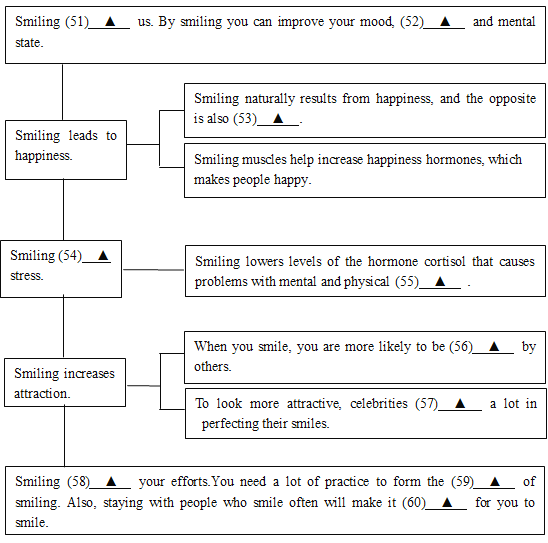
Not only does smiling reward our brain’s feel-good system, it also makes us look more attractive and lowers stress levels. In stressful situations, smiling is a great way to relieve extreme levels of stress and to keep your cortisol (皮质醇) levels under control.

Naturally, happiness can result in smiling. Also, smiling can actually create happiness. Smiling tricks our brains into believing we are happy, and one way it does this is by making us think of happier memories, which improve our moods.

When the smiling muscles in our face contract, it sends a signal to the brain to encourage the reward system that further increases our levels of endorphins, or happiness hormones (荷尔蒙). It can have the same effect on our happiness as eating chocolate or receiving a monetary prize.

Even though the exact relationship behind facial expression and mental state is largely unknown, it has been suggested that smiling reduces levels of the stress-inducing hormone cortisol. Increased levels of cortisol could potentially lead to cardiovascular disease, mental illness, and obesity, so it’s worth every effort to try to decrease our cortisol levels.

Research shows that when you smile, people treat you differently. Smiling instantly makes you appear more reliable, relaxed, sincere, and attractive. A study found that people who smiled more were rated as more attractive than those who avoided eye contact and didn’t smile at all.

Perhaps this is why celebrities (名人) invest in perfect smiles, often looking for porcelain veneers to give them flawlessly straight, white teeth. According to a cosmetic (化妆用的) dentistry practice in Boston, broken and stained teeth can make a person look older, while a brighter smile gives a look of health and youthfulness. Anyone you spot on television will more likely than not have a perfect smile. This gives them a youthful shine while at the same time making them look more attractive.

Smiling is an act that many of us may have to practice in order to make a regular habit. However, it’s a habit worth investing in, as smiling, happiness, and health have a scientifically proven link to one other. If you find it hard to smile, try being around people who tend to smile a lot. According to a Swedish study, it is difficult to keep a straight face when constantly faced with people who are smiling at you.

Title: The Science Behind Smiling
1_______________

2_______________

3_______________

4_______________

5_______________

6_______________

7_______________

8_______________

9_______________

10_______________

【答案】

1benefits/rewards/pays

2appearance

3true

4reduces/decreases/relieves

5health

6appreciated/loved/liked/trusted/respected

7invest/spend

8deserves

9habit

10easy/easier

【解析】文章介绍了微笑的好处,鼓励我们要多多微笑。

1由第一段的内容可知,微笑对我们有益。该空做谓语,根据主谓一致原则,该空填benefits,rewardspays。

2由第一段中的it also makes us look more attractive可知,微笑可以使我们看起来有吸引力。即微笑可以改善我们的外表故该空填appearance。

3由第二段中的Naturally, happiness can result in smiling. Also, smiling can actually create happiness可知,幸福感会导致微笑同样,微笑也可以产生幸福感。即:相反的情况也是对的。故该空填true。

4由第四段中的it has been suggested that smiling reduces levels of the stress-inducing hormone cortisol可知,微笑可以减轻或缓解压力。故该空填reduces/decreases/relieves。

5由第四段中的Increased levels of cortisol could potentially lead to cardiovascular disease, mental illness, and obesity可知,幸福荷尔蒙会导致精神疾病,肥胖等情况。即:幸福荷尔蒙会引发和身体精神健康有关的问题。故该空应填health。

6由第六段的介绍可知,微笑使一个人更有吸引力。所以经常微笑的人可能会被别人喜欢或者尊敬等。故该空填appreciated/loved/liked/trusted/respected

7由第六段中的Perhaps this is why celebrities (名人) invest in perfect smiles可知,名人们花很多时间或金钱来使自己的微笑看起来完美。故该空应填spendinvest。

8由最后一段中的it’s a habit worth investing in可知,微笑值得我们努力付出。故该空填谓语动词deserves。

9由最后一段中的Smiling is an act that many of us may have to practice in order to make a regular habit可知,我们应该养成微笑的习惯。故填habit。

10由最后一段中的If you find it hard to smile, try being around people who tend to smile a lot可知,如果你发现微笑很难,那么可以和经常微笑的人待在一起。那样你就很容易微笑了。故该空填easyeasier。

练习册系列答案
相关题目

【题目】 Let us all raise a glass to AlphaGo and the advance of artificial intelligence. AlphaGo

DeepMind’s Go-playing AIjust defeated the best Go-playing humanLee Sedol. But as we drink to its success. we should also begin trying to understand what it means for the future.

The number of possible moves in a game of Go is so huge that. in order to win against a player like Lee. AlphaGo was designed to adopt a human—like style of gameplay by using a relatively recent development--deep learning. Deep learning uses large data sets“machine learning”algorithms (计算程序) and deep neural networks to teach the AI how to perform a particular set of tasks. Rather than programming complex Go rules and strategies into AlphaGoDeepMind designers taught AlphaGo to play the game by feeding it data based on typical Go moves. ThenAlphaGo played against itself, tirelessly learning from its own mistakes and improving its gameplay over time. The results speak for themselves.

Deep learning represents a shift in the relationship humans have with their technological creations. It results in AI that displays surprising and unpredictable behaviour. Commenting after his first lossLee described being shocked by an unconventional move he claimed no human would ever have made. Demis Hassabis. one of DeepMind's foundersechoed this comment“We're very pleased that AlphaGo played some quite surprising and beautiful moves. ”

Unpredictability and surprises are—or can be—a good thing. They can indicate that a system is working wellperhaps better than the humans that came before it. Such is the case with AlphaGo. Howeverunpredictability also indicates a loss of human control. That Hassabis is surprised at his creation's behaviour suggests a lack of control in the design. And though some loss of control might be fine in the context of a game such as Goit raises urgent questions elsewhere.

How much and what kind of control should we give up to AI machines? How should we design appropriate human control into AI that requires us to give up some of that very control? Is there some AI that we should just not develop if it means any loss of human control? How much of a say should corporationsgovernmentsexperts or citizens have in these matters? These important questions, and many others like themhave emerged in responsebut remain unanswered. They require humannot human - likesolutions.

So as we drink to the milestone in AI, let's also drink to the understanding that the time to answer deeply human questions about deep learning and AI is now.

1What contributes most to the unconventional move of AlphaGo in the game?

A. The capability of self-improvement.

B. The constant input of large data sets.

C. The installation of deep neutral networks.

D. The knowledge of Go rules and strategies.

2A potential danger of Al is _____.

A. the loss of human control B. the friendly relationship

C. the fierce competition D. the lack of challenge

3How should we deal with the unpredictability of AI?

A. We should stop AI machines from developing even further.

B. We should call on the government to solve these problems for us.

C. We should rely on ourselves and come up with effective solutions.

D. We should invent even more intelligent machines to solve everything.

4What's the author’s attitude towards this remarkable advance in AI?

A. Supportive. B. Optimistic.

C. Doubtful. D. Cautious.

【题目】 You are walking alone down the street. Suddenly, you hear footsteps. Is someone following you? How do you know the footsteps are someone else’s and not your own?

You can tell because your brain has the ability to ignore certain sounds, according to a study from New York University. Because of this, we often ignore our own footsteps. But we may easily hear others’ footsteps.

Scientists tested this on mice. They found that when mice became familiar with the sound of their own footsteps, they developed a “sensory filter (感觉过滤器)”, according to David Schneider, one of the lead authors of the study. This allowed the mice to ignore the sounds of their own footsteps. They could more easily notice the sounds of their environment.

“For mice, this is really important,” Schneider told Science Daily. “They need to listen for a cat getting close to them, even when they’re walking and making noise.”

Our brains don’t just ignore our footsteps. We also ignore some other sounds that we make ourselves, including the sound of eating, breathing heavily and typing on a keyboard. Being able to ignore these unimportant noises lets us focus on more important and dangerous ones. For example, we are quick to notice the sound of a baby crying. So we can rush to make sure they are okay and keep them alive. The same idea applies to humans screaming. When we hear this sound, we can quickly go to help the screaming person.

1What help(s) mice ignore the sounds of their own footsteps?

A. The environment.B. Their sensory filters.

C. Cats’ footsteps.D. A study from New York.

2What do human brains normally fail to notice?

A. Others’ footsteps.B. Human’s screaming.

C. a baby crying.D. Self-made sounds.

3How does ignoring some sounds benefit humans?

A. More important things can be focused on.

B. People can stay calm in face of danger.

C. It’s easy to stay healthy and strong.

D. People tend to do dangerous things.

4What can we learn from the text?

A. More studies on human brains are needed.

B. Mice are very helpful in human brain studies.

C. Ignoring certain sounds helps mice survive.

D. Screaming and crying are unimportant noises.

违法和不良信息举报电话:027-86699610 举报邮箱:58377363@163.com

精英家教网