题目内容
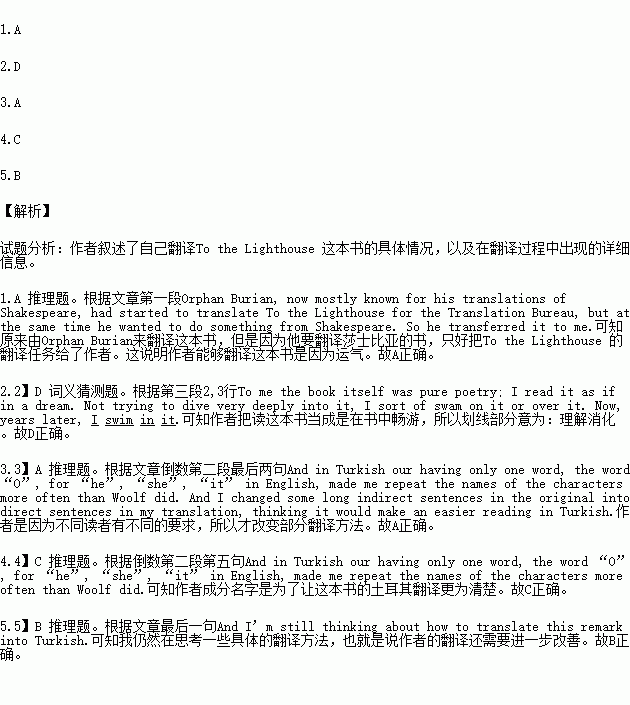
For years I have been asked by several people how and why I came to translate a novel by Virginia Woolf in 1945. I graduated from the University of Ankara in 1941 and my four teachers, including Orphan Burian, are members of the Translation Bureau who prepared a list of works to be translated into Turkish and set themselves to translating some of these, besides shouldering the heavy work of correcting or editing the translations submitted to the Bureau. Orphan Burian, now mostly known for his translations of Shakespeare, had started to translate To the Lighthouse for the Translation Bureau, but at the same time he wanted to do something from Shakespeare. So he transferred it to me.
For me, To the Lighthouse was love at first sight or rather at first reading. To translate a book, I first read it from the beginning to the end. Then I started writing each sentence by hand. When I finished the whole book I read my translation from the beginning to the end, checking it with the original, and making corrections. Then I typed it, and read the typed copy, making changes again. All in all that added up to five readings. I started translating the novel in 1943 and submitted it to the Bureau in 1944. It was published in 1945 under the general title of “New English Literature” in the series called “Translations from World Literature” known as the “Classical Series”.
So, the first book by Virginia Woolf in Turkish appeared in 1945, and it was To the Lighthouse. This was eighteen years after its publication in England in 1927. To me the book itself was pure poetry; I read it as if in a dream. Not trying to dive very deeply into it, I sort of swam on it or over it. Now, years later, I swim in it. Even after so many years, in each reading I become conscious of new layers of which I haven’t been aware before. It keeps pace with my experiences in life as years go by, and each reading is a new reading for me.
In 1982 and again in 1989 I revised it for two new editions and I again did it sentence by sentence checking it with the original. In those years I had thought it was necessary to revise my translations every ten years, but now I think I must do it every three or four years. In a country like Turkey, where we work very hard to clear our language from old and new foreign words, we should try to be up to date as to the words we are using, and of the same importance are the studies being made on the methods or techniques of translation, and new approaches in translation.
While translating, I usually have both the writer and the reader in mind. The novels she wrote after 1920 were especially new for most of the readers. She usually uses very short sentences, followed by rather long ones. I remember sentences of more than ten lines which weren’t easy for me to translate as they were. And in Turkish our having only one word, the word “O”, for “he”, “she”, “it” in English, made me repeat the names of the characters more often than Woolf did. And I changed some long indirect sentences in the original into direct sentences in my translation, thinking it would make an easier reading in Turkish.
When translating, I make use of all kinds of dictionaries. A difficult English word for me is the word “vision”. In To the Lighthouse, the artist Lily Briscoe is trying to finish the picture she has been drawing for some time and the novel ends with the following sentences: “Yes, she thought, laying down her brush extremely tired, I’ve had my vision.” And I’m still thinking about how to translate this remark into Turkish.
1.How and why did the writer come to translate To the Lighthouse?
A. It was really a piece of good luck.
B. She was the only qualified person for it.
C. Virginia Woolf was very familiar to her.
D. She was a member of the Translation Bureau.
2.What does the underlined part in paragraph 3 mean?
A. The writer prefers the work very much.
B. The writer likes the sport swimming.
C. The writer is aware of her advantages.
D. The writer has digested the book very well.
3.Why does the writer revise her translations more often now?
A. Readers make new demands.
B. Turkish is a language of mobility.
C. Many mistakes are spotted in the old edition.
D. She wants to make it more popular in the market.
4.While translating, the writer repeated the names of the characters to_________.
A. make full use of the direct sentences
B. emphasize all of these characters
C.make her translation clearer in Turkish
D. make her translation much briefer
5.The last paragraph mainly implies that_________.
A. the writer is taking up a difficult job
B. the writer’s translation needs improving
C. English is a difficult language in the world
D. remarks from characters are difficult to translate

 开心快乐假期作业暑假作业西安出版社系列答案
 名题训练系列答案