题目内容
【题目】英语课上,老师要求同桌同学相互修改作文。假设以下书信为你同桌所写,请你对其进行修改。文中共有10处错误,每句中最多有两处。错误涉及一个单词的增加、删除或修改。
增加:在缺词处加一个漏词符号(∧),并在此符号下面写出该加的词。
删除:把多余的词用斜线(\)划掉。
修改:在错的词下划一横线,并在该词下面写出修改后的词。
注意: 1、每处错误及其修改均仅限一词;
2、只允许修改10处,多者(从第11处起)不计分。
During the Renaissance, painters tried to paint people and nature as they real were. Rich people paid famous artists to paint pictures of them, their houses and possessions as well as their activities and achievements. One of the most important discovery during this period was how to draw things with perspective. This technique was first used by Masaccio in 1428. When people first saw his paintings, they convinced that they were looking through a hole in a wall at a real scene. If the rules of perspective have not been discovered, no one would have been able to paint such the realistic pictures. By coincidence, oil paints were also developed at this time, that made the colours used in paintings look rich and deeper. Without the new paints and the new technique, we will not be able to see the great masterpieces for which this period is famous.
【答案】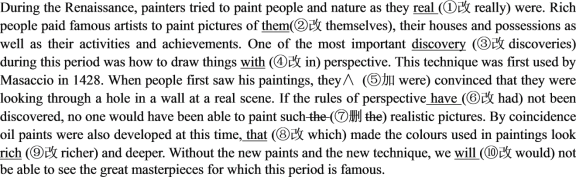
【解析】
这是一篇记叙文。文章讲述了文艺复兴时期绘画艺术的发展以及这种发展对现在的影响。
1.考查副词。句意:在文艺复兴时期,画家们试图把人和自然真实地描绘出来。分析句子,此处应将形容词real改为副词really以修饰动词paint。故将real改为really。
2.考查反身代词。句意:富人付钱给著名的艺术家,让他们为自己、他们的房子、财产以及他们的活动和成就画像。分析句意,此处应该表示,为他们自己画像。故应用反身代词。故将them改为themselves。
3.考查名词的复数。句意:这一时期最重要的发现之一是如何用透视法绘画。One of译为:其中之一。和one of 连用的名词应该用复数。故将discovery 改为discoveries。
4.考查固定短语。in perspective译为“用透视法”。故将with改为in。
5. 考查固定短语。句意:当人们第一次看到他的画时,他们相信他们是透过墙上的一个洞在看一个真实的场景。be convinced that相信,确信,信服。是固定表达。又因为文章整体时态是过去时。故在convinced 前加were。
6.考查虚拟语气。句意:如果没有发现透视法,就没有人能画出如此逼真的画。这是一个非真实条件句。根据非真实条件句虚拟的要求:若表达和过去相反,主句应该用would / should / could / might +have done而从句应该用had done(过去完成时)表示。故将have改为had。
7.考查冠词。realistic pictures中的pictures已经加了“s”了,且这边表示泛指。不需要在前加the。故将the去掉。
8.考查非限制性定语从句。句意:巧合的是,油彩也是在这个时候发展起来的,这使得绘画中使用的颜色看起来更加丰富和深沉。分析句子,逗号后面的从句为非限制性定语从句。而that不能引导非限制性定从。故将that改为which。
9.考查形容词的比较级。分析句子,and deeper后面的deep用了形容词的比较级。根据and前后级别一致,故rich也应用比较级。故将rich改为richer。
10.考查含蓄条件句的虚拟。句意:没有新的颜料和新的技术,我们就不能看到这一时期著名的杰作。分析句子,without译为“如果没有”后面的句子常用含蓄条件句的虚拟。根据句意,此处应表达和现在相反的虚拟,故应该用would / should / could / might +do 表示虚拟。故将will改为would。

 黄冈冠军课课练系列答案