题目内容

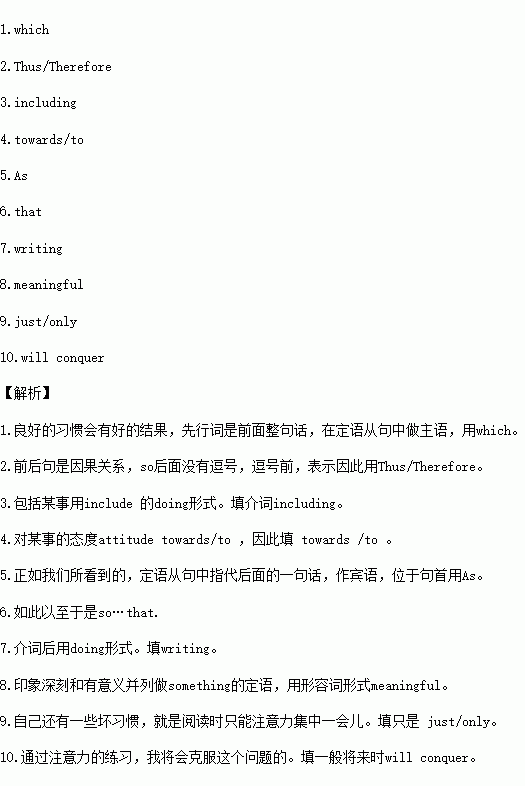
How Learning Habits Influence On Learning Results. It’s useful and necessary to discuss learning habits. There is a famous saying “Good habits lead to good endings.”, 1.shows the importance of habits.

“An apple a day keeps doctor away .”also shows how a healthy everyday habit helps to build up our body.2., good learning habits can help us gain great learning results3.(include) high scores and abundant knowledge. At first, learning habits form our ways of thinking and attitudes4.the content of our learning. Obviously, a good habit can help us to speed up to reach our destinations.5.we can see, cultivating a good habit is so important 6.I would like to introduce one kind of good learning habits----keep a learning diary every day. We can start the habit by7.write) learning summary and remember to record something impressive and8.(mean). Keep it in mind, and gradually we can gain this good learning habit and benefit from it.

What’s more, I find out that I still have some bad learning habits as well. I can9. concentrate on reading for a short time and I10. ( conquer) this problem by spending more effort on concentration practice.

I believe that through my efforts, I can gain good learning results by having good habits.
练习册系列答案
相关题目

Thousands of hungry birds left the countryside of Britain in the bitter winter to find food and warmth in urban gardens. The move included species such as the redwing and the fieldfare, almost unknown outside rural areas

The hard situation of farmland birds has been revealed in the latest survey of bird populations from the Royal Society for the Protection of Birds released today.

The redwing has an obvious stripe over the eye and a red flash on the flanks (侧翼), while the fieldfare has a grey head, a peach under?belly, and a distinctive dark band on the tail.

Graham Madge, the society's spokesman, says, “For many urban birdwatchers the sight of these striking species is a real treat. Many people have never imagined there being such an amazing chance.”

“Frozen ground prevented them from getting food in the countryside and they have been saved from starvation in towns,” he added.

He says the unusual sight this year somewhat tempered the frustration felt at the suffering of small garden birds such as robins and wrens. These birds are sensitive to cold and must eat almost continuously to stay alive. Data from people who took part in the society's Big Garden Birdwatch recorded sightings in 280,000 gardens during the last weekend of January, with the goldcrest down 75 percent, the long?tailed tit down 27 percent, and the coal tit down 20 percent. The study highlighted the need for food to be left out for birds during winter.

The redwing and the fieldfare are relatively unknown outside the eastern part of the country. The research shows, however, that they moved to the other side of the country where the climate is generally mild in winter and that many for the first time have reached Cornwall and Isles of Scilly. The number of redwing sightings was up 185 percent, those of the fieldfare 73, and of the yellowhammer 68.

Another surprise garden “guest” this year was the blackcap. This robin?sized, silver?grey bird was rare in Britain 50 years ago, but increasing numbers now arrive each year from Germany and Austria.

1.How did the urban birdwatchers probably feel when seeing the hungry birds?

A. Excited. B. Worried.

C. Annoyed. D. Motivated.

2.Which of the following can best replace the underlined word “tempered”?

A. Prevented. B. Relieved.

C. Explained. D. Increased.

3.According to the passage, Cornwall is perhaps ________.

A. a village in eastern Britain

B. a city in western Britain

C. a village in western Britain

D. a city in eastern Britain

4.What does the passage mainly talk about?

A. The tough living conditions of some British birds.

B. The various species of Britain's garden birds.

C. The changes of some bird's population in Britain.

D. Unusual bird visitors in Britain's urban gardens.

Eating too much fatty food,exercising too little and smoking can raise your future risk of heart disease. But there is another factor that can cause your heart problems more immediately:the air you breathe.

Previous studies have linked high exposure(暴露)to environmental pollution to an increased risk of heart problems, but two analyses now show that poor air quality can cause heart attack or stroke(中风) within as little as a few hours after exposure. In one report of the research, scientists found that people exposed to high levels of pollutants(污染物)were up to 5% more likely to suffer a heart attack within days of exposure than those with lower exposure. Another study of stroke patients showed that even air that the U.S. Environmental Protection Agency(EPA)considers to be of “moderate”(良好) quality and relatively safe for our health can raise the risk of stroke as much as 34% within 12 to 14 hours of exposure.

The authors of both studies stress that these risks are relatively small for healthy people and certainly modest compared with other risk factors such as smoking and high blood pressure. However, it is important to be aware of these dangers because everyone is exposed to air pollution regardless of lifestyle choices. So stricter regulation by the EPA of pollutants may not only improve environmental air quality but could also become necessary to protect public health.

1.The text mainly discusses the relationship between _________ .

A. heart problems and air quality

B. heart problems and exercising

C. heart problems and smoking

D. heart problems and fatty food

2.The underlined word “modest” in Paragraph 3 most probably means _________ .

A. relatively high B. extremely low

C. relatively low D. extremely high

3.We can learn from the text that __________?

A. eating fatty food has immediate effects on your heart.

B. the EPA conducted many studies on air quality.

C. moderate air quality is more harmful than smoking.

D. stricter regulations on pollutants should be made.

4.The author’s purpose of writing the text is most likely to _________ .

A. inform B. persuade C. describe D. entertain

Waste can be seen everywhere in the school. Some students ask for more food than they can eat and others often forget to turn off the lights when they leave the classroom. They say they can afford these things. But I don‘t agree with them.

Waste can bring a lot of problems. Although China is rich in some resources, we are short of others, for example, fresh water. It is reported that we will have no coal or oil to use in 100 years. So if we go on wasting our resources, what can we use in the future and where can we move? Think about it. I think we should say no to the students who waste things every day. Everybody should stop wasting as soon as possible.

In our everyday life, we can do many things to prevent waste from happening, for example, turn off the water taps when we finish washing, turn off the lights when we leave the classroom, try not to order more food than we need, and so on. Little by little, everything will be changed. Waste can be stopped one day, if we do our best.

1. From the passage we know that some students often _______ in the school.

A. eat too much B. don‘t work hard

C. waste things D. throw rubbish everywhere

2.What may happen in 100 years?

A. We may still have enough oil.

B. We may still have enough coal.

C. We may have a little oil

D. We may have no coal or oil to use.

3.Which of the following is right?

A. Waste brings problems.

B. Waste can bring no problem.

C. China is rich in fresh water.

D. Students never waste things.

4.Which is the best title of this passage?

A. Stop Wasting

B. School life

C. Waste in the School

D. Rich Resources in China

One day an ant was drinking at a small stream and fell in. She made desperate(拼死的) efforts to reach the side, but made no progress at all. The poor ant almost exhausted(精疲力竭的) was still bravely doing her best. when a dove saw her. Moved with pity, the bird threw her a blade of grass, which supported her like a raft, and thus the ant reached the bank again. While she was resting and drying herself in the grass, she heard a man come near. He was walking along barefooted with a gun in his hand. As soon as he saw the dove, he wished to kill it. He would certainly have done so, but the ant bit him in the foot just as he raised his gun to fire. He stopped to see what had bit him, and the dove immediately flew away. It was an animal much weaker and smaller than herself that had saved her life.

1. The ant could not reach the side though _______.

A. she cried for help

B. she asked the dove to save her

C. she tried very hard

D. she could smell well

2. The dove saved the ant because _______.

A. she was the ant's friend

B. she took pity on the poor ant

C. the ant was almost exhausted

D. the ant had been struggled in the water for a long time

3.The ant succeeded in getting on the bank with the help of _______.

A. a leaf B. a piece of wood

C. a blade of grass D. a raft

4.Just as the man shot at the dove, _______.

A. the dove immediately flew away

B. the dove hid himself in the grass

C. the ant told the dove to leave at once

D. he felt something biting him in the foot

5. In writing the story, the writer wants to show _______.

A. how clever the ant was

B. how kind the dove was

C. how the ant and the dove helped each other

D. we often need help from others, therefore we should help others as much as we can

违法和不良信息举报电话:027-86699610 举报邮箱:58377363@163.com

精英家教网
