题目内容
Young women are more adventurous than young men when travelling abroad in gap years.One in three female backpackers visits more than three countries during a year out and travels alone, according to new research.
By contrast, the majority of their male counterparts(地位相当者) visit only one country and tend to travel in groups, says a survey by the Gap Year company, which provides information and services for students considering taking a year out.
More women than men say that their prime reason for taking time off is to see the world and experience different cultures.Men are more likely to rank “having fun” higher on their list of priorities.Women are more likely to value the challenge of a foreign trip, and many cited reasons such as learning a language and meeting new people.
The more adventurous gap years taken by women seem to work to their benefit; more than three quarters of those surveyed have reported increased confidence, self-reliance(自立) and independence, whereas only half of the men had that experience.
The research also shows that women are more likely to do voluntary work while travelling, with more than one in ten helping with teaching or development projects.One of the reasons given for this is a wish to see the country in an authentic light.
A greater proportion of women than men face objections or criticism from their families over their gapyear plans.Among the men surveyed, lack of money is the main barrier to travel.
Carolyn Martin, a doctor from London,is a typically confident female traveller.Starting in Cape Town, she travelled around southern Africa and Australia with a string of unusual and sometimes dangerous jobs.
“I had one job chasing elephants off the runway in Africa by banging a stick against a pan,” she recalled.“It was OK but one day I did get chased by one.”
She said that she had travelled alone because “you meet more people”.
- 1.
By referring to “gap year” the writer means ________.
- A.a gap you come across after leaving high school
- B.a time when you are caught in a dilemma between work and study
- C.a period after you find a job upon your graduation from college
- D.a year off between high school and college for certain purposes
- A.
- 2.
In the third paragraph, the underlined word “priorities” most probably means ________
- A.selections
- B.attractions
- C.preferences
- D.projects
- A.
- 3.
Which of the following statements is TRUE?
- A.Men students will travel less during the gap year because of their part-time jobs.
- B.Women students will travel more but face more objections.
- C.The article suggests that women travelling alone will have dangerous experiences.
- D.Men students prefer to travel inside their own country to going abroad.
- A.
- 4.
Which of the following would be the best title of the passage?
- A.Girls Get the Best out of Gap Years
- B.Boys Lack Courage in Gap Years
- C.For Fun or for Adventure?
- D.Young Women Are More Adventurous
- A.
试题分析:文章介绍女性在空档年会独自旅行”,而男性更倾向于团体旅行。他们的旅游对的目的也不尽相同。男性主要是为了玩,女性更喜欢利用这个机会体验不同的文化,语言等。
1.词义猜测题。文章第二段提到 students,所以相比之下,D 项最适合。在英国等国家,年轻人会有“空档年”,即上完高中、上大学之前的这段时间。而C 项是最大的干扰项,由常识可知,大学毕业后,学生一般都得忙着找工作,然后上班,没有足够的时间去旅行,所以D 项比C 项更贴切。
2.猜词题:从文章的句子可以看出男性把玩乐看成是更偏爱的东西。选C
3.细节理解题。由第六段第一句A greater proportion of women than men faced objections or criticism from their families over their gap-year plans. 可知,女性更喜欢在空档年出游,但与男性相比,她们面临更多的反对意见。选B
4.主旨大意题。文章第三段提到女性旅行原因是了解世界、体验不同的文化、学习语言、认识新朋友。在第四段中作者提到“more than three quarters of those surveyed reported increased confidence, self-reliance and independence(超过四分之三的女性通过旅行会增强自信、自立和独立)”,而只有一半的男性有同样的体验。所以 A 项正确。D 项是最大的干扰项,其实 D 项与原文第一段首句相比缺少了关键的状语限定部分(when travelling abroad in gap years)。选A
考点:考查社会现象类短文
点评:这篇文章考查较全面:细节,推理,句意和主旨都考查了,特别是主旨题要注意最适合做文章题目的选项应该是最能概括文章主旨大意的选项,不能以偏概全。考生头脑中要对文章有了大概的印象:

 浙大优学小学年级衔接捷径浙江大学出版社系列答案
Eleven months ago, an act of good sportsmanship(体育精神)changed a girls’ running race into something bigger. 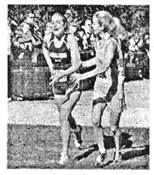
Jenna Huff received a national sportsmanship award from the US Olympic Committee for what she did for Deb Guthmann.
In the race, Jenna was behind Deb until the final few meters of the 5-kilometer race.
Then something awful happened. Deb’s right hip(髋部)broke. She screamed in pain and stopped.
Jenna had never met Deb and had been taught to pass every runner she could to win.
Instead, Jenna stopped with no hesitation.
“Come on.” Jenna told Deb. “We’re going to run.”
Jenna took Deb’s left elbow with her right hand. She helped her jog the last few meters. At the finishing line, she pushed Deb in front of her, reasoning Deb would have beaten her anyway if not for the injury. That act helped Deb’s team win the regional race and advance to the state meet.
Both girls are now 17.
Jenna is still an athlete for her school.
She and her parents went to Colorado to accept an award for the national sportsmanship award. Jenna had to give a five-minute speech to the crowd, a crowd which included a number of former Olympians. “I’m pretty scared about my speech,” Jenna said the other night when we talked on the phone. “You want to hear part of it?” She read me one part including the words from Albert Einstein: “Each of us comes for a short visit, not knowing why, yet sometimes seeming to a divine(神圣的)purpose. From the standpoint of daily life, however, there is one thing we do know:That we are here for the sake of(为了)others.”
Deb is also still running. She received a full scholarship to Emmanuel College in Franklin Springs, Georgia. The award was because of her excellent academic record and great sports potential.
But she recently got hurt again and was unable to run for weeks.
Even so, I am confident Deb will write a happier ending for herself one day. Both of these young women make you feel confident about the future. They are strong, compassionate(富于同情心的)and smart.
As Einstein said-and as Jenna showed 11 months ago— “we are here for the sake of others”.
【小题1】The story is intended to __________.
| A.tell us an unexpected story in the girls’ running race |
| B.introduce a famous sportswoman |
| C.show the beauty of good sportsmanship |
| D.remind athletes to pay attention to their safety during the race |
| A.she wanted to get the prize |
| B.she thought she didn’t match Deb in reality |
| C.she helped Deb’s team to win the regional race |
| D.Deb had been injured |
| A.she is still running |
| B.she was good at her academy and sports |
| C.she showed the good sportsmanship in the race |
| D.she never gave up even though she had been injured |
| A.Jenna was the last one to reach the finishing line. |
| B.Deb went to Colorado to accept the prize with her parents. |
| C.The author had a face-to-face interview with Jenna the other night. |
| D.Helping each other can make a big difference to people’s lives. |