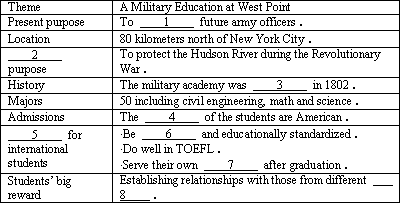
请认真阅读下列短文,并根据所读内容在文章后表格中的空格里填入一个最恰当的单词。注意:每个空格只填1个单词。

  West Point is a college for future army officers.It has more than four thousand students, called cadets(士官生).The school is located about eighty kilometers north of New York City.

  West Point is the oldest continuously occupied military post in the United States.General George Washington built a fort(要塞)there during the Revolutionary War to protect the Hudson River from the British.He moved his headquarters to West Point in seventeen seventy-nine in the middle of the war.

  In eighteen hundred and two, President Thomas Jefferson signed legislation(立法)to establish the military academy.The education centered on civil engineering.West Point graduates designed many roads, bridges, harbors and railways for the young nation.

  Today, math and science are still a large part of the education.But cadets can choose from almost fifty areas of study.If cadets major in the humanities(人文学科), they must have an engineering minor(副科).

  Not all the young men and women at West Point are American.This year, fifty-eight are from other countries.Up to sixty cadets can be international students.

  International students are chosen by their governments.They must satisfy physical and educational requirements and do well in the Test of English as a Foreign Language.After graduation, they return home to serve in their nation's armed forces.Other services besides the Army also accept foreign students at their academies.

  Major Joe Sowers, a West Point public affairs officer, says information is available through American embassies.He says the presence of international students at West Point serves a purpose for the Army.He says:“Cultural understanding, cultural awareness is essential for a modern-day officer.Now we have cadets from Panama and cadets from African countries, which doesn't necessarily increase your knowledge on how to interact in Iraq or Afghanistan.At least not specifics, anyway.But you’ve begun the process of understanding that the world is bigger than your hometown and West Point and the United States of America.But I think the big reward is at the individual cadet level, establishing relationships with those who come from much, much different backgrounds.”

第二节:Peter,Helen,Catherine,Elizabeth和Levin想根据各自在环保方面的兴趣(61—65)进行案例研究。阅读下面某杂志的专题报道摘要(A、B、C、D、E和F),选出适合他们研究的最佳案例,并在答题纸上将相应选项的标号涂黑。选项中有一项是多余选项。

61. Peter: Reducing plastic and other wastes through DTY

62. Helen : Making use of the heavy traffic to produce electricity

63. Catherine: Building a community without private cars

64. Elizabeth: Building houses with recycled materials and energy-efficiency systems

65. Levin: Developing a new type of urban car which bums less gas


A

B

Vauban

   We know cars are terrible polluters, but would you give yours up? Vauban, a community in southwestem Germany, did just that, and its 5,000 citizens are doing fine. Most streets are free of vehicles, and there are generous green spaces and good public-transport links, including fast buses and bicycle paths.  When,, people must drive, they can turn to car-sharing clubs.  All the citizens had the chance to plan their own city," says Andreas Delleke, an energy expert, "and it's just how we wanted it to be. "

Denmark

   During the period of gas shortage in the early, 70s, Denmark decided to become self-sufficient ( 自足). So they began a few projects making smart investments along the way.

   On the island of Samsoe, local families, fishermen and farmers bought wind turbines (涡轮机],) to produce their own energy. Within seven years these turbines were completely paid for. And can you believe just one of wind turbines  produces  enough  electricity  for 600 households?

C

D

Trey Parker and Matt Stone

  Trey Parker and Matt Stone, creators of South Park, have built a sustainable (可持续的) castle with outer siding and inner flooring of recycled wood, recycled carpeting, high-efficiency boiler systems.

  "I think more and more today, people are willing to make a statement about the Earth and how they want to proteet it," Michael Rath, home designer and builder says. "For high-end homes in this valley, this is entirely consistent with what they cost. "

P-NUT

  Who doesn't love the name P-NUT- short for Personal-Neo  Urban  Transport?  It's  Honda's  latest attempt to create a tiny footprint for a new urban vehicle.

  This little P-NUT is unique. With a central driving position, the car is designed to move in tight settings. The l 1-foot micro car will seat three with two rear-seat passengers behind the driver.

  "The P-NUT conce, pt explores the packaging and design potential for a vehicle designed for the city lifestyle,"  said  Dave  Marek,   a  Honda  design Spokesman.

E

F

Israel Company

  Is it possible that annoying rash hour traffic could become a source of renewable energy?

  Israel's Technion Institute of Technology claims that if we placed special generators ( 发电机 ) under roads, railways, and runways -- we could harvest enough energy to mass-produce electricity. A trial process has been used on a smaller scale,  in dance clubs for instance, where the pounding feet of dancers light up the floor.

  "We can produce electricity anywhere there is a busy road using energy that normally goes to waste," said Uri Amit,  chairman  of  Israel's  Technion . Institute  Of Technology.

Coffee

  Coffee. Some of us can't start our day without it, and we don't mind waiting 10 minutes in line for it.

  Here is the most effective tip to make you a superstar in environment protection.

  Get a coffee machine for your home or office, or persuade your company into buying one.  ( Tell them it will improve productivity. ) Skip the coffee line on the way to work and make something that is better-tasting and much better for your wallet.

  Plus, you Won't need those plastic cups or carrying cases that jnst get thrown away.  Better yet, use your favorite travel mug.


PART THREE: READING COMPREHENSION (30分)
Directions: Read the following three passages. Each passage is followed by several questions or unfinished statements. For each of them there are 4 choices marked A, B, C and D. Choose the one that fits best according to the information given in the passage you have just read.
A
The Wuhan to Guangzhou MU(动车组) Train route will start to operate on the 26th of this month. The train is the fastest in the world. All the construction and preparations for the route's operation are in the final stages. Our reporter Li Dong has the details.
In a trial operation, the speed of the MU Train reached 394 kilometers per hour, the highest in the world. Though the speed during normal operation may be at 350 kilometers per hour, but this newly built high speed railway may still reduce the travel time of Wuhan to Guangzhou from more than 10 to 3 hours.
The total length of Wuhan—Guangzhou high speed railway is more than 1068 kilometers. The railway connects Hubei, Hunan and Guangdong. The total investment is more than 116 billion yuan.
Protection facilities like bars and surveillance cameras are installed along the whole railway. Zhang Shuguang, director of transport bureau of the Ministry of Railway says the safety system of the train and the route is also state of the art.
"The break distance of the train is 5 kilometers. But the MU Train can respond to any emergency situations within 32 kilometers. It's very safe."
The shortened travel distance is good news for many people. However some passengers also hope the service can be upgraded.
"The dinning and entertainment service can be better. I hope I can watch TV on the train."
"The weariness during travel can be eased if I can use internet on the train. I can feel more comfortable."
Jing Libin is the MU Train driver of the Wuhan—Guangzhou high speed railway. As a MU Train engineer who witnessed China's high speed railway development. Jing Libin says: It's a way faster!
"The development of China's railway is so fast. In the beginning of the year, the speed is only 160 kilometers per hour. Soon, the speed reached 250 kilometers. And now, it's 350 kilometers! As a driver, I am very impressed."
China plans to increase the railway operation length from the current 80 thousand kilometers to 110 thousand kilometers, which includes 18 thousand kilometers of high speed passenger railways by 2012.
Within 3 years, China plans to build an "8 Hour, High Speed Transportation Circle", which means, passengers may reach nearly all the provincial capital cities in China in about 8 hours by high speed railway. With the development of the railway, China’s economy will also continue her highest development. In the near future, China will be really powerful in the world.
56. What is the best title of the passage?
A. Fastest Train in the World
C. High Speed Railway Construction
B. Trial Operation of the MU Train
D. Newly Typed Train in the World.
57. Surveillance cameras are used for________.
A. art   B. speed   C. safety    D. research
58. How much time would be needed from Wuhan to Guangzhou if the train travelled at its top speed?
A. a little more than three hours           C. more than four hours
B. less than three hours                  D. less than seven hours
59. What can we learn from the passage?
A. There will be no problems on the new train.
B. Passengers are completely satisfied with the new train.
C. Jing Libin is very proud of the development of China’s railway.
D. China has 110 thousand kilometers ofthe railway operation length now.
60. What can we infer according to the author?
A. Nobody expected China would have such a fast train.
B. China will build more high speed railways.
C. The service of the train is hard to be improved.
D. China’s economy would slow down if her transport couldn’t be improved.

For years and years people have been saying that the railways are dead. “ We can do without railways.” People say…as if motorcars and planes have made the railways unnecessary. We all keep hearing that trains are slow, that they lose money, and that they’re dying .But this is far from the truth: in these days of expensive oil, the railways have become highly competitive with motorcars and planes. If you want to carry people or goods from place to place, they are cheaper than planes. And they have much in common with planes. A plane goes in a straight line and so does a railway. What is more, it takes you from the heart of a city into the heart of another. It doesn’t leave you up as a plane does, miles and miles from the city center. It doesn’t hold you up as a car does, in endless traffic jams, and a single train carry goods which a plane or a motorcar could never do.
Far from being dead, the railways are very much alive. Modern railway lines give you a smooth, untroubled journey. Where else can you eat well, sleep in comfort, feel safe and enjoy the scene while you are traveling at speed at the same time? And we are only at the beginning, for we have just entered the age of super-fast trains, trains traveling at 150 miles an hour and more. Soon we will be wondering why we spent so much on motorcars we can’t use because we have not enough money to buy the oil and planes we can’t fly for the same reason..
【小题1】Some people think the railways are unnecessary for many reasons except that       .

A.planes and motorcars have taken the place of trains
B.oil is expensive today
C.trains are slow
D.railways lose money
【小题2】According to the writer, which of the following is Not true?
A.It is cheaper to travel by train than by plane.
B.The railway station is usually at the center of the city.
C.When you get off the plane you will find yourself right in the city center.
D.No motorcar or plane can carry as many goods as a train does.
【小题3】The writer thinks that the railways, far from being dead, are very much alive because      .
A.we can have a smooth and untroubled journey
B.we’ll not have enough money to fly in planes
C.we can now travel in super-fast train
D.all of the above
【小题4】The best title for this passage may be”        
A.Not the End but the Beginning
B.Which is the Best: Train, Motorcar or Plane
C.Trains are More Competitive than Motorcars or Planes
D.Oh, Super-fast Trains

The past ages of man have all been carefully labeled by anthropologists. Descriptions like ‘Palaeolithic Man’, ‘Neolithic Man’, etc., neatly sum up whole periods. When the time comes for anthropologists to turn their attention to the twentieth century, they will surely choose the label ‘Legless Man’. Histories of the time will go something like this: ‘in the twentieth century, people forgot how to use their legs. Men and women moved about in cars, buses and trains from a very early age. There were lifts and escalators in all large buildings to prevent people from walking. This situation was forced upon earth dwellers of that time because of miles each day. But the surprising thing is that they didn’t use their legs even when they went on holiday. They built cable railways, ski-lifts and roads to the top of every huge mountain. All the beauty spots on earth were ruined by the presence of large car parks.’

The future history books might also record that we were deprived of the use of our eyes. In our hurry to get from one place to another, we failed to see anything on the way. Air travel gives you a bird’s-eye view of the world—or even less if the wing of the aircraft happens to get in your way. When you travel by car or train a blurred (=not clear) image of the countryside constantly smears the windows. Car drivers, in particular, are forever obsessed with the urge to go on and on: they never want to stop. Is it the lure (引诱;诱惑) of the great motorways, or what? And as for sea travel, it hardly deserves mention. It is perfectly summed up in the words of the old song: ‘I joined the navy to see the world, and what did I see? I saw the sea.’ The typical twentieth-century traveler is the man who always says ‘I’ve been there. ’You mention the remotest, most evocative (引起记忆的) place-names in the world like El Dorado, Kabul, Irkutsk and someone is bound to say ‘I’ve been there’—meaning, ‘I drove through it at 100 miles an hour on the way to somewhere else.’

When you travel at high speeds, the present means nothing: you live mainly in the future because you spend most of your time looking forward to arriving at some other place. But actual arrival, when it is achieved, is meaningless. You want to move on again. By traveling like this, you suspend all experience; the present ceases to be a reality: you might just as well be dead. The traveler on foot, on the other hand, lives constantly in the present. For him traveling and arriving are one and the same thing: he arrives somewhere with every step he makes. He experiences the present moment with his eyes, his ears and the whole of his body. At the end of his journey he feels a delicious physical weariness. He knows that sound. Satisfying sleep will be his: the just reward of all true travellers.

1. Anthropologists label nowadays’ men ‘Legless’ because _________.

A. people forget how to use his legs.

B. people prefer cars, buses and trains.

C. lifts and escalators prevent people from walking.

D. there are a lot of transportation devices.

2.Travelling at high speed means _________.

A. people’s focus on the future       B. a pleasure

C. satisfying drivers’ great thrill      D. a necessity of life

3.Why does the author say ‘we are deprived of the use of our eyes’?

A. People won’t use their eyes.

B. In traveling at high speeds, eyes become useless.

C. People can’t see anything on his way of travel.

D. People want to sleep during travelling.

4.What is the purpose of the author in writing this passage?

A. Legs become weaker.

B. Modern means of transportation make the world a small place.

C. There is no need to use eyes.                 D. The best way to travel is on foot.

5. What does ‘a bird’s-eye view’ mean?

A. See view with bird’s eyes.               B. A bird looks at a beautiful view.

C. It is a general view from a high position looking down.

D. A scenic place.


违法和不良信息举报电话:027-86699610 举报邮箱:58377363@163.com

精英家教网