题目内容

【题目】One of my summertime reading pleasures has been reading C.S. Lewis’s The Screwtape Letters for the first time. The Screwtape Letters is written in a satirical style while it is fictional in format. The story takes the form of a series of letters from a senior devil Screwtape to his nephew Wormwood.

As a new generation of property student begins the school year, I thought it would be useful to pass on this comment on the most property adjective, the possessive “my.” In this excerpt(摘录), a devil named Screwtape is continuing to tutor his nephew on how best to direct and control humans toward “our Father below”:

We teach them not to notice the different senses of the possessive pronoun(物主代词)—the finely graded differences that run from “my boots” through “my dog”, “my servant”, “my wife”, “my father”, “my master” and “my country”, to “my God”. They can be taught to reduce all these senses to that of “my boots,” the “my” of ownership.

Even in the nursery, a child can be taught to mean by “my Teddy-bear” not the old imagined recipient(接受者)of affection to whom it stands in a special relation (for that is what the Enemy will teach them to mean if we are not careful) but “the bear I can pull to pieces if I like.” And on the other hand, we have taught men to say “My God” in a sense not really very different from “My boots”, meaning “The God on whom I have a claim for my distinguished services and whom I make use of the pulpit—the God I have done a corner in.” And all the time the joke is that the word “Mine” in its fully possessive sense cannot be expressed by a human being about anything. In the long run either Our Father or the Enemy will say “Mine” of each thing that exists, and especially of each man. They will find out in the end, never fear, to whom their time, their souls, and their bodies really belong—certainly not to them, whatever happens.

These “finely graded differences” are often lost in legal conceptions of both real and intellectual property.

1When the author read The Screwtape Letters, he felt ______ .

A. pleased B. dissatisfied

C. puzzled D. scared

2What does the underlined word in the second paragraph mean?

A. scold or blame B. attend or care

C. teach or train D. ask or beg

3Which of the following statements is TRUE?

A. In some degree, “my dog” is equal to “my servant”.

B. The expression “my God” means God belongs to me.

C. Screwtape is a kind of tape with a screw on it.

D. The different senses of the possessive pronoun are often lost in legal conceptions.

【答案】

1A

2C

3D

【解析】本文是一篇说明文,主要介绍《魔鬼家书》里的物主代词形式。

1细节理解题。根据文中的"One of my summertime reading pleasures has been reading C.S. Lewis’s The Screwtape Letters for the first time."可知,作者读这本书时感觉很愉悦。故选A。

2词义猜测题。A. scold or blame责骂或责备;B. attend or care参加或关心; C. teach or train教授或训练;D. ask or beg要求或请求。根据文中的"a devil named Screwtape is continuing to tutor his nephew on how best to direct and control humans toward “our Father below”"可知,恶魔教给他的外甥…。故选C。

3推理判断题。根据文中的"These “finely graded differences” are often lost in legal conceptions of both real and intellectual property."可知,D项是这句话的同义转述。故选D。


练习册系列答案
相关题目

【题目】Technological change is everywhere and affects every aspect of life, mostly for the better. However, social changes brought about by new technology are often mistaken for a change in attitudes.

An example at hand is the involvement of parents in the lives of their children who are attending college. Surveys (调查) on this topic suggests that parents today continue to be “very” or “somewhat” overly-protective even after their children move into college dormitories. The same surveys also indicate that the rate of parental involvement is greater today than it was a generation ago. This is usually interpreted as a sign that today’s parents are trying to manage their children’s lives past the point where this behavior is appropriate.

However, greater parental involvement does not necessarily indicate that parents are failing to let go of their “adult” children.

In the context (背景) of this discussion, it seems valuable to first find out the cause of change in the case of parents’ involvement with their grown children. If parents of earlier generations had wanted to be in touch with their college-age children frequently, would this have been possible? Probably not. On the other hand, does the possibility of frequent communication today mean that the urge to do so wasn’t present a generation ago? Many studies show that older parents—today’s grandparents—would have called their children more often if the means and cost of doing so had not been a barrier.

Furthermore, studies show that finances are the most frequent subject of communication between parents and their college children. The fact that college students are financially dependent on their parents is nothing new; nor are requests for more money to be sent from home. This phenomenon is neither good nor bad; it is a fact of college life, today and in the past.

Thanks to the advanced technology, we live in an age of bettered communication. This has many implications well beyond the role that parents seem to play in the lives of their children who have left for college. But it is useful to bear in mind that all such changes come from the technology and not some imagined desire by parents to keep their children under their wings.

1The surveys inform us of______.

A. the development of technology

B. the changes of adult children’s behavior

C. the parents’ over-protection of their college children

D. the means and expenses of students’ communication

2The writer believes that__________.

A. parents today are more protective than those in the past

B. the disadvantages of new technology outweigh its advantages

C. technology explains greater involvement with their children

D. parents’ changed attitudes lead to college children’s delayed independence

3What is the best title for the passage?

A. Technology or Attitude

B. Dependence or Independence

C. Family Influences or Social Changes

D. College Management or Communication Advancement

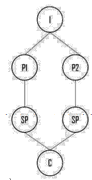
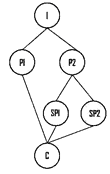
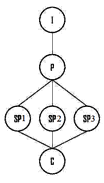
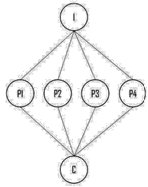
4Which of the following shows the development of ideas in this passage?

I: Introduction P:Point Sp: Sub-point C: Conclusion

A. B.

C. D.

【题目】Section B (10 marks)

Directions: Read the following passage, answer the questions according to the information given in the passage.

Generosity and kindness does not mean that you give only when you have a lot or after fulfilling all your needs, but in fact you can still give when you yourself are struggling. Generosity literally means willingness and liberty in giving away one’s own money, time, talent, etc. sincerely without any personal gain as shown in the following story.

Mahatma Gandhi went from city to city, village to village collecting funds for the Charkha Sangh. During one of his tours he addressed a meeting in Orissa. After his speech a poor old lady got up. She was gone with age, her hair was grey and her clothes were in rags. The volunteers tried to stop her, but she fought her way to the place where Mahatma Gandhi was sitting.

“I must see him,” she insisted. She went up to Mahatma Gandhi and touched his feet. Then from the folds of her sari(卷布), she brought out a copper coin and placed it at his feet. Mahatma Gandhi picked up the copper coin and put it away carefully. The Charkha Sangh funds were under the charge of Jamnalal Bajaj. He asked Mahatma Gandhi for the coin but Mahatma Gandhi refused.

“I keep cheques worth thousands of rupees (卢比) for the Charkha Sangh,” Jamnalal Bajaj said laughingly, “yet you won’t trust me with a copper coin.” “This copper coin is worth much more than those thousands,” Mahatma Gandhi said. “If a man has one hundred thousand rupees and he gives away a thousand or two, it doesn’t mean much.” “But this coin was perhaps all that the poor lady possessed. She gave me all she had. That was very generous of her. What a great sacrifice she made. That is why I value this copper coin more than ten millions of rupees.

【1】What does generosity really mean according to the passage? (No more than 14 words)

_________________________________________________________________________

【2】 What did Gandhi make a speech in Orissa for? (No more than 12 words)

_________________________________________________________________________

【3】Why did the old lady insist seeing Gandhi? (No more than 10 words)

_________________________________________________________________________

【4】Why did Gandhi refuse to give the copper coin to Jamnalal Bajaj? (No more than 10 words)

_________________________________________________________________________

太珍贵了:Because Gandhi thought it was very valuable.

违法和不良信息举报电话:027-86699610 举报邮箱:58377363@163.com

精英家教网