题目内容
The offer has been withdrawn.
那个报价已经撤销了。
阅读下面短文,按照句子结构的语法性和上下文连贯的要求,在空格处填人一个适当的词或使用括号中词语的正确形式填空,并将答案填写在答题卡标号为3l-40的相应位置上。
I was on my way to the Taiyetos Mountains. The sun was setting when my car 31 (break) down near a remote and poor village. Cursing my misfortune, I was wondering where I was going to spend the night when I realized that the villagers who had gathered around me were arguing as to 32 should have the honor of receiving me 33 a guest in their house. Finally, I accepted the offer of an old woman who lived alone in a little house. While she was getting me 34 (settle) into a tiny but clean room, the head of the village was tying up his horse to my car to pull it to 35 small town some 20 kilometres away 36 there was a garage.
I had noticed three hens running free in my hostess's courtyard and that night one of them ended up in a dish on my table. 37 villagers brought me goat's cheese and hone. We drank together and talked 38 (merry) till far into the night.
When the time came for me to say goodbye to my friends in the village, I wanted to reward the old woman 39 the trouble I had caused 40 .
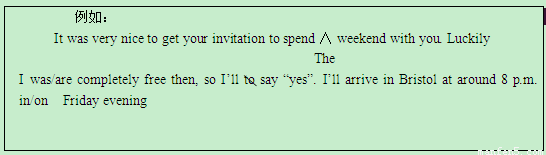
此题要求改正所给短句中的错误. 对标有题号的每一行作出判断, 每行只有一个错误, 按下列情况改正:
此行缺一个词: 在缺词处加一个漏字符号 (^) , 在该行右边横线写出该加的词.
此行多一个词: 把多余的词用斜线(\)划掉,在该行右边横线上写出该词,并也用斜线划掉.
此行错一个词:在错的词下画一横线,在该行右边横线上写出改正后的词.
Helen is a twenty-years-old girl. She never had a job _____
before. Now she wanted get a job. So she went to meet _______
Mr Black, the manager of the hotel. Mr Black told ___
her it was getting very busy in the hotel on the evenings. _______
He asked her if she was interesting in a part-time job. ________
The girl said that she did. Then Mr Black said she had _______
to work very faster and that she must be there at six ______
every afternoon and work from six to ten, Monday to _____
Friday. He offered her with 4.5 dollars an hour. Hellen _____
pleased with the offer and decided to start work the next day. _____
It was not much bigger than a soccer ball and weighed less than 185 pounds. But 50 years ago, when the Russian satellite Sputnik successfully orbited the Earth, it made headlines around the world and marked the beginning of the race for space.
The launch of the world's first artificial satellite on October 4, 1957 ignitedBefore Sputnik's launch, the US had plans to send its own satellites into space to study cosmic (宇宙的) rays and gravity, among other things. But the Russians struck first, leaving US scientists and ordinary citizens in shock. To make matters worse, the Russians successfully launched a second satellite less than one month later. This one was much larger, at 1,120 pounds. The Americans were more eager than ever to make their mark in space.
Americans thought their time had finally come on December 6. But what was supposed to be a day to remember quickly turned into a disaster to forget. The US satellite Vanguard rose just four feet off the ground before its engine failed and it burst into flames. Finally, on January 31, 1958, the Americans had the reason to celebrate. The US satellite Explorer 1 blasted into space. During its voyage, it made one of the most significant scientific finds to date—the discovery of magnetic radiation belts around the Earth.
As the consequence of Sputnik, American Congress passed the National Defense Education Act of 1958.The act was aimed at improving education in science, mathematics, and foreign languages. Congress also passed the National Aeronautics and Space Act on July 29, 1958. The federal legislation (立法) created the National Aeronautics and Space Administration, most commonly known as NASA.Today, the United States and Russia are no longer in competition. In fact, NASA astronauts and Russian cosmonauts are working together and making important scientific discoveries aboard the International Space Station.
1.How can we conclude the first period of the space race between the US and Russia?
A.A Russian victory. B.A close game.
C.An American honor. D.A hard win for both.
2.The Russians successfully launched the first satellite________ earlier than the Americans.
A.nearly half a year B.about two months
C.less than 100 days D.more than 100 days
3.In 1958 American Congress passed two acts for fear that ________.
A.the US wouldn't get any help from the Soviet Union
B.the Soviet Union would cancel the offer in the competition
C.the Soviet Union would do better than the US in the space race
D.the US would be in want of research forces
4.The underlined word “ignited” here can be replaced by “________”.
A.prepared B.caused C.approved D.compared
第二部分
第一节 短文改错(共10 小题;每小题 1分, 满分10分)
此题要求改正所给短文中的错误。对标有题号的每一行做出判断:如无错误, 在该行右边横线上画一个勾(√);如有错误(每行只有一个错误), 则按下列情况改正:
此行多一个词:把多余的词用斜线(\)划掉, 在该行右边横线上写出该词,并也用斜线划掉。
此行缺一个词:在缺词处加一个漏字符号(∧),在该行右边横线上写出该加的词。
此行错一个词:在错的词下划一横线,在该行右边横线上写出改正后的词。
One rainy day while I was walking home with one of my friend, a truck came to a stop besides us.The driver put the window down and offered us a umbrella because he found we were wet through. I stood there and couldn’t believe in that a complete stranger is so thoughtful. The man insisted, so I grateful accepted the offer, thanked him and watched the truck disappear down the road.This man might need the umbrella himself , and he preferred to give it to everyone else.It was a lesson to us that it was possible give without expect anything in retum.
下面短文中有10处语法错误。请在有错误的地方增加、删除或修改某个单词。
增加:在缺词处加一个漏字符号(∧),并在其下面写上该加的词。
删除:把多余的词用斜线(\)划掉。
修改:在错的词下划一横线,并在该词下面写上修改后的词。
注意:1.每处错误及其修改均仅限一词;
2.只允许修改10处,多者(从11处起)不计分。
One rainy day while I was walking home with one of my friend, a trunk came
friends
to a stop besides us. The driver put the window down and offered us a unbrella
beside an
because he found we were wet through. I stood there and couldn’t believe in
i\n
that a complete stranger is so thoughtful. The man insisted, so I grateful
was gratefully
accepted the offer, thanked him and watched the truck disappear down the road.
This man might need the umbrella himself, and he preferred to give it to
but
everyone else. It was a lesson to us that it was possible ∧give without expect
someone/somebody to expecting
anything in return.