题目内容

Dear Alice,

I heard from you three days ago. I’m all right.

Good news! We moved to a new flat yesterday! There are more rooms here than in our old one. You know, I shared a room with my sister in the old flat. But now I have my own bedroom! It is small but it’s my favorite room! I can be alone in it. I can read books, draw pictures, listen to my radio and play CDs. I can also play games on my computer and send e-mails to my friends.

I also love the new bigger kitchen. I love helping my mother with our meals. Mom cooks well. She always teaches me how to make different kinds of dishes. She lived in China when she was young, so she can cook Chinese food. It’s delicious.

Write to me soon and tell me about your home. Please get on the Internet so that we can chat with each other.

All good wishes!

1. Lily and her family moved to a new flat __________.

A. yesterday B. last week

C. last month D. three days ago

2. Lily is very happy mainly because ________.

A. she has just heard from Alice

B. she has got her own bedroom

C. she has a bigger bedroom now

D. she shares a room with her sister

3. Lily ________ on her computer.

A. reads books and draws pictures

B. learns to make different dishes

C. plays CDs and listens to the radio

D. plays games and sends e-mails

4. From the letter we know all the following EXCEPT that ________.

A. there is a computer in Lily’s room

B. Lily often helps her mother cook

C. Lily’s mother is good at cooking

D. Lily’s mother is Chinese


1.A

2.B

3.D

4.D

【解析】

试题分析:这篇文章是莉莉写给爱丽丝的一封信,介绍了自己的近况。

1.Good news! We moved to a new flat yesterday!可知莉莉和她的家人昨天搬到了新的楼房。

2.But now I have my own bedroom! It is small but it’s my favorite room! I can be alone in it. I can read books, draw pictures, listen to my radio and play CDs. I can also play games on my computer and send e-mails to my friends. 可知莉莉很高兴是因为她独自拥有了一个房间。

3. D细节题。根据I can also play games on my computer and send e-mails to my friends. 可知莉莉在电脑上玩游戏和发电子邮件。

4.

考点:考查信件类阅读

练习册系列答案
相关题目

What is language for?Some people seem to think it’s for practising grammar rules and learning lists of words-the longer the lists,the better. That’s wrong. Language is for the exchange(交流)of ideas and information. It’s meaningless knowing all about a language if you can’t use it freely. Many students I have met know hundreds of grammar rules,but they can’t speak correctly or fluently.They are afraid of making mistakes. One shouldn’t be afraid of making mistakes when speaking a foreign language. Native speakers make mistakes and break rules, too. Bernard Shaw once wrote,“Foreigners often speak English too correctly.” But the mistakes that native speakers make are different from those that Chinese students make. They’re English mistakes in the English language. And if enough native speakers break a rule,it is no longer a rule. What used to be wrong,becomes right. People not only make history,they make language. But a people can only make its own language. It can’t make another people’s language. So Chinese students of English should pay attention to grammar,but they shouldn’t overdo(做过头)it. They should put communication(交际)first.

1.Language is used to________.

A.express oneself

B. practise grammar rules

C.talk with foreigners only

D.learn lists of words

2.Generally,when an American or an Englishman speaks English,he or she________.

A.never makes mistakes

B.often makes mistakes

C.can’t avoid making mistakes

D.always makes mistakes

3.The sentence“Foreigners often speak English too correctly.”means that________.

A.foreigners speak correct English

B.foreigners speak incorrect English

C.foreigners speak English according to the grammar rules

D.foreigners never make mistakes when they speak English

4.When we speak a foreign language,we should________. 

A.speak in Chinese way

B.speak by the rules

C.speak to native speakers

D.not be afraid of making mistakes


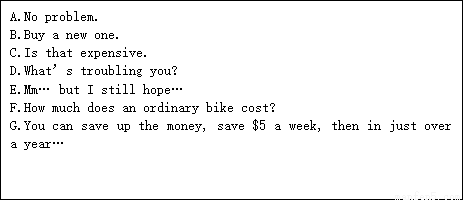
Tips for a happier workplace

You don’t have to be friends with your co-workers, but you do need to be friendly. Read on for fresh ways to make your office a kinder, gentler place.

◆Give a happy “Hello!” in the morning.

Do you walk into the office, eyes down, and immediately start work? If so, you are likely to find that co-workers ignore you or avoid you. 1. It’s really amazing how fast this small gesture can change unfriendly workplace relations.

◆Learn the art of small talk.

Ask your co-workers about their interests— their favorite music, movies, and books, as well as their hobbies. 2. Once you know what catches their imagination, pick up stories from newspapers or magazines to help start conversations.

◆ Ask what they think.

People love to be asked for their opinion, so go out of your way to ask ,“What do you think of this report?” or “How do you think I should deal with this situation?” 3.

◆Avoid gossip.

4. So return the favor. When a co-worker walks towards you bearing a piece of gossip, respond with, “Really?” and then change the subject or get back to work. If you don’t respond, the gossiper will move on.

◆5.

To win friends at work, start with good office etiquette (礼节).There’s nothing more frustrating to busy co-workers than to have their emails and phone messages ignored. Your silence doesn’t just make their jobs harder, it also conveys an unpleasant message: You are unimportant to me.

A. Stop complaining.

B. Return calls and emails immediately.

C. Then give the advice giver a silent thank-you.

D. Always work as hard as anyone working for you.

E. You don’t want anyone talking about you behind your back, right?

F. Showing an interest in them will make them feel comfortable around you.

G. Get into the habit of greeting your co-workers with a smile as you arrive in the morning.


阅读下面短文,从短文后各题所给的四个选项(A, B, C和D)中,选出可以填入空白处的最佳选项,并在答题卡上将该项涂黑

Learning to Accept

I learned how to accept life as it is from my father. ,he did not teach me acceptance when he was strong and healthy, but rather when he was and ill.

My father was a strong man who loved being active, but a terrible illness all that away. Now he can no longer walk, and he must sit quietly in a chair all day. Even talking is . One night, I went to visit him with my sisters. We started about life, and I told them about one of my . I said that we must very often give things up we grow—our youth, our beauty, and our friends— but it always that after we give something up, we gain something new in its place. Then suddenly my father up. He said, “But, Peter, I gave up ! What did I gain?” I thought and thought, but I couldn't think of anything to say. , he answered his own question: “I the love of my family,” I looked at my sisters and saw tears in their eyes, along with hope and thankfulness.

I was also by his words. After that,when I began to feel irritated(愤怒的)at someone, I remember his words and become . If he could replace his great pain with a feeling of love for others, then I should be to give up my small irritations. In this , I learned the power of acceptance from my father.

Sometimes I what other things I could have learned from him if I had listened more carefully when I was a boy. For now, though, I am grateful for this one .

1.A. Afterwards B. However C. Therefore D. Meanwhile

2.A. tired B. poor C. weak D. slow

3.A. already B. still C. only D. once

4.A. took B. threw C. sent D. put

5.A. impossible B. difficult C. stressful D. hopeless

6.A. worrying B. caring C. talking D. asking

7.A. decisions B. experiences C. ambitions D. beliefs

8.A. as B. since C. before D. till

9.A. seems B. promises C. suggests D. requires

10.A. cheered B. turned C. spoke D. opened

11.A. something B. everything C. nothing D. anything

12.A. Surprisingly B. Immediately C. Naturally D. Certainly

13.A. had B. gained C. accepted D. enjoyed

14.A. moved B. amazed C. attracted D. warned

15.A. should B. could C. would D. might

16.A. quiet B. relaxed C. calm D. happy

17.A. ready B. able C. free D. likely

18.A. case B. form C. method D. way

19.A. doubt B. wonder C. know D. guess

20.A. award B. word C. lesson D. gift


违法和不良信息举报电话:027-86699610 举报邮箱:58377363@163.com

精英家教网