Alexis,17,sat quietly in the passenger seat of her dad's car.She let her eyes lazily scan the landscape for wildlife.Then a deer came into view about 200 yards in front of them."Dad,there's a deer there!" Alexis said.It was a male deer with sharp antlers (角) on each side of its head.

As the car moved closer,Alexis saw that the deer's head was bent toward the ground.Then she heard a scream and saw an arm fly up near the deer's head.Alexis realized the deer was attacking a woman.Sue,a 44-year-old mother,had been out for her morning run.The deer followed her and edged closer."I knew I was in trouble," Sue says.She went to pick up a stick for self-defense,and the deer charged.It lifted her with its antlers and threw her into the air.Sue could feel blood flew down her leg.Within seconds,the deer had pushed her off the road.

When Alexis and her father pulled up,the deer was throwing Sue like a doll.Alexis looked into the woman's terrified eyes,and before her father had even stopped the car,the teenager jumped quickly out of the car and ran toward the deer."I was kicking it to get its attention," she says.Then her father,who had followed his daughter,pushed the deer away from the women.

Alexis helped Sue into the car,and then applied a piece of cloth to Sue's injured leg."We're going to get you to a hospital," Alexis said.Then she heard her father shout loudly.He had been knocked to the ground.Alexis took hold of a hammer from the car and ran to where her father lay on his back.She beat the deer's head and neck,but the blows didn't scare it away."I was losing faith," she says."A couple more strikes,Alexis," said her father."You can do it." Turning the hammer around,Alexis closed her eyes and beat the deer's neck with all her strength.When she opened her eyes,the deer was running away.Alexis got in the driver's seat and sped toward the nearest hospital.

After Sue was treated,she tearfully thanked her rescuers."You expect a teenage girl to get on the phone and call for help," she says,"not to beat up a deer."

1.What was Sue doing when she was attacked by the deer?

A.She was driving home.

B.She was resting on the road.

C.She was taking exercise.

D.She was feeding wild animals.

2.What did Alexis do to save Sue?

A.She pushed the deer away.

B.She hit the deer with her feet

C.She drove the car to hit the deer.

D.She beat the deer with a hammer.

3.Which of the following words can best describe Alexis?

A.Strong.

B.Cruel.

C.Energetic.

D.Brave.

4.What is the best title for the passage?

A.A Woman Was Seriously Injured

B.A Dangerous Deer Attacked a Woman

C.A Girl Rescued Her Father Successfully

D.A Teenager Saved Others from a Deer Attack

A great Loss-Shirley Temple dies at 85

February 12,2014

BY DERRIK J. lANG, Associated Press

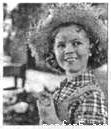
Shirley Temple Black, who died on February 10th at age 85,wasn’t just a child star. She was THE child star—the sweet little girl whose shining smile helped illumine some of the darkest days the US has known during the Great Depression.

It’s hard today to imagine the super star Shirley was once “America’s Little Darling”. She sang and danced her way to the top of the box office in such films as Bright Eyes, Curly Top and Heidi. By 1940, she had appeared in 43 films. Temple teamed with Bill Robison in four movies, and their dance on the stairs in The Little Colon is still a legendary film moment.

In the 1930s, her name on a movie introduction assured (保证) a packed house. She inspired dolls, dresses, dishes—even a drink (alcohol-free, of course).

US President Franklin D. Roosevelt once famously said that “as long as our country has Shirley Temple, we will be all right.”

Unlike so many of today’s child stars, Temple didn’t end up with her name appearing across the headlines for bad behaviors. Instead of getting her photos on front pages or struggling with drugs and alcohol, Temple went on to a second career in diplomacy (外交) , including presidential appointments as ambassador to Ghana.

She surprised a lot of people who doubted her with her grace, knowledge and eagerness to serve. In fact, her career in public service (20 years) was longer than her career in movies (19). The role she valued most, however, was as wife, mother, grandmother and great-grandmother.

The world has lost a treasured Hollywood legend. But her movies will allow that little dynamic figure to continue charming audiences for a very long time.

1.The word “illumine” in Paragraph l means ________.

A. shorten B. sweeten

C. strengthen D. brighten

2.Temple, as a child movie star, can best be described as ________.

A. sweet and lively B. gentle and kind

C. smart and knowledgeable D. shy and attractive

3.What part did she regard as the most important in her life?

A. A top movie star. B. A businesswoman.

C. Her family role. D. Her diplomacy career.

4.Where does this passage possibly come from?

A. A biography. B. A newspaper.

C. A magazine. D. A poster.

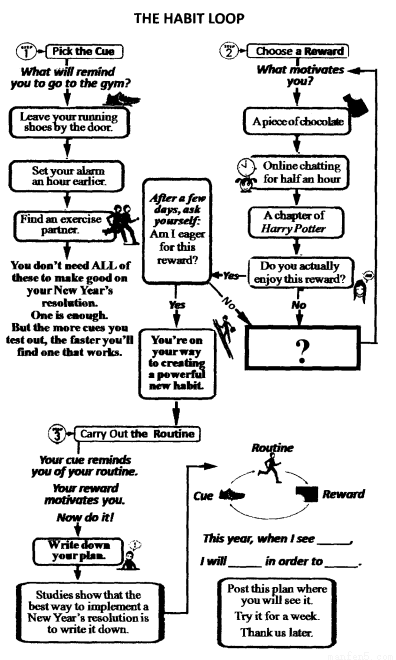
Let's say you want to hit the gym more regularly this year. How do you make that happen? Consider putting the habit loop to use.

Here's how it works:

A habit is a 3-step process. First, there's a cue, something that tells your brain to operate automatically. Then there's a routine. And finally, a reward, which helps your brain learn to desire the behavior. It's what you can use to create-or break-habits of your own.

Here's how to apply it:

Choose a cue, like leaving your running shoes by the door, then pick a reward---say, a piece of chocolate when you get home from the gym. That way, the cue and the reward become interconnected. Finally, when you see the shoes, your brain will start longing for the reward, which will make it easier to work out day after day. The best part? In a couple of weeks, you won't need the chocolate at all. Your brain will come to see the workout itself as the reward. Which is the whole point, right?

1.Which of the following best fits in the box with a “?” in THE HABIT LOOP?

A. Pick a new cue.

B. Form a new habit.

C. Choose a new reward.

D. Design a new resolution.

2.What's the purpose of putting the habit loop to use?

A. To test out different kinds of cues.

B. To do something as a habit even without rewards.

C. To work out the best New Year's resolution.

D. To motivate yourself with satisfactory rewards

3.“This year when I see the Harry Potter poster, I will read 30 pages of an English novel or an English newspaper in order to watch TV for half an hour." What is the cue in this resolution?

A. The Harry Potter poster.

B. Reading 30 pages of an English novel.

C. An English newspaper.

D. Watching TV for half an hour.

My oldest child, Emma, just returned to campus after a long holiday break to finish up her last period of college. These days, friends and family have begun flooding me with one question: What is she going to do after graduation?

The job market is, after all, awfully tough. Just this month the Federal Reserve Bank published a study showing that “recent graduates are increasingly working in low-paid jobs or working part-time.” The bright spot, according to the study, is for students who majored(主修) in STEM — science, technology, engineering and mathematics — areas in which recent graduates “have tended to do relatively well”.

But Emma is a student of the humanities(人文) at a small college. She’s an American Studies major with a focus on the politics and culture of food. For quite a while, I think her field of study is so fashionable right now that I’m not the least bit worried she will find a good job. Yet the more I’ve thought about it, the more I’ve decided to be honest. “I’m not sure what Emma is going to do,” I now say. “But she’s gotten a great education and has really found her interest. — and I know those things will serve her well over the course of her life.”

Nowadays, more and more universities and colleges are being measured by the salaries of their recent graduates. In this climate, encouraging your kid to study the humanities, seems, at best, unwise or, at worst, unconcerned with earning a living. But a college is not a vocational(职业) school. And promoting STEM subjects should not be society’s only answer to helping the next generation grow in a competitive world.

From the beginning, we never urged Emma to pick a college or a major with an eye on its expected return on money, as more and more families are doing. To Emma, what really matters will be something that we may not be able to measure for quite a long time: Emma’s contribution to the world and how happy she is in it.

1.The author’s friends and family_________.

A. are worried about Emma’s safety

B. have been worrying about the flood

C. are concerned about Emma’s future

D. are worried about the job market

2. What can we learn from Paragraph 2?

A. The number of the graduates is increasing.

B. STEM graduates can be better employees.

C. STEM graduates are in relatively greater demand.

D. More and more graduates like to do a part-time job.

3.Why did Emma choose a major in the humanities?

A. Because she is interested in it.

B. Because her mother told her to.

C. Because it is increasingly popular.

D. Because she wants further education.

4.According to the author, what matters most in choosing a major is that_________.

A. it should be among the STEM

B. it should be fashionable and interesting

C. it should allow a good job and a high salary

D. it should bring achievements and happiness

违法和不良信息举报电话:027-86699610 举报邮箱:58377363@163.com

精英家教网