A land free from destruction, plus wealth, natural resources, and labor supply-all these were important 1 in helping England to become the center for the Industrial Revolution. 2 they were not enough.Something 3 was needed to start the industrial process.That“something special”was men- 4 individuals who could invent machines, find new 5 of power, and establish business organizations to reshape society.
The men who 6 the machines of the Industrial Revolution 7 from many backgrounds and many occupations.Many of them were 8 inventors than scientists.A man who is a 9 scientist is primarily interested in doing his research 10 .He is not necessarily working 11 that his findings can be used.
An inventor or one interested in applied science is 12 trying to make something that has a concrete use.He may try to solve a problem by 13 the theories 14 science or by experimenting through trial and error.Regardless of his method, he is working to obtain a 15 result:the construction of a harvesting machine, the burning of a light bulb, or one of 16 other objectives.
Most of the people who 17 the machines of the Industrial Revolution were inventors, not trained scientists.A few were both scientists and inventors.Even those who had 18 or no training in science might not have made their inventions 19 a groundwork had not been laid by scientists years 20 .
(1)
[ ]
A.
cases
B.
reasons
C.
factors
D.
situations
(2)
[ ]
A.
But
B.
And
C.
Besides
D.
Even
(3)
[ ]
A.
else
B.
near
C.
extra
D.
similar
(4)
[ ]
A.
generating
B.
effective
C.
motivating
D.
creative
(5)
[ ]
A.
origins
B.
sources
C.
bases
D.
discoveries
(6)
[ ]
A.
employed
B.
created
C.
operated
D.
controlled
(7)
[ ]
A.
came
B.
arrived
C.
stemmed
D.
appeared
(8)
[ ]
A.
less
B.
better
C.
more
D.
worse
(9)
[ ]
A.
genuine
B.
practical
C.
pure
D.
clever
(10)
[ ]
A.
happily
B.
occasionally
C.
reluctantly
D.
accurately
(11)
[ ]
A.
now
B.
and
C.
all
D.
so
(12)
[ ]
A.
seldom
B.
sometimes
C.
all
D.
never
(13)
[ ]
A.
planning
B.
using
C.
idea
D.
means
(14)
[ ]
A.
of
B.
with
C.
to
D.
as
(15)
[ ]
A.
single
B.
sole
C.
specialized
D.
specific
(16)
[ ]
A.
few
B.
those
C.
many
D.
all
(17)
[ ]
A.
proposed
B.
developed
C.
supplied
D.
offered
(18)
[ ]
A.
little
B.
much
C.
some
D.
any
(19)
[ ]
A.
as
B.
if
C.
because
D.
while
(20)
[ ]
A.
ago
B.
past
C.
ahead
D.
before
完形填空
A land free from destruction, plus wealth, natural resources, and labor supply-all these were important 1 in helping England to become the center for the IndustrialRevolution. 2 they were not enough.Something 3 was needed to start the industrial process.That “something special” was men- 4 individuals who could invent machines, find new 5 of power, and establish business organizations to reshape society.
The men who 6 the machines of the Industrial Revolution 7 from many backgrounds and many occupations.Many of them were 8 inventors than scientists.A man who is a 9 scientist is primarily interested in doing his research 10 .He is not necessarily working 11 that his findings can be used.
An inventor or one interested in applied science is 12 trying to make something that has a concrete use.He may try to solve a problem by 13 the theories 14 science or by experimenting through trial and error.Regardless of his method, he is working to obtain a 15 result:the construction of a harvesting machine, the burning of a light bulb, or one of 16 other objectives.
Most of the people who 17 the machines of the Industrial Revolution were inventors, not trained scientists.A few were both scientists and inventors.Even those who had 18 or no training in science might not have made their inventions 19 a groundwork had not been laid by scientists years 20 .
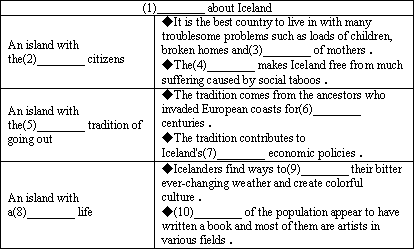
Iceland has the highest birth rate in Europe, the highest divorce rate, and the highest percentage of women working outside the home.Such statistics are often evidence of an unhappy, troublesome society, with loads of children, broken homes and absent mothers.But Iceland is the exception-its citizens are apparently the happiest in the world.New rankings from the United Nations rate Iceland as the best country in the world in which to live.
Perhaps the country's geographic location contributes to Icelanders' happiness.Located in the middle of the North Atlantic, with Greenland as its nearest neighbor, Iceland is free from the taboos that cause so much suffering elsewhere.For instance, people who divorce are not looked down upon by the society.
Icelanders' ancestors are the Vikings, a north European people who invaded European coasts from the beginning of the 8th through the 10th century.This tradition of getting out into the world lives on in modern-day Iceland.Practically all Icelanders have studied or worked in other countries, and most speak English.Perhaps as a result, Iceland's economic policies combine the best of those from Europe and the US to create its own welfare system.
Indeed, the country is rich in writers, painters, film makers and accomplished musicians.There's Sigur Ros, a post-rock band that plays to the highest standards all over the world.Half the population appears to have written a book.
“Iceland has terrible nature, with its bitter ever-changing weather,” said Haraldur Jonsson, a painter, video and performance artist.“We cannot escape it.So we find ways to live with it.We have to have a rich life to fill the empty spaces.”

 智能训练练测考系列答案